Extract:

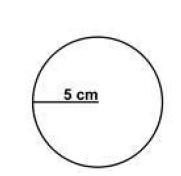
Using the following diagram, calculate the total circumference, rounding to the nearest decimal place.
-
A
25.0 cm
-
B
15.7 cm
-
C
78.5 cm
-
D
31.4 cm
The total circumference of the circle is 31.4 cm because the diagram shows a radius of 5 cm, and applying the circumference formula C=2πrC = 2\pi rC=2πr yields a value that rounds to 31.4 cm.
The circumference of a circle depends on its radius or diameter. Since the diagram labels 5 cm from the center to the edge, this value represents the radius. Substituting the radius into the standard formula provides the correct measurement.
A. 25.0 cm
This value is too small to represent the circumference of a circle with a radius of 5 cm. A circumference of 25.0 cm would correspond to a much smaller radius. This option may result from incorrectly multiplying the radius by π only once or confusing circumference with diameter-related calculations.
B. 15.7 cm
This value is approximately equal to 5π5\pi5π, which suggests that only half of the circumference formula was used. This error commonly occurs when the factor of 2 in 2πr2\pi r2πr is omitted. As a result, this option underestimates the true circumference.
C. 78.5 cm
This value is too large for the given circle and likely comes from using the diameter as 10 cm but then mistakenly multiplying by π twice or confusing circumference with area. A circumference near 78.5 cm would correspond to a much larger circle.
D. 31.4 cm
Using the correct formula C=2πrC = 2\pi rC=2πr and substituting r=5r = 5r=5 cm gives
C=2×π×5=10π≈31.4C = 2 \times \pi \times 5 = 10\pi \approx 31.4C=2×π×5=10π≈31.4 cm.
This calculation correctly applies the formula and rounds the result to one decimal place, making this option accurate.
Conclusion
By identifying the given measurement as the radius and correctly applying the circumference formula, the calculated value is approximately 31.4 cm. Careful use of the formula and proper rounding confirm that 31.4 cm is the correct total circumference of the circle.