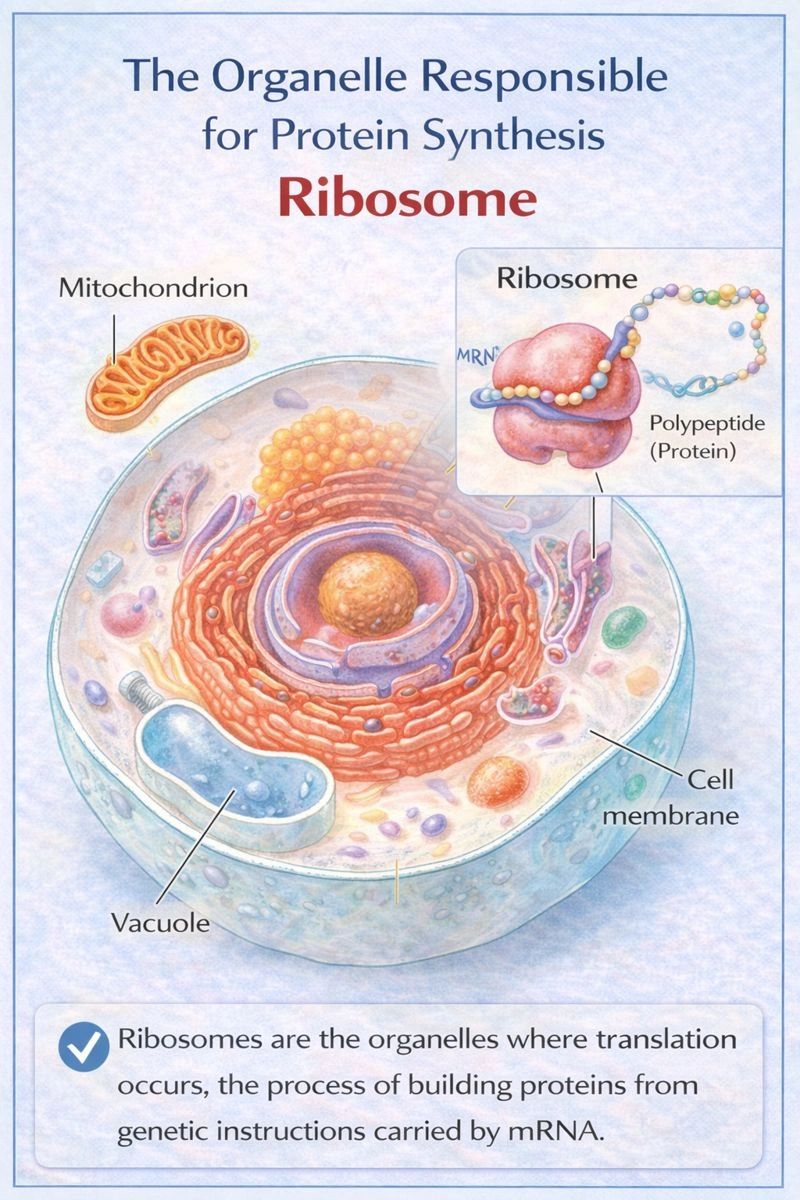
Which organelle is responsible for protein synthesis?
-
A
Mitochondrion
-
B
Vacuole
-
C
Cell membrane
-
D
Ribosome
The organelle responsible for protein synthesis is the ribosome.
Protein synthesis is the process by which cells build proteins from amino acids using genetic instructions carried by messenger RNA (mRNA). This process, called translation, occurs on ribosomes, which are specialized cellular structures designed to read the genetic code and assemble polypeptide chains that later fold into functional proteins.
A) Mitochondrion
Mitochondria are known as the “powerhouses” of the cell because their primary function is to generate adenosine triphosphate (ATP) through aerobic cellular respiration.
While mitochondria do contain their own small ribosomes and can synthesize a limited number of proteins needed for their internal function, this is not their main or defining role. The vast majority of cellular protein synthesis occurs outside mitochondria, either in the cytoplasm or on the rough endoplasmic reticulum.
Therefore, mitochondria are not considered the primary organelle responsible for protein synthesis.
B) Vacuole
Vacuoles are membrane-bound sacs involved in storage and regulation within the cell.
They store water, ions, nutrients, and waste products, help maintain internal pressure (especially in plant cells), and may assist in cellular digestion. However, vacuoles do not contain the molecular machinery needed to translate genetic information into proteins.
Thus, vacuoles do not participate in protein synthesis and this option is incorrect.
C) Cell membrane
The cell membrane forms the outer boundary of the cell and regulates what enters and leaves the cell.
It is involved in transport, cell recognition, signaling, and maintaining homeostasis. Although many proteins are embedded in the membrane, the membrane itself does not manufacture proteins.
Protein production occurs inside the cell on ribosomes, not at the cell membrane. Therefore, this option is incorrect.
D) Ribosome
Ribosomes are the cellular structures that perform protein synthesis directly.
They function by:
- Binding to mRNA
- Reading the genetic code in codons
- Linking amino acids together in the correct sequence to form polypeptides
Ribosomes may be:
- Free in the cytoplasm, producing proteins used within the cell
- Attached to the rough endoplasmic reticulum, producing proteins for secretion, membranes, or organelles
Because ribosomes carry out the actual assembly of proteins, this option is correct.
Conclusion:
Protein synthesis is a fundamental cellular process that converts genetic information into functional molecules essential for structure, metabolism, signaling, and repair. Among the organelles listed, only ribosomes possess the machinery required to translate mRNA into protein chains.
Mitochondria generate energy, vacuoles store materials, and the cell membrane regulates transport, but ribosomes are uniquely specialized for protein production.
Therefore, the correct answer is the ribosome.

Topic Flashcards
Click to FlipThis organelle is often called the "powerhouse" of the cell, generating ATP, but is not the main site for building proteins.
Mitochondrion
This organelle reads mRNA to assemble amino acids into proteins.
Ribosome
This structure is a membrane-bound sac for storage, not for building proteins.
Vacuole
The process of translation happens on this cellular structure.
Ribosome
Proteins are embedded in it, but it does not manufacture them.
Cell membrane
This is the primary organelle responsible for protein synthesis in the cell.
Ribosome