An electric balance measures an object's
-
A
Mass
-
B
Length
-
C
Temperature
-
D
Volume
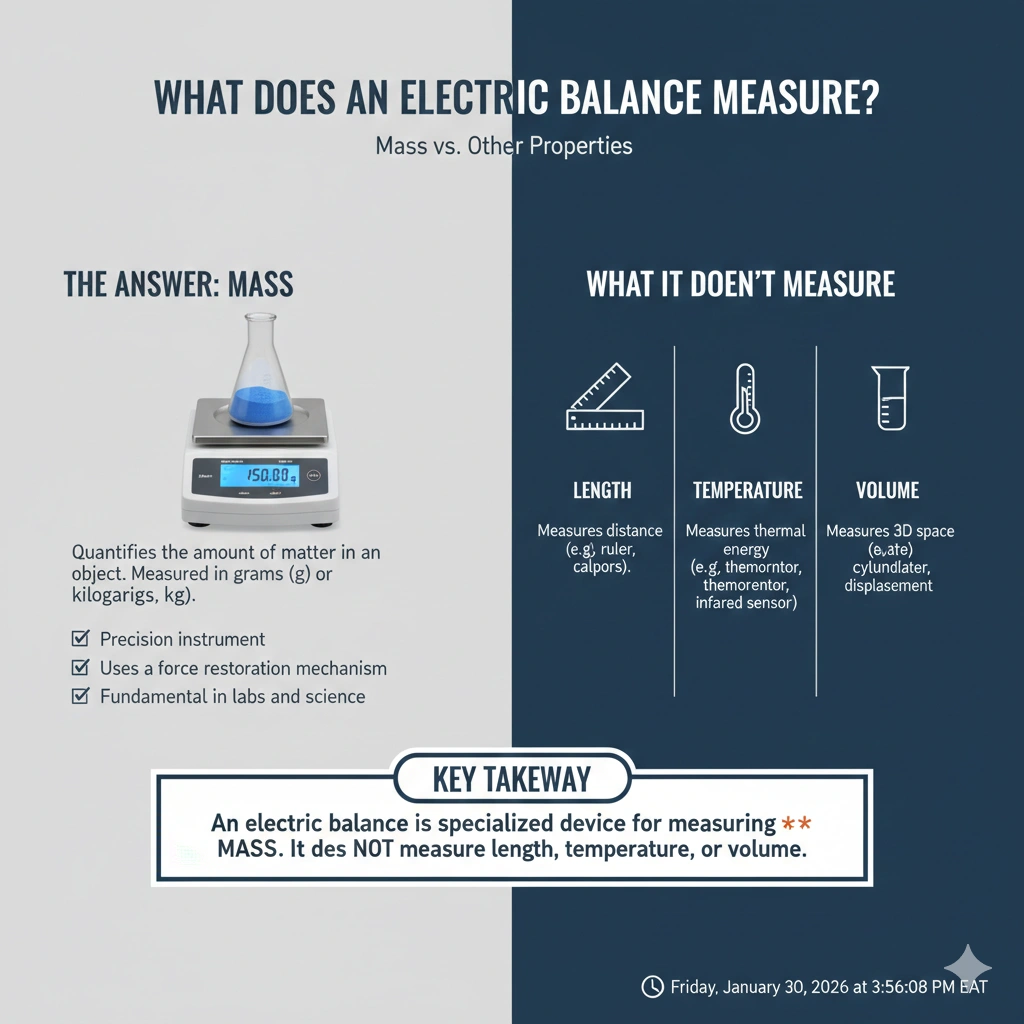
An electric balance measures an object's mass.
An electric balance is a precision instrument designed to determine the quantity of matter in an object, which is its mass. It operates by comparing the gravitational force exerted on the object to a known standard or by using a force restoration mechanism, providing a reading typically in grams or kilograms. This measurement is fundamental in scientific and laboratory settings for quantifying matter independently of location, unlike weight which varies with gravity.
A) Mass
Mass is the correct function of an electric balance. The instrument's internal mechanism, often a strain gauge or electromagnetic force compensation system, is engineered specifically to respond to the force due to gravity on a mass. By calibrating against known standards, it reports the mass value directly. This makes it the primary tool for obtaining accurate mass measurements in contexts ranging from chemical reagent preparation to pharmaceutical dosing.
B) Length
Length is a measure of one-dimensional distance and is not within the operational capability of an electric balance. Instruments such as rulers, vernier calipers, or laser rangefinders are designed to assess spatial dimensions through physical alignment or time-of-flight calculations. An electric balance contains no components, such as calibrated scales or optical sensors, that can detect or translate spatial extension into a reading. Its sensing elements are solely responsive to force, not geometry.
C) Temperature
Temperature quantifies the average kinetic energy of particles and requires sensory components that are thermally sensitive. Devices like thermometers, thermistors, or infrared sensors utilize the expansion of materials, changes in electrical resistance, or emitted infrared radiation to measure thermal energy. An electric balance lacks any such thermal detection elements. Its electronic components are shielded from thermal interference to ensure mass measurement accuracy, not to measure temperature itself.
D) Volume
Volume measures the three-dimensional space occupied by a substance and is determined using tools like graduated cylinders, volumetric flasks, or through displacement methods. While an object's mass and density can be used to mathematically calculate its volume, the balance itself performs no such computation or spatial assessment. Its design is singularly focused on measuring mass; any determination of volume is an indirect, separate process requiring additional data or apparatus.
Conclusion:
The electric balance is a specialized device whose sole function is the determination of mass. It does not possess the mechanical, thermal, or spatial measuring capabilities required to assess length, temperature, or volume. These properties are measured by entirely different classes of instruments based on distinct physical principles. Therefore, the electric balance is correctly identified as an instrument for measuring mass.

Topic Flashcards
Click to FlipWhich lab instrument would you choose to precisely measure 2.50 grams of a solid reagent?
An electric (analytical) balance.
What property of matter, distinct from weight, remains constant regardless of gravity and is measured by a balance?
Mass
To find an object's density, you divide the measurement from a balance by the measurement from a...
Volume-measuring tool (e.g., graduated cylinder).
What is the key limitation of an electric balance that prevents it from telling you the size of an object?
It measures mass/force only, not spatial dimensions (length/volume).
Name the two different instruments required to directly measure both the mass and the temperature of a liquid sample.
An electric balance and a thermometer.