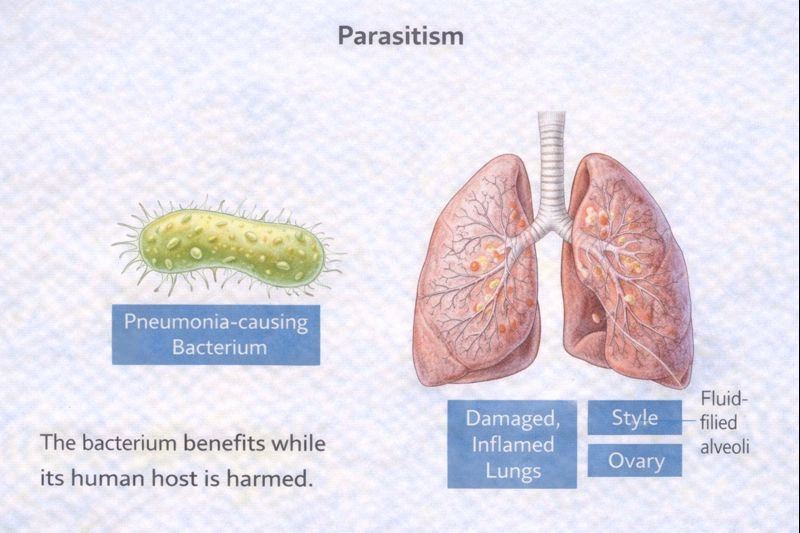
What kind of symbiosis exists between a pneumonia bacterium and a human?
-
A
Mutualism
-
B
Parasitism
-
C
Commensalism
-
D
Competition
The correct type of symbiosis is parasitism.
A pneumonia-causing bacterium lives in or on the human body, gains nutrients and a place to reproduce, and in the process harms the human host by damaging lung tissue and interfering with normal breathing.
A) Mutualism
Mutualism is a relationship in which both organisms benefit.
Examples include:
- Humans and gut bacteria that help digest food
- Bees and flowering plants during pollination
In pneumonia infection, only the bacterium benefits. The human does not benefit and instead becomes ill. Therefore, this relationship is not mutualism.
B) Parasitism
Parasitism is a relationship in which:
- One organism benefits (the parasite)
- The other organism is harmed (the host)
Pneumonia bacteria such as Streptococcus pneumoniae or Klebsiella pneumoniae enter the lungs and:
- Use the host’s nutrients
- Multiply inside lung tissue
- Trigger inflammation and fluid buildup
- Damage alveoli, reducing oxygen exchange
This causes symptoms such as coughing, fever, chest pain, and difficulty breathing. In severe cases, it can be fatal.
The bacterium benefits by surviving and reproducing, while the human is harmed. This exactly matches the definition of parasitism.
C) Commensalism
Commensalism occurs when:
- One organism benefits
- The other is neither helped nor harmed
Some bacteria on human skin or in the intestines are commensal because they live on the body without causing disease.
Pneumonia bacteria do not fit this category because they clearly cause harm to the human host. Therefore, this option is incorrect.
D) Competition
Competition occurs when two organisms fight for the same limited resource, such as:
- Two animals competing for food
- Two plants competing for sunlight
A bacterium infecting a human is not competing with the human for external resources. Instead, it is living inside the host and exploiting the host’s tissues. Therefore, this is not competition.
Conclusion
A pneumonia bacterium benefits by living and reproducing inside the human body, while the human is harmed by infection and disease. This interaction fits the definition of parasitism.
The correct answer is B) Parasitism

Topic Flashcards
Click to FlipWhat type of symbiotic relationship is characterized by one organism benefiting while the other is harmed?
Parasitism.
In the relationship between a pneumonia bacterium and a human, which organism is the parasite and which is the host?
The bacterium is the parasite. The human is the host.
What are the two defining outcomes for each partner in a mutualistic relationship?
Both organisms benefit.
What is the term for a symbiotic relationship where one organism benefits and the other is unaffected?
Commensalism.
Name a key reason why the pneumonia bacterium/human relationship is NOT commensalism.
Because the human is harmed (develops illness), not merely unaffected.