Which organism reproduces via binary fission?
-
A
Mushroom
-
B
Blue whale
-
C
Rainbow trout
-
D
Salmonella
Salmonella is the organism that reproduces via binary fission.
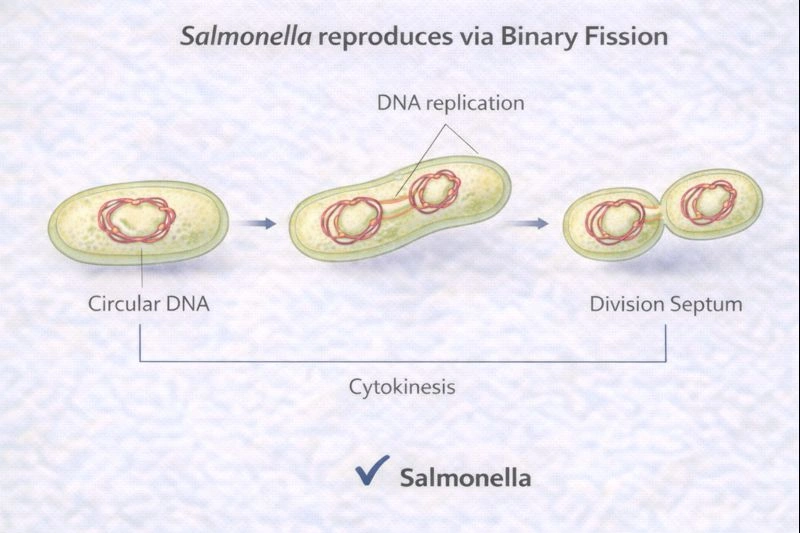
Binary fission is a form of asexual reproduction used by prokaryotic organisms, especially bacteria. In this process, a single cell grows, replicates its DNA, and then divides into two genetically identical daughter cells. This method allows bacteria to reproduce very rapidly under favorable conditions and is one of the main reasons bacterial populations can increase so quickly during infections or in nutrient-rich environments.
A) Mushroom
Mushrooms are fungi and do not reproduce by binary fission. Instead, they reproduce primarily by producing spores, which may be formed through sexual or asexual reproduction. Some fungi can also reproduce by budding or fragmentation of hyphae, but their cells do not divide by the bacterial process of binary fission. Therefore, mushrooms are not the correct answer.
B) Blue whale
Blue whales are mammals and reproduce sexually through internal fertilization, pregnancy, and live birth. Their reproduction involves specialized reproductive organs, gametes (sperm and eggs), and embryonic development inside the uterus. This complex reproductive process is completely different from binary fission, making this option incorrect.
C) Rainbow trout
Rainbow trout are fish and reproduce sexually, usually through external fertilization. The female releases eggs into the water, and the male releases sperm to fertilize them. This form of reproduction involves meiosis and the fusion of gametes, not simple cell division. Therefore, rainbow trout do not reproduce by binary fission.
D) Salmonella
Salmonella is a genus of bacteria, which are single-celled prokaryotic organisms. Bacteria lack a nucleus and reproduce asexually through binary fission. During this process, the Salmonella cell duplicates its circular DNA, elongates, forms a division septum, and splits into two identical cells. This is the standard and defining reproductive method of bacteria, making this option correct.
Conclusion
Binary fission is the characteristic method of reproduction for bacteria. Among the options given, only Salmonella is a bacterium and therefore reproduces in this way. The correct answer is D) Salmonella.

Topic Flashcards
Click to FlipWhat type of reproduction, common in bacteria, involves a single cell dividing into two identical daughter cells?
Binary fission.
Which type of organisms—prokaryotes or eukaryotes—primarily reproduce through binary fission?
Prokaryotes (bacteria and archaea). Eukaryotes typically use mitosis/meiosis.
Name one key genetic outcome of asexual reproduction like binary fission.
It produces genetically identical offspring (clones).
Is the DNA replication that precedes binary fission similar to eukaryotic mitosis?
No. Bacteria have a single circular chromosome that replicates before splitting; they do not have a nucleus or mitotic spindle.
Which organism from the list—Salmonella, mushroom, blue whale, or rainbow trout—is a prokaryote?
Salmonella (a bacterium). The others are all eukaryotes.