Physical factors such as temperature and pH can alter enzyme activity because they have an effect on the enzyme’s ___________.
-
A
acidity
-
B
shape
-
C
chemistry
-
D
substrate
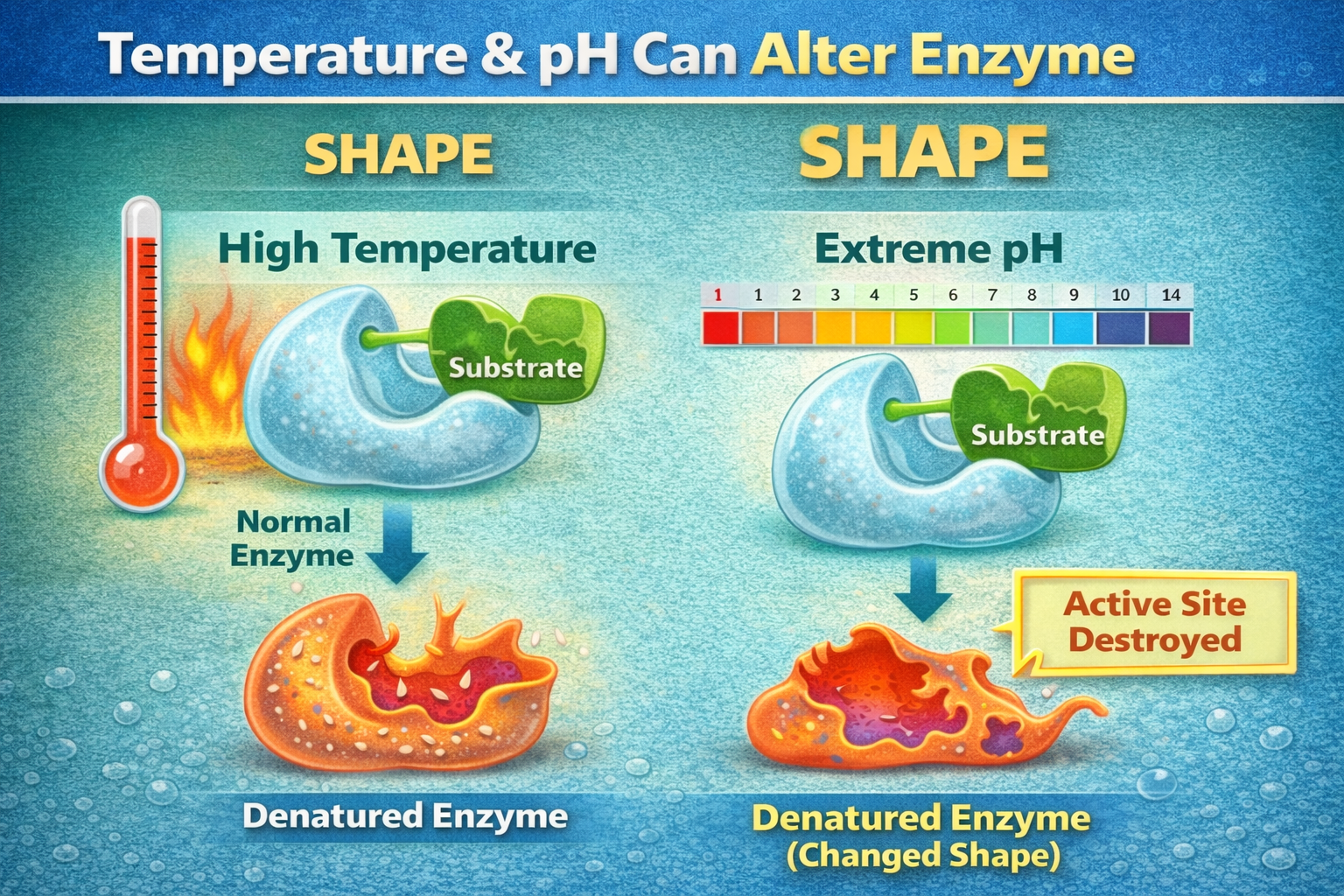
Physical factors such as temperature and pH alter enzyme activity by affecting the enzyme’s shape.
Enzymes are proteins that function by binding to specific substrates at an active site. This active site depends on the enzyme’s precise three-dimensional structure. When temperature or pH changes, the bonds that maintain this structure can be disrupted, altering the enzyme’s shape and reducing or completely stopping its ability to catalyze reactions.
A) Acidity
pH does relate to acidity or alkalinity, and changes in pH can influence enzyme activity. However, acidity itself is not a structural property of the enzyme.
Instead, pH affects the charges on amino acids within the enzyme, which in turn disrupts the bonds holding the enzyme in its proper configuration. The real factor being altered is the enzyme’s structure, not its “acidity.”
Therefore, this option does not correctly answer what property of the enzyme is affected.
B) Shape
Enzymes are proteins folded into specific three-dimensional conformations determined by hydrogen bonds, ionic interactions, and other weak forces between amino acids.
Temperature increases can cause excessive molecular motion that breaks these bonds, while extreme pH changes can alter electrical charges on amino acids, also breaking stabilizing interactions. When this happens, the enzyme becomes denatured, meaning:
- The active site changes shape
- The substrate no longer fits properly
- The enzyme loses its catalytic function
Because enzyme activity depends directly on its shape, especially the structure of the active site, this option is correct.
C) Chemistry
The chemical composition of an enzyme refers to its amino acid sequence.
Temperature and pH do not change this sequence. The enzyme remains made of the same amino acids in the same order. Only the folding and spatial arrangement of those amino acids is affected.
Therefore, this option is incorrect.
D) Substrate
The substrate is the molecule that the enzyme acts upon.
While environmental conditions can influence how fast molecules move, the question asks specifically what part of the enzyme is affected by temperature and pH. The substrate is a separate molecule and is not the primary factor being altered in this context.
Thus, this option is incorrect.
Conclusion:
Enzyme function depends on a precise three-dimensional structure that forms a correctly shaped active site. Temperature and pH can disrupt the bonds that maintain this structure, causing the enzyme to lose its functional shape and become denatured.
Acidity is a condition, chemistry refers to amino acid composition, and the substrate is a different molecule altogether. The key property affected is the enzyme’s shape.
Therefore, the correct answer is shape.

Topic Flashcards
Click to FlipWhat specific property of an enzyme is directly disrupted by extreme temperature or pH?
Its three-dimensional shape (conformation), leading to denaturation.
Why is an enzyme's shape so critical to its function?
The specific shape creates an active site that only fits its particular substrate(s), enabling catalysis.
What is the term for the loss of an enzyme's functional shape due to high temperature or incorrect pH?
Denaturation.
Does denaturation change an enzyme's amino acid sequence (primary structure)?
No. Denaturation disrupts the weaker bonds (hydrogen, ionic) that maintain the 3D shape, but the covalent peptide bonds of the primary structure remain intact.
How does a change in pH primarily affect an enzyme's structure?
It alters the charges on amino acid side chains, disrupting the ionic and hydrogen bonds that stabilize the enzyme's shape.