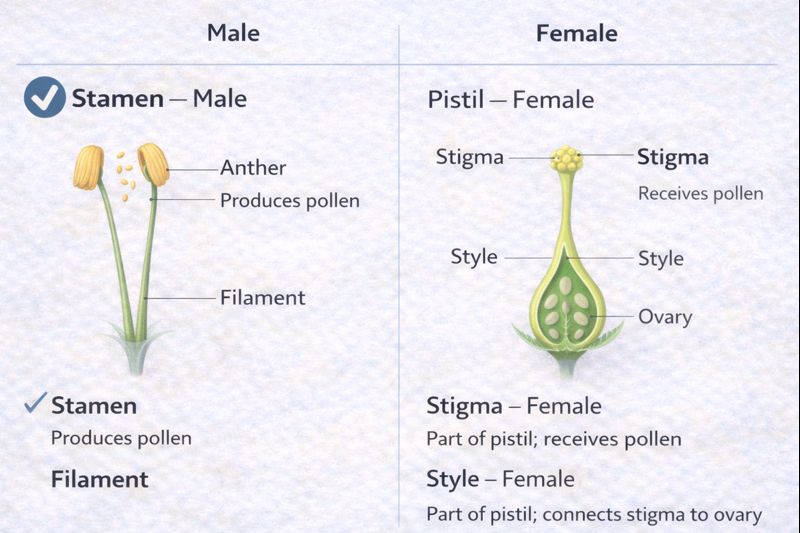
Which part of a plant’s reproductive system is of a different “gender” than the others?
-
A
Stamen
-
B
Pistil
-
C
Stigma
-
D
Style
The stamen is the part of a flowering plant’s reproductive system that is a different “gender” than the others.
In typical flowering plants, reproductive structures are divided into male and female parts. The male reproductive organ is the stamen, which produces pollen containing the male gametes. The female reproductive organ is the pistil (also called the carpel), and its key parts include the stigma and style. Since three of the options are female structures and only one is male, the stamen is the different one.
A) Stamen
The stamen is the male reproductive structure of a flower.
It is made of two main parts:
- The anther
- This is the pollen-producing structure. Inside the anther are pollen sacs (microsporangia) where pollen grains develop. Pollen represents the male gametophyte and contains the cells that ultimately contribute sperm cells for fertilization.
- The filament
- This is the stalk that supports the anther and positions it in a way that helps pollen be transferred to other flowers. This transfer may occur through wind, insects, birds, or other pollinators depending on the plant species.
Because the stamen’s main role is to produce and release pollen, which carries the male reproductive contribution, it is considered male. This makes it the option that differs in “gender” from the others.
B) Pistil
The pistil is the female reproductive organ of the flower.
It includes the structures involved in receiving pollen and housing the ovules (the female gametes). The pistil is typically composed of:
- Stigma: receives pollen
- Style: provides the pathway for pollen tube growth
- Ovary: contains ovules, which can become seeds after fertilization
The pistil is female because it contains the ovules and is the site where fertilization ultimately occurs. Since it belongs to the female reproductive system, it is not the structure that differs from the others in gender.
C) Stigma
The stigma is part of the female reproductive organ (the pistil).
It is located at the top of the pistil and is specialized for pollen reception. The stigma is often sticky or has surface adaptations that help trap pollen grains. Once pollen lands on the stigma, it may germinate and form a pollen tube.
This pollen tube then grows downward through the style toward the ovary so that fertilization can occur. Because the stigma is a component of the pistil and functions in receiving pollen rather than producing it, it is female and therefore does not differ in gender from the other female structures listed.
D) Style
The style is also part of the female reproductive organ (the pistil).
It is the slender stalk-like structure that connects the stigma to the ovary. The style plays a crucial role after pollination by providing the route for the pollen tube to grow from the stigma down to the ovary.
This pathway is important because it allows sperm cells carried in the pollen to reach the ovules for fertilization. Since the style is part of the pistil and supports the process of fertilization within the female reproductive system, it is female and does not differ in gender from the other female options.
Conclusion:
Flower reproductive structures are classified as male or female based on their function. The stamen is male because it produces pollen, which carries the male reproductive contribution. The pistil is female, and both the stigma and style are female structures because they are parts of the pistil involved in receiving pollen and guiding fertilization.
Since stamen is the only male structure listed and the others are female, the part of a different “gender” than the others is the stamen.

Topic Flashcards
Click to FlipWhat is the primary male reproductive structure of a flower?
The stamen, which consists of the anther (produces pollen) and filament.
What is the collective term for the female reproductive structures of a flower?
The pistil (or carpel), which includes the stigma, style, and ovary.
Which two listed structures are specifically parts of the pistil?
The stigma (pollen receptor) and the style (pollen tube pathway).
What is the primary function of the anther?
To produce and release pollen grains, which contain the male gametes.
In terms of biological "gender," how are the stamen and pistil different?
The stamen is the male organ (produces sperm). The pistil is the female organ (produces eggs and receives pollen).