Which of the following describes a neutral atom of tin-120?
-
A
50 protons, 70 neutrons, 50 electrons
-
B
50 protons, 120 neutrons, 50 electrons
-
C
50 protons, 120 neutrons, 70 electrons
-
D
70 protons, 120 neutrons, 70 electrons
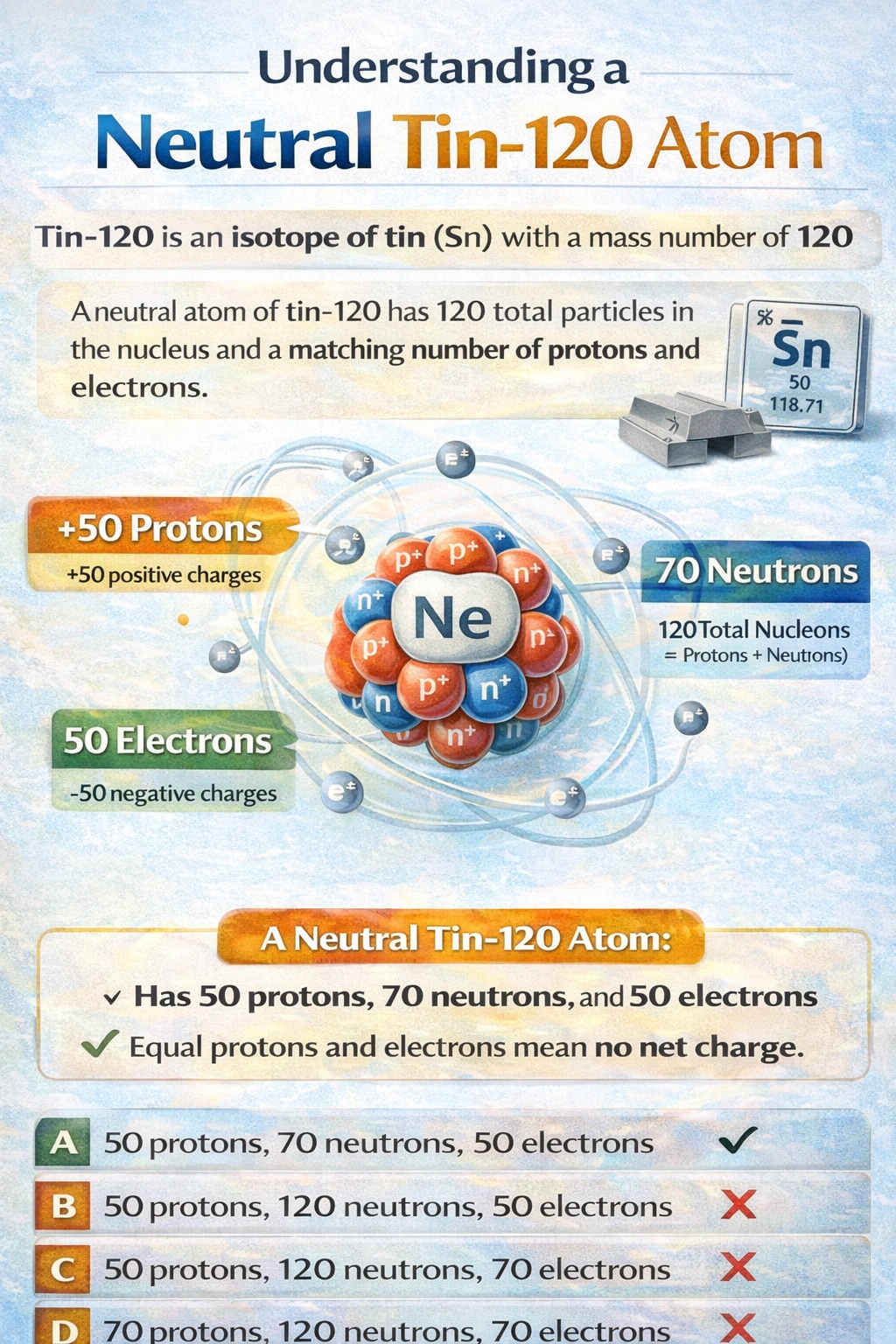
A neutral atom of tin-120 has 50 protons, 70 neutrons, and 50 electrons.
The isotope name "tin-120" indicates the element is tin (Sn) and its mass number (A) is 120. The atomic number of tin, found on the periodic table, is 50, which defines its proton count. In a neutral atom, the number of electrons equals the number of protons.
A) 50 protons, 70 neutrons, 50 electrons
Tin has an atomic number of 50, so it must have 50 protons. The mass number is 120, which is the sum of protons and neutrons. Therefore, neutrons = 120 - 50 = 70. A neutral atom has no net charge, so electrons = protons = 50. This option provides the correct values for all three subatomic particles.
B) 50 protons, 120 neutrons, 50 electrons
This option incorrectly uses the mass number (120) as the neutron count. If an atom had 50 protons and 120 neutrons, its mass number would be 170, not 120. The neutron count is always calculated by subtracting the atomic number from the mass number.
C) 50 protons, 120 neutrons, 70 electrons
This repeats the error of using 120 as the neutron count. Furthermore, it suggests 70 electrons for an atom with 50 protons. This would result in a net charge of -20 (70 negative charges vs. 50 positive charges), making it a highly charged anion, not a neutral atom.
D) 70 protons, 120 neutrons, 70 electrons
An atom with 70 protons is not tin; it is the element ytterbium (Yb). The "120" in tin-120 is the mass number, not the proton count. This option misidentifies the element entirely and also incorrectly suggests the mass number would be 190 (70p + 120n).
Conclusion:
For any isotope, the atomic number (proton count) is fixed for that element. The mass number minus the proton count gives the neutron count. Electrical neutrality requires an equal number of electrons and protons. Applying these rules to tin-120 yields 50 protons, 70 neutrons (120-50), and 50 electrons.

Topic Flashcards
Click to FlipIn the isotope name "tin-120," what does the number 120 represent?
The mass number, which is the total number of protons plus neutrons in the nucleus.
How many protons does every atom of tin (Sn) have, and where do you find this number?
50 protons. This is tin's atomic number, which is found on the periodic table and defines the element.
For a neutral atom of tin-120, how do you calculate the number of neutrons?
Neutrons = Mass Number - Atomic Number. For Sn-120: 120 - 50 = 70 neutrons.
Why must a neutral atom of tin have the same number of electrons as protons?
Because the positive charge of the protons must be balanced by an equal number of negatively charged electrons for the atom to have a net charge of zero.
What is the complete subatomic composition (p⁺, n⁰, e⁻) for a neutral atom of tin-120?
50 protons, 70 neutrons, 50 electrons.