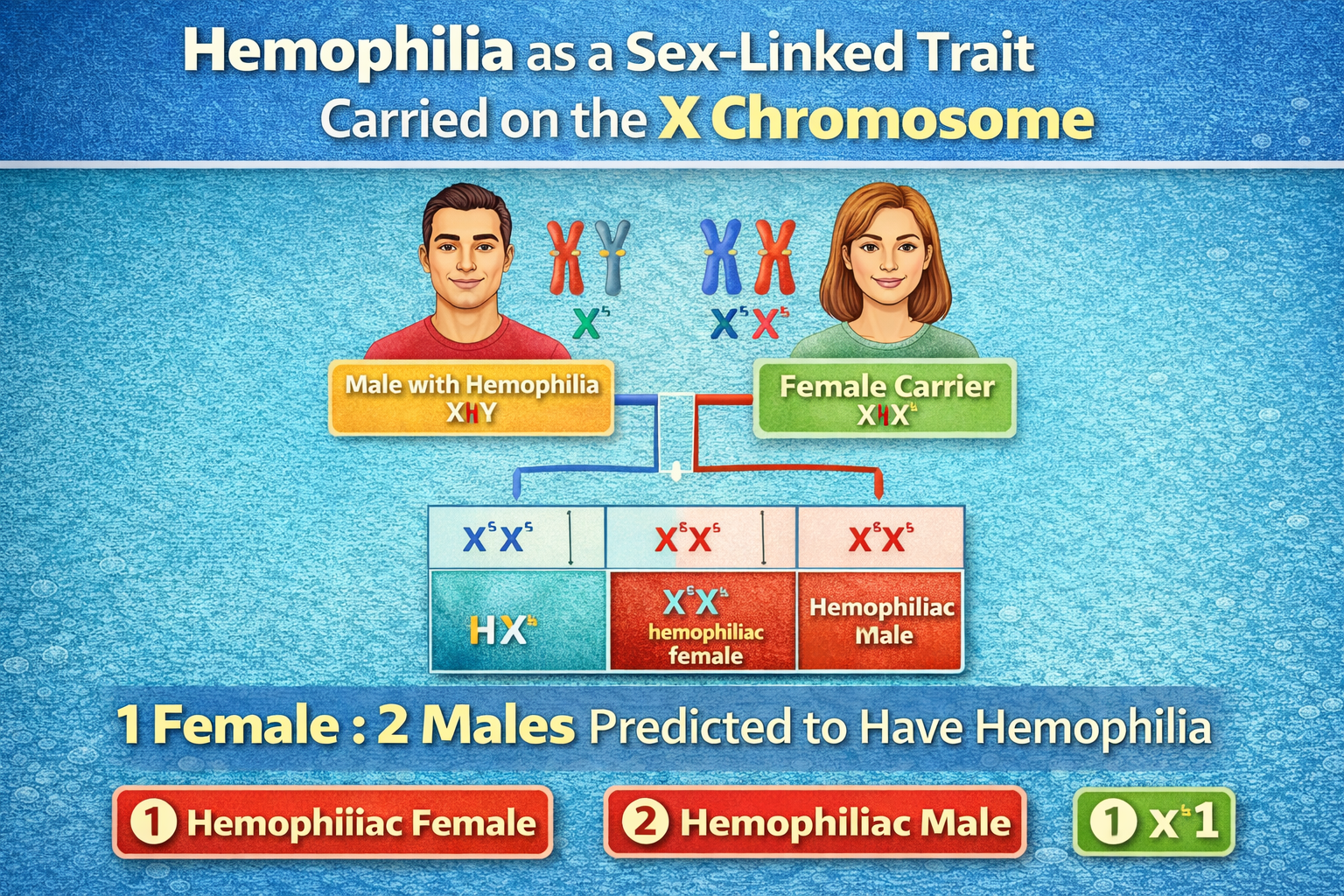
Hemophilia is a sex-linked trait carried on the X chromosome. In an example of a male with hemophilia and a female carrier, what ratio of the offspring is predicted to have the disease?
-
A
0 female : 2 male
-
B
1 female : 0 male
-
C
1 female : 2 male
-
D
2 female : 1 male
Hemophilia is predicted to affect 1 female : 1 male of the offspring in this cross.
Hemophilia is an X-linked recessive disorder, meaning the gene is carried on the X chromosome and a person must inherit the affected allele (Xʰ) in a specific way to show the disease. A male with hemophilia has the genotype XʰY because males have only one X chromosome, so a single affected allele causes the condition. A female carrier has the genotype XᴴXʰ because she has one normal allele and one affected allele; the normal allele typically prevents the disease from being expressed, so she usually does not have hemophilia but can pass it on.
For this cross:
Male with hemophilia: XʰY
Female carrier: XᴴXʰ
The possible offspring outcomes are:
- XᴴXʰ = carrier female (does not typically have the disease)
- XʰXʰ = affected female (has the disease)
- XᴴY = normal male (no disease)
- XʰY = affected male (has the disease)
That means 2 out of 4 offspring have hemophilia (50% total). Of those affected offspring, one is female and one is male, giving a 1:1 affected female to affected male ratio.
A) 0 female : 2 male
This ratio would mean that no females are affected and that only males are affected. However, in this cross, an affected female (XʰXʰ) is clearly possible because the father passes his affected Xʰ to all daughters, and the mother can also pass her affected Xʰ allele. Therefore, females can be affected here, so this option is incorrect.
B) 1 female : 0 male
This ratio would mean that females can be affected but no males are affected. That is not true for this cross because a son can inherit the affected Xʰ from the carrier mother and the Y chromosome from the father, producing XʰY, which is an affected male. Since affected males are possible and occur at the same frequency as affected females in this cross, this option is incorrect.
C) 1 female : 2 male
This option suggests that affected males occur twice as often as affected females. That pattern can happen in some X-linked crosses, but it does not happen in this specific cross.
When you list the four equally likely offspring:
- 1 carrier female (XᴴXʰ)
- 1 affected female (XʰXʰ)
- 1 normal male (XᴴY)
- 1 affected male (XʰY)
Only one male is affected and only one female is affected. That produces a 1 female : 1 male ratio, not 1 female : 2 male. Therefore, this option is not correct for the cross described.
D) 2 female : 1 male
This option suggests more affected females than affected males. In this cross, affected females and affected males occur equally often (each is 25%), so this option is incorrect.
Conclusion
A male with hemophilia (XʰY) crossed with a female carrier (XᴴXʰ) produces offspring where 25% are affected females (XʰXʰ) and 25% are affected males (XʰY). That means 50% of all offspring have the disease, and among the affected offspring the ratio is 1 female : 1 male.

Topic Flashcards
Click to FlipWhat is the genotype of a male with hemophilia?
XʰY (where Xʰ is the affected allele on the X chromosome).
What is the genotype of a female who is a carrier for an X-linked recessive disorder like hemophilia?
XᴴXʰ (one normal allele Xᴴ and one affected allele Xʰ).
In a cross between a hemophiliac male (XʰY) and a carrier female (XᴴXʰ), what percentage of all offspring are predicted to have the disease?
50% (or 2 out of 4 possible genetic outcomes).
Among the offspring that have the disease in the above cross, what is the female-to-male ratio?
1 affected female : 1 affected male (a 1:1 ratio).
In X-linked inheritance, can a father pass his affected X chromosome to his son?
No. A father passes his Y chromosome to a son. The son's X chromosome always comes from the mother.