In a strand of DNA, you would expect to see adenine paired with ___________.
-
A
cytosine
-
B
cytosine
-
C
thymine
-
D
guanine
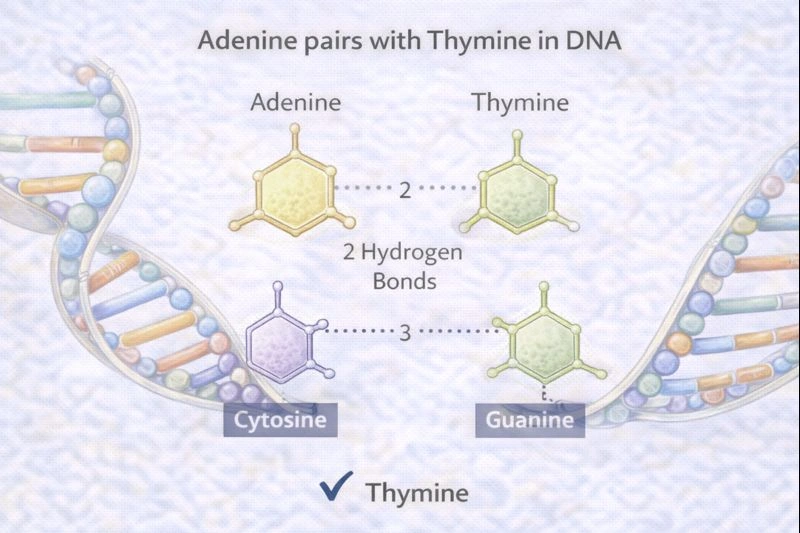
Adenine pairs with thymine in a strand of DNA.
DNA has a precise and consistent structure based on complementary base pairing. Each nitrogenous base can only bond with one specific partner in order to maintain the uniform shape and stability of the double helix. Adenine, which is a purine base, always pairs with thymine, a pyrimidine base, through two hydrogen bonds. This pairing is essential for accurate DNA replication, transcription, and long-term storage of genetic information.
A) Cytosine
Cytosine is one of the four nitrogenous bases found in DNA, but it does not pair with adenine. Instead, cytosine pairs specifically with guanine through three hydrogen bonds. This pairing creates a strong and stable bond that complements the A–T pair. Adenine and cytosine have incompatible shapes and hydrogen bonding sites, so they cannot form a proper base pair. For this reason, cytosine is not the correct answer.
B) Uracil
Uracil is a base found in RNA, not DNA. In RNA, uracil replaces thymine and pairs with adenine. However, DNA uses thymine instead of uracil to increase genetic stability and to help cells detect and repair mutations. If uracil appears in DNA, it is usually treated as an error and removed by repair enzymes. Therefore, although adenine pairs with uracil in RNA, it does not do so in DNA, making this option incorrect.
C) Thymine
In DNA, adenine always pairs with thymine through two hydrogen bonds, forming an A–T base pair. This specific pairing keeps the width of the DNA double helix consistent and ensures that genetic information can be copied accurately during cell division. DNA polymerase relies on this exact matching rule when building new strands. Without proper A–T pairing, the structure and function of DNA would be compromised.
D) Guanine
Guanine is another purine base, like adenine, but it pairs exclusively with cytosine. Guanine and cytosine form three hydrogen bonds, creating a stronger bond than A–T pairs. Guanine cannot pair with adenine because their molecular structures and hydrogen bonding patterns do not align correctly. An A–G pairing would distort the DNA helix and is not biologically stable. Therefore, this option is incorrect.
Conclusion
DNA base pairing follows strict rules that maintain the structure and function of the genetic molecule. Adenine pairs only with thymine in DNA, while cytosine pairs with guanine. Uracil is used only in RNA. Therefore, the correct answer is C) Thymine.

Topic Flashcards
Click to FlipIn a DNA molecule, which nitrogenous base specifically pairs with Adenine (A)?
Thymine (T).
How many hydrogen bonds stabilize the connection between an Adenine and a Thymine base pair?
Two hydrogen bonds.
Which base pair in DNA is held together by three hydrogen bonds and is therefore slightly stronger?
Cytosine-Guanine (C-G).
In RNA, what base replaces Thymine and pairs with Adenine?
Uracil (U).
What is the primary structural reason Adenine cannot pair with Guanine in the DNA double helix?
Both are purines (double-ring structures); pairing them would distort the helix's uniform width.