Atom X has an atomic number of 10 and a mass of 20 amu. Atom Y has 10 protons and 12 neutrons. Which of the following describes the relationship between these atoms?
-
A
They are different elements.
-
B
. They are isotopes of the same element.
-
C
They have the same atomic number and the same atomic mass.
-
D
They have different atomic numbers and different atomic masses.
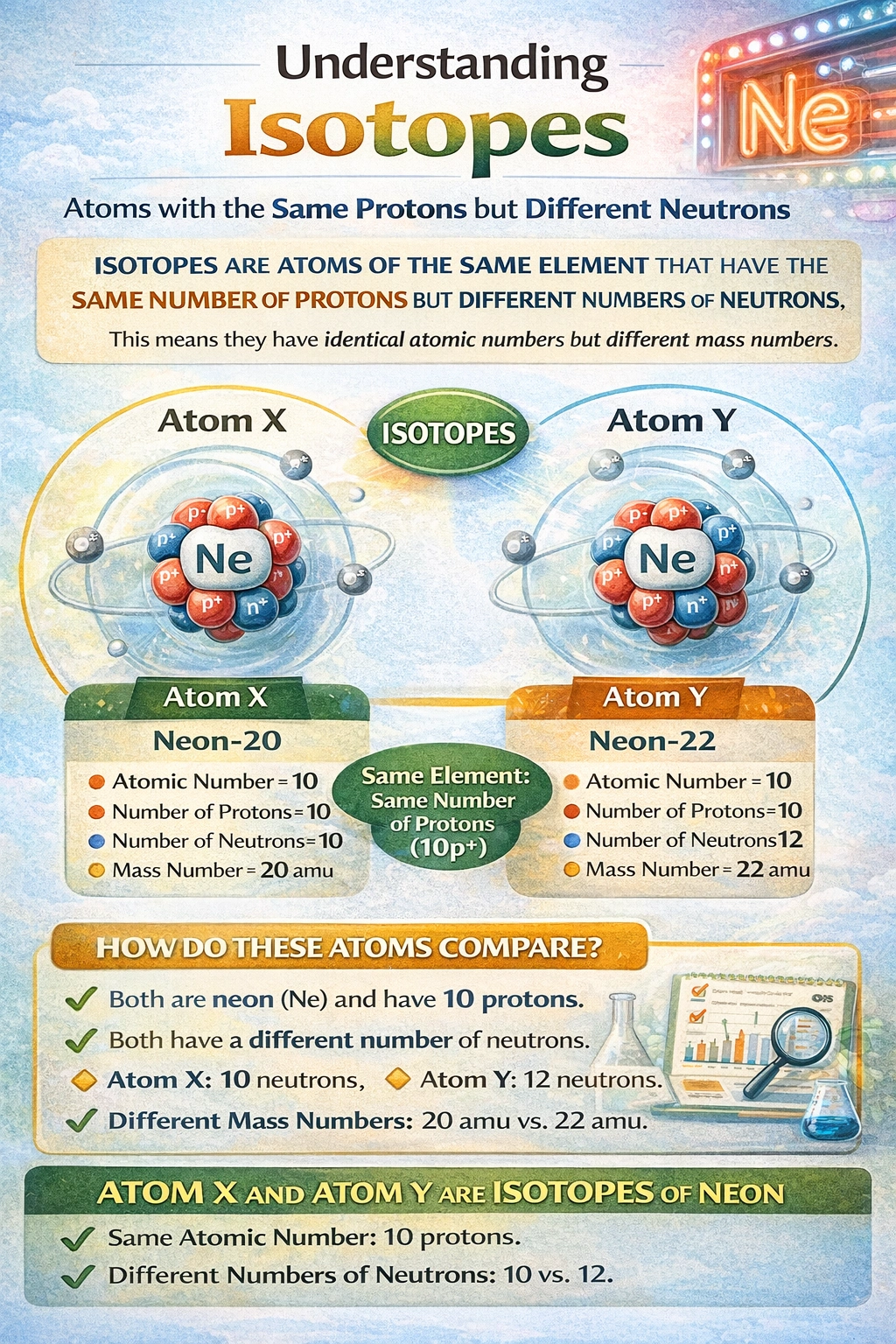
They are isotopes of the same element.
Isotopes are atoms of the same element that share the same number of protons (and thus the same atomic number) but have different numbers of neutrons, resulting in different mass numbers.
A) They are different elements.
The identity of an element is determined exclusively by its atomic number, which is the number of protons in the nucleus. Atom X has an atomic number of 10. Atom Y has 10 protons, which also gives it an atomic number of 10. Since both atoms have 10 protons, they are atoms of the same element, specifically neon (Ne). Different elements have different proton counts.
B) They are isotopes of the same element.
For Atom X: Atomic number = 10 (10 protons). Mass number = 20 amu. Therefore, neutrons = Mass number - Protons = 20 - 10 = 10 neutrons. For Atom Y: Protons = 10, Neutrons = 12. Therefore, its mass number = 10 + 12 = 22 amu. Both atoms are neon, but Atom X is Neon-20 and Atom Y is Neon-22. They have the same proton count but different neutron counts, perfectly meeting the definition of isotopes.
C) They have the same atomic number and the same atomic mass.
They do have the same atomic number (10). However, they do not have the same atomic mass. Atom X has a mass of 20 amu. Atom Y, with 10 protons and 12 neutrons, has a mass number of 22 amu. Atomic mass (or mass number) is the sum of protons and neutrons, which differs between these two atoms.
D) They have different atomic numbers and different atomic masses.
This statement is partially correct and partially incorrect. They do have different atomic masses (20 vs. 22 amu). However, they have the same atomic number (10). The claim that their atomic numbers are different is false, as established by the given information for both atoms.
Conclusion:
Two atoms are isotopes if they possess identical proton counts but different neutron counts. Atom X (10p, 10n) and Atom Y (10p, 12n) are both neon atoms with differing mass numbers. They are not different elements, nor do they share the same mass. Their relationship is correctly described as that of isotopes of the same element.

Topic Flashcards
Click to FlipWhat defines an isotope?
Atoms of the same element (same number of protons) that have different numbers of neutrons, and therefore different mass numbers.
Atom X has an atomic number of 10 and a mass of 20 amu. How many neutrons does it have?
10 neutrons. (Mass number 20 - Atomic number 10 = 10 neutrons).
Atom Y has 10 protons and 12 neutrons. What is its mass number, and what element is it?
Mass number = 22 amu. It is the element Neon (atomic number = number of protons = 10).
Why are Atom X (Ne-20) and Atom Y (Ne-22) considered isotopes of the same element?
They both have 10 protons (same atomic number, same element), but Atom X has 10 neutrons and Atom Y has 12 neutrons (different mass numbers).
What two subatomic particles contribute to an atom's mass number?
Protons and neutrons. (Mass number = # of protons + # of neutrons. Electrons have negligible mass).