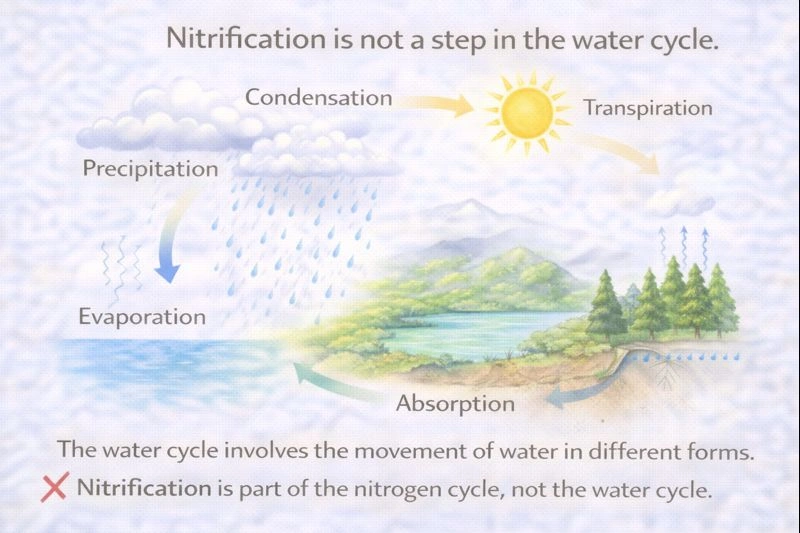
Which is not a step in the water cycle?
-
A
Condensation
-
B
Transpiration
-
C
Nitrification
-
D
Absorption
Nitrification is not a step in the water cycle.
The water cycle describes the continuous movement of water through the environment in different physical states (solid, liquid, and gas). It includes processes such as evaporation, condensation, precipitation, transpiration, runoff, and infiltration or absorption into the ground. Nitrification, however, is a biochemical process involving nitrogen compounds and belongs to the nitrogen cycle, not the water cycle.
A) Condensation
Condensation is a major and essential step in the water cycle. It occurs when water vapor in the atmosphere cools and changes into tiny liquid droplets, forming clouds and fog. This process allows water that evaporated from oceans, lakes, and land surfaces to return to the Earth later as precipitation. Because it directly involves the movement and phase change of water, condensation is a true step in the water cycle.
B) Transpiration
Transpiration is also a genuine step in the water cycle. It refers to the release of water vapor from plant leaves through small openings called stomata. Water absorbed by plant roots travels upward through the plant and eventually enters the atmosphere as vapor. This process is especially important in forested regions and contributes significantly to atmospheric moisture, making it a key part of the water cycle.
C) Nitrification
Nitrification is the correct answer because it does not involve the movement or transformation of water. Instead, it is part of the nitrogen cycle. In this process, specialized bacteria convert ammonia into nitrites and then into nitrates in the soil. These chemical transformations help plants obtain usable nitrogen but have nothing to do with the circulation of water through the environment. Therefore, nitrification is not a step in the water cycle.
D) Absorption
Absorption, also called infiltration, is an important step in the water cycle. It occurs when rainwater or melted snow soaks into the soil and moves downward to become groundwater. This process helps replenish aquifers, supports plant growth, and eventually allows water to return to rivers and oceans. Because it involves the movement of water through the Earth, absorption is part of the water cycle.
Conclusion
The water cycle includes physical processes that move water through the atmosphere, land, and living organisms. Condensation, transpiration, and absorption are all part of this system. Nitrification, however, is a chemical process in the nitrogen cycle, not the water cycle. Therefore, the correct answer is C) Nitrification.

Topic Flashcards
Click to FlipThe process where bacteria in soil convert ammonia into nitrites and nitrates is called nitrification. To which biogeochemical cycle does this process belong?
The nitrogen cycle. Nitrification is a key step in making nitrogen usable by plants, but it is not part of the water cycle.
When water soaks into the soil and becomes groundwater, is this process of absorption (infiltration) considered part of the water cycle?
Yes. Absorption/infiltration is a major step, moving water from the surface into the ground, where it can be stored or flow to other reservoirs.
The Amazon Rainforest releases massive amounts of water vapor into the air through plant leaves. What is the name of this specific process within the water cycle?
Transpiration. It is the evaporation of water from plants and is a significant contributor to atmospheric moisture in ecosystems.
Which process describes water vapor cooling and turning back into liquid droplets to form clouds?
Condensation. This phase change is essential in the water cycle for cloud formation and subsequent precipitation.
Are all of the following processes—condensation, transpiration, absorption, and nitrification—steps in the water cycle?
No. Nitrification is not part of the water cycle. It is a process in the nitrogen cycle involving bacterial conversion of nitrogen compounds.