Which statement regarding energy content is true?
-
A
Decomposers > secondary consumers
-
B
Primary consumers > producers
-
C
Primary consumers > producers
-
D
Secondary consumers > primary consumers
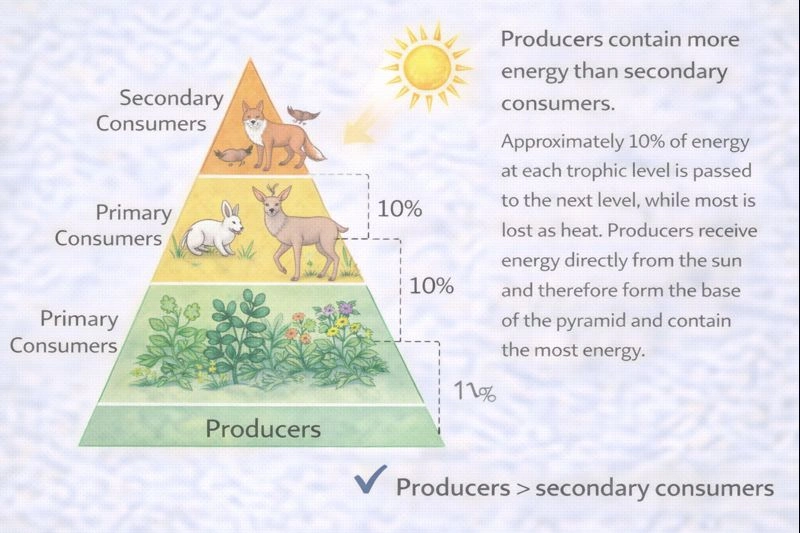
Producers contain more energy than secondary consumers.
In ecosystems, energy flows from one trophic level to the next, but a large portion is lost at each transfer, mainly as heat due to metabolism and normal life processes. This is commonly described by the 10% rule, which states that only about 10% of the energy at one trophic level is passed on to the next level. Because producers capture energy directly from the sun through photosynthesis, they form the base of the energy pyramid and contain the greatest total amount of energy. By the time energy reaches secondary consumers, only a small fraction of the original energy remains.
A) Decomposers > secondary consumers
Decomposers obtain energy by breaking down dead organisms from all trophic levels, but this does not mean they contain more total energy than secondary consumers. Like all higher trophic levels, decomposers are limited by the amount of energy available in organic matter. They do not exceed secondary consumers in overall energy content. Therefore, this statement is incorrect.
B) Primary consumers > producers
Producers, such as plants and algae, capture solar energy and convert it into chemical energy stored in glucose and other organic molecules. Primary consumers (herbivores) eat producers and receive only about 10% of that stored energy. Since most energy is lost as heat and through metabolic processes, primary consumers always contain less energy than producers. This option is incorrect.
C) Producers > secondary consumers
Producers form the first trophic level and contain the greatest amount of energy in any ecosystem. Primary consumers receive about 10% of this energy, and secondary consumers receive about 10% of the energy stored in primary consumers, which is roughly 1% of the original energy captured by producers. This large decrease explains why food chains are short and why top consumers are few in number. This statement correctly reflects the structure of the energy pyramid.
D) Secondary consumers > primary consumers
Secondary consumers feed on primary consumers and therefore receive even less energy than them. Because energy decreases with each trophic transfer, secondary consumers always contain less energy than primary consumers. This statement reverses the natural order of the energy pyramid and is incorrect.
Conclusion
Energy decreases significantly at each trophic level in an ecosystem. Producers, which capture energy directly from sunlight, contain the most energy, while secondary consumers contain far less. Therefore, the correct answer is C) Producers > secondary consumers.

Topic Flashcards
Click to FlipIn an energy pyramid, which trophic level contains the greatest total amount of stored chemical energy?
The producers (e.g., plants). They capture sunlight directly, forming the broad base of the pyramid where energy enters the system.
Why can a grassland support many more rabbits (primary consumers) than foxes (secondary consumers)?
Due to energy loss. Only ~10% of energy transfers between trophic levels, so less energy is available to support fewer organisms at higher levels.
What is the primary form of energy loss that explains why secondary consumers have less available energy than primary consumers?
Heat loss from metabolism. Organisms use most of the energy they consume for cellular respiration, releasing it as heat, which is not stored or transferred.
If decomposers break down material from all levels, why don't they contain the most energy in an ecosystem?
They are energy recyclers, not storers. They obtain energy for their own use from waste, but their total biomass and energy content are far less than the producers that initially captured the sun's energy.
A statement claims "Tertiary consumers > Primary consumers" in energy content. Why is this always false?
Energy decreases at each step. Tertiary consumers are three steps above producers, so they retain only about 0.1% of the original energy, making their total energy content the smallest.