How does an enzyme work on a chemical reaction that occurs in a substrate?
-
A
An enzyme slows down the chemical reaction.
-
B
An enzyme speeds up the chemical reaction.
-
C
An enzyme has no effect on the chemical reaction.
-
D
An enzyme stops most chemical reactions.
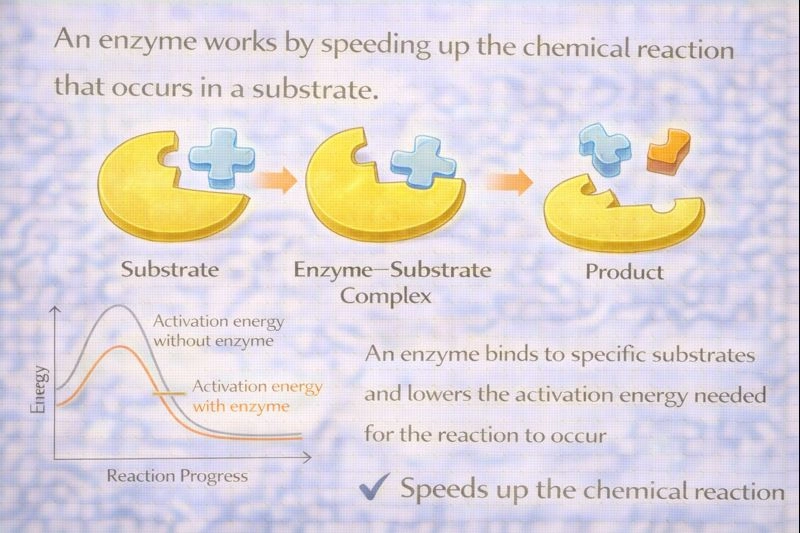
An enzyme works by speeding up the chemical reaction that occurs in a substrate.
Enzymes are biological catalysts. They bind to specific substrate molecules at a region called the active site and form an enzyme–substrate complex. By doing this, the enzyme lowers the activation energy required for the reaction to occur. This may involve bringing reactant molecules closer together, straining chemical bonds, or providing an optimal micro-environment for the reaction. The enzyme itself is not consumed and can be reused many times. This speeding up of reactions is essential because most biochemical reactions would occur too slowly to sustain life without enzymes.
A) An enzyme slows down the chemical reaction
Enzymes do not inhibit or reduce reaction speed. Slowing reactions would interfere with vital processes such as digestion, respiration, and DNA replication.
B) An enzyme speeds up the chemical reaction
Enzymes increase the rate of chemical reactions by lowering the activation energy barrier. This allows reactions to proceed rapidly at normal body temperature and conditions, ensuring efficient metabolism and cellular function.
C) An enzyme has no effect on the chemical reaction
Without enzymes, many reactions would take hours, days, or years instead of milliseconds or seconds. Enzymes dramatically increase reaction rates.
D) An enzyme stops most chemical reactions
Enzymes facilitate reactions rather than stopping them. Their role is to promote specific biochemical reactions, not prevent them.
Conclusion
Enzymes function as catalysts that speed up chemical reactions by lowering activation energy and forming temporary enzyme–substrate complexes. Therefore, the correct answer is B) An enzyme speeds up the chemical reaction.

Topic Flashcards
Click to FlipWhat is the primary function of an enzyme in a biochemical reaction?
To speed up (catalyze) the reaction by lowering the activation energy required for the reaction to proceed.
What is the name of the specific region on an enzyme where the substrate binds?
The active site. This is where the enzyme and substrate form a temporary enzyme-substrate complex.
True or False: Enzymes are consumed and permanently changed during the chemical reactions they facilitate.
False. Enzymes are not consumed. They are catalysts that can be reused multiple times.
How does an enzyme's structure relate to its function in speeding up a reaction?
Its specific 3D shape, especially at the active site, allows it to bind only to particular substrates and orient them in a way that makes the reaction more likely to occur.
What term describes the loss of an enzyme's 3D shape and function, often caused by high temperature or extreme pH?
Denaturation. This disrupts the active site and stops the enzyme from working.