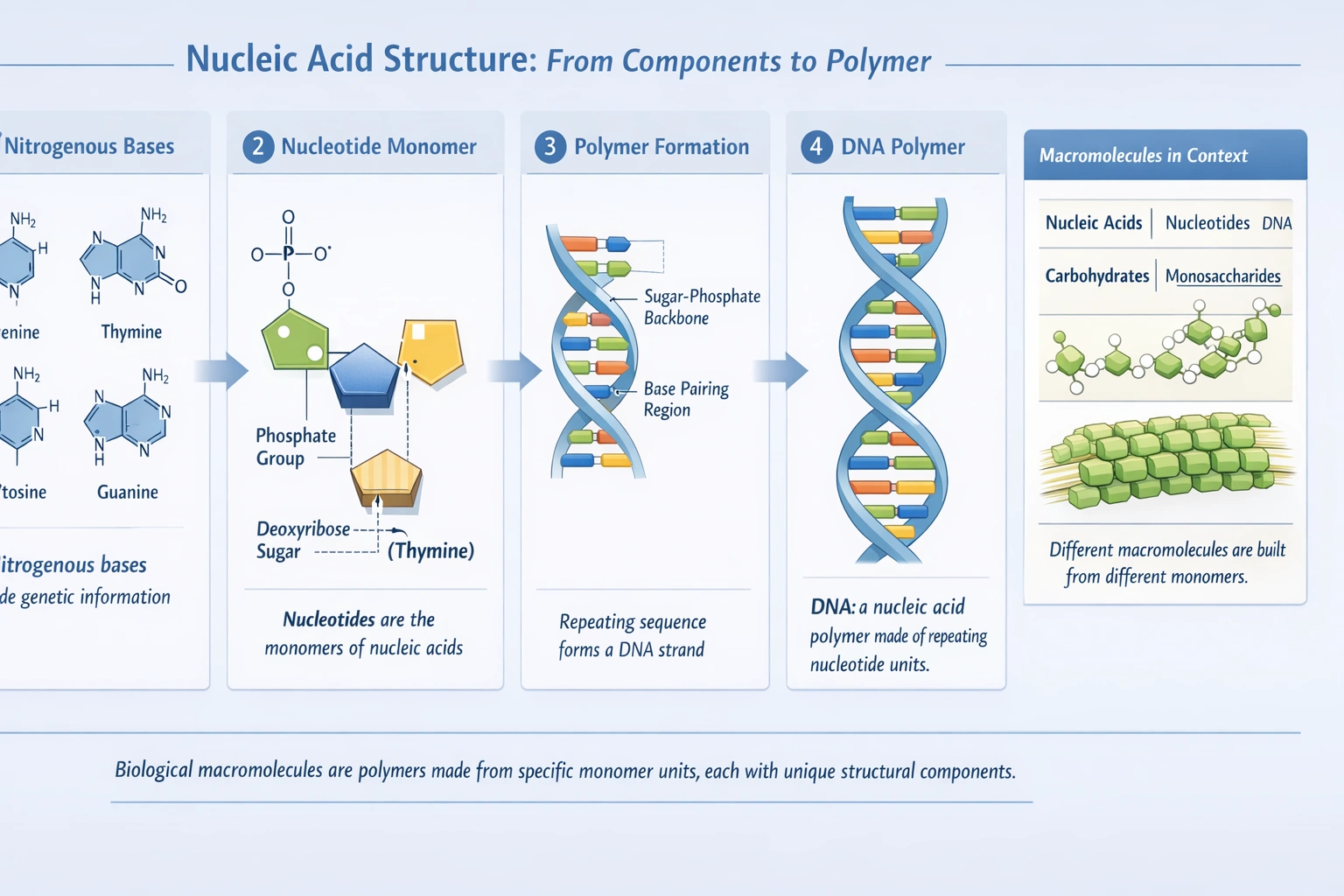
Which is part of the monomer structure of a nucleic acid?
-
A
DNA
-
B
Glucose
-
C
Thymine
-
D
Cellulose
Thymine is a structural component of the nucleotide, which is the monomer of a nucleic acid.
Nucleic acids, such as DNA and RNA, are polymers built from repeating monomeric units called nucleotides. Each nucleotide consists of three covalently bonded parts: a phosphate group, a five-carbon sugar (deoxyribose in DNA, ribose in RNA), and a nitrogenous base. The nitrogenous base is a fundamental part of this monomer structure. Thymine is one of the four nitrogenous bases found specifically in DNA nucleotides, where it pairs with adenine.
A) DNA
DNA, or deoxyribonucleic acid, is not a monomer but the polymer itself. It is the macromolecule that carries genetic information and is composed of long chains of thousands to millions of linked nucleotide monomers. DNA represents the final, complex product of polymerization, not a singular component of a monomer.
B) Glucose
Glucose is a six-carbon monosaccharide and serves as the primary monomer for carbohydrates, such as starch and cellulose. Its chemical structure and biological role are central to energy metabolism and structural polysaccharides, but it is not incorporated into the structure of nucleic acid monomers. Glucose belongs to an entirely different class of biological macromolecules.
C) Thymine
Thymine is a pyrimidine-derived nitrogenous base. In the structure of a DNA nucleotide, thymine is attached to the 1' carbon of the deoxyribose sugar. It forms two hydrogen bonds with adenine in the complementary DNA strand, contributing to the molecule's coding and structural properties. Thymine is an integral and specific part of the DNA nucleotide monomer.
D) Cellulose
Cellulose is a structural polysaccharide and a major component of plant cell walls. It is a linear polymer consisting of many β-glucose monomers linked together. Like DNA, cellulose is a polymer, not a monomer. Its function is mechanical support, and it is categorically a carbohydrate, not a component of nucleic acid structure.
Conclusion:
The monomer of a nucleic acid is the nucleotide, composed of a sugar, a phosphate, and a nitrogenous base. Among the options, thymine serves as one of these nitrogenous bases in DNA. DNA and cellulose are polymers, not monomer parts, and glucose is a monomer for a different class of molecules. Therefore, thymine is the only option that is a direct constituent of a nucleic acid monomer.
Topic Flashcards
Click to FlipTrue or False: Glucose and thymine are both monomers used to build the same type of macromolecule.
False. Glucose is the monomer for carbohydrates (e.g., starch). Thymine is a component of the monomer (nucleotide) for nucleic acids (DNA).
What is the key structural difference between a polymer (like DNA) and a monomer (like a nucleotide)?
A polymer is a long chain of repeating monomers. DNA is a polymer of nucleotides; a single nucleotide is its monomer.
If a molecule is described as a "nitrogenous base," what is its primary role within a nucleotide?
It is the part of the nucleotide that carries genetic information through its sequence and forms specific base pairs (e.g., A-T, G-C).
In which type of nucleic acid is the nitrogenous base thymine found?
DNA. Thymine is specific to DNA. In RNA, the base uracil replaces thymine.
What are the three components that make up a single nucleotide monomer?
A phosphate group, a five-carbon sugar (deoxyribose or ribose), and a nitrogenous base (like thymine, adenine, etc.).