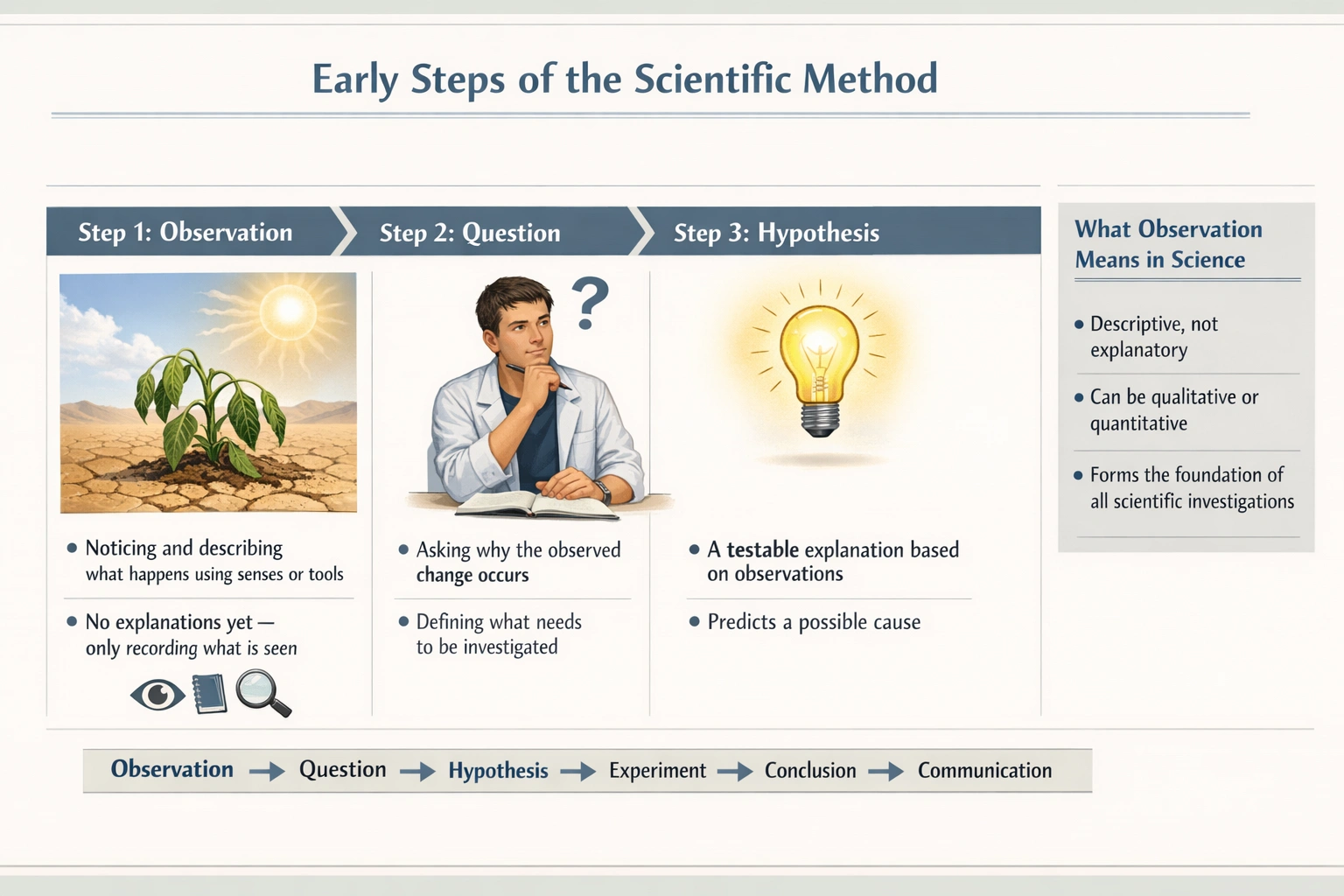
In a study, a researcher describes what happens to a plant following exposure to a dry and hot environment. What step of the scientific method does this most likely describe?
-
A
Forming a hypothesis
-
B
Making an observation
-
C
Communicating findings
-
D
Characterizing the problem
The researcher describing the plant’s response is making an observation.
This activity represents the initial, foundational step of the scientific method, where empirical information is gathered about a phenomenon through the senses or measurement tools. The researcher is documenting specific, measurable changes in the plant, such as wilting, leaf curling, stomatal closure, or changes in pigmentation, without proposing an explanation for why these changes occur. This descriptive data collection serves as the essential raw material from which testable questions and hypotheses can later be formulated. It is a passive recording of events that grounds further inquiry in factual reality.
A) Forming a hypothesis
Forming a hypothesis is a subsequent step that involves proposing a testable, falsifiable explanation for an observed phenomenon. It moves beyond description to prediction, often framed as an "if-then" statement. In the given scenario, the researcher is only documenting what happens; there is no mention of proposing a mechanism or cause for the plant’s reaction. This step requires an observation to have already been made and a specific question to have been asked.
B) Making an observation
Making an observation is the deliberate act of gathering information about the natural world. It involves noting and recording events, patterns, or changes as they occur, which is precisely what the researcher is doing by describing the plant’s condition. This step is purely about data collection and provides the empirical foundation necessary for all subsequent steps in the scientific process.
C) Communicating findings
Communicating findings is the final step, where the complete results of an investigation, including methodology, data, analysis, and conclusions, are shared with the scientific community through publications or presentations. The researcher’s action is an initial, solitary act of data gathering, not the dissemination of a completed study. Communication requires a full narrative from question to conclusion, which has not been developed at this early stage.
D) Characterizing the problem
Characterizing the problem involves a more analytical phase that occurs after an initial observation. It entails defining the scope of an investigation, identifying key variables, and formulating a precise research question. While closely linked to observation, this step is more structured and focused. The simple act of describing an event is the precursor that allows a researcher to recognize a problem worthy of systematic study.
Conclusion:
The scientific method begins with the collection of unbiased data about a natural event. Forming a hypothesis, communicating findings, and characterizing the problem are all critical later stages that depend on the initial observational data. The described activity of documenting a plant’s reaction to environmental stress is emblematic of this first, crucial step of making an observation, which transforms casual noticing into deliberate scientific inquiry.
Topic Flashcards
Click to FlipWhat is the name of the initial scientific method step where a researcher collects and records information about a phenomenon without yet proposing an explanation?
Making an observation. This step provides the empirical data that forms the foundation for all further investigation.
Describing how a plant wilts in hot, dry conditions is an example of which specific scientific method step?
Making an observation. The researcher is documenting measurable changes, which is a form of data collection.
Why is the observation step considered indispensable in the scientific method?
It grounds the process in factual, unbiased reality. Without accurate observations, any subsequent hypothesis or experiment may be flawed.
Which later step in the scientific method involves analyzing the initial observations to define a specific, researchable question?
Characterizing the problem. This analytical step narrows the focus based on what was observed.
True or False: The steps "Forming a hypothesis" and "Making an observation" describe the same scientific activity.
False. Observation is gathering data; a hypothesis is a proposed, testable explanation for that data.