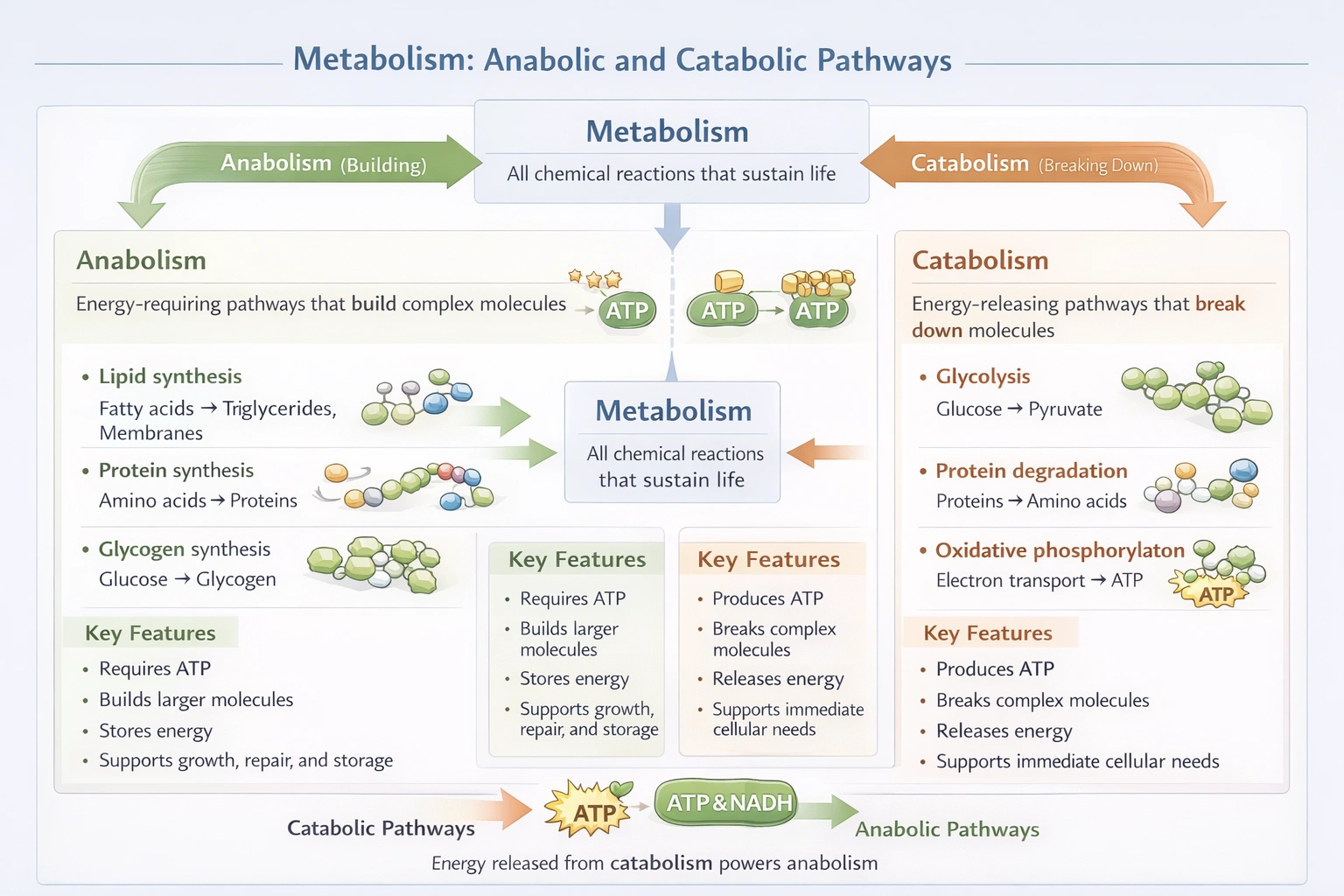
Which process is anabolic?
-
A
Glycolysis
-
B
Lipid synthesis
-
C
Protein degradation
-
D
Oxidative phosphorylation
Lipid synthesis is a biosynthetic process that builds complex molecules from simpler ones, which defines anabolism.
Anabolism encompasses the set of metabolic pathways that construct larger, more complex molecules from smaller precursors. These processes are endergonic, meaning they require an input of energy, typically in the form of ATP. Anabolic pathways are essential for growth, repair, differentiation, and the storage of energy reserves, building the proteins, nucleic acids, carbohydrates, and lipids that constitute cellular structures.
A) Glycolysis
Glycolysis is a universal catabolic pathway. It involves the breakdown of one molecule of glucose into two molecules of pyruvate. This process occurs in the cytoplasm and yields a small net gain of ATP and NADH through substrate-level phosphorylation. Its overarching purpose is to extract chemical energy by dismantling a larger, energy-rich molecule into smaller components, which is the defining characteristic of a catabolic process.
B) Lipid synthesis
Lipid synthesis, such as the formation of triglycerides or phospholipids, assembles glycerol and fatty acid chains through dehydration synthesis reactions that form ester bonds. Building these long-chain hydrocarbons from acetyl-CoA precursors consumes substantial amounts of ATP and reducing equivalents like NADPH. The creation of these dense energy-storage molecules and membrane components from smaller subunits exemplifies constructive, anabolic metabolism.
C) Protein degradation
Protein degradation, whether via the ubiquitin-proteasome system or lysosomal autophagy, breaks down polypeptides into their constituent amino acids through hydrolysis of peptide bonds. This serves to remove damaged proteins, regulate cellular processes, and provide amino acids during nutrient scarcity. Degradation involves the dismantling of complex structures, which is the opposite of biosynthesis and is therefore a catabolic process.
D) Oxidative phosphorylation
Oxidative phosphorylation is the final stage of aerobic cellular respiration and is fundamentally catabolic in its overall context. While it involves building a proton gradient, its primary function is to harvest the energy stored in electron carriers (NADH and FADH₂) that were generated from the catabolic breakdown of fuels like sugars and fats. The energy released is used to drive ATP synthesis, making it the energy-yielding phase of catabolism.
Conclusion:
Anabolic pathways build complex molecules and require energy input. Lipid synthesis clearly fits this definition, assembling large molecules from simpler precursors. In contrast, glycolysis, protein degradation, and oxidative phosphorylation are processes centered on breaking down molecules to release energy or recycle components, placing them firmly in the catabolic domain.
Topic Flashcards
Click to FlipWhat term describes metabolic pathways that build complex molecules from simpler ones, consuming energy in the process?
Anabolism. This is in contrast to catabolism, which breaks down molecules to release energy.
True or False: Glycolysis, which breaks down glucose into pyruvate, is an example of an anabolic pathway.
False. Glycolysis is catabolic as it degrades glucose to extract energy (producing a net gain of ATP and NADH).
Is the synthesis of triglycerides from fatty acids and glycerol considered an anabolic or a catabolic process?
Anabolic. It assembles larger, energy-storage molecules from smaller subunits, requiring ATP and reducing agents like NADPH.
What type of metabolic process is the hydrolysis of proteins into amino acids: anabolic or catabolic?
Catabolic. Degradation via hydrolysis breaks down complex structures into simpler components for recycling or energy.
Does the process of oxidative phosphorylation primarily serve an anabolic or catabolic function in cells?
Catabolic. It is the energy-yielding phase of respiration, harvesting energy from electron carriers (produced by catabolic reactions) to generate ATP.