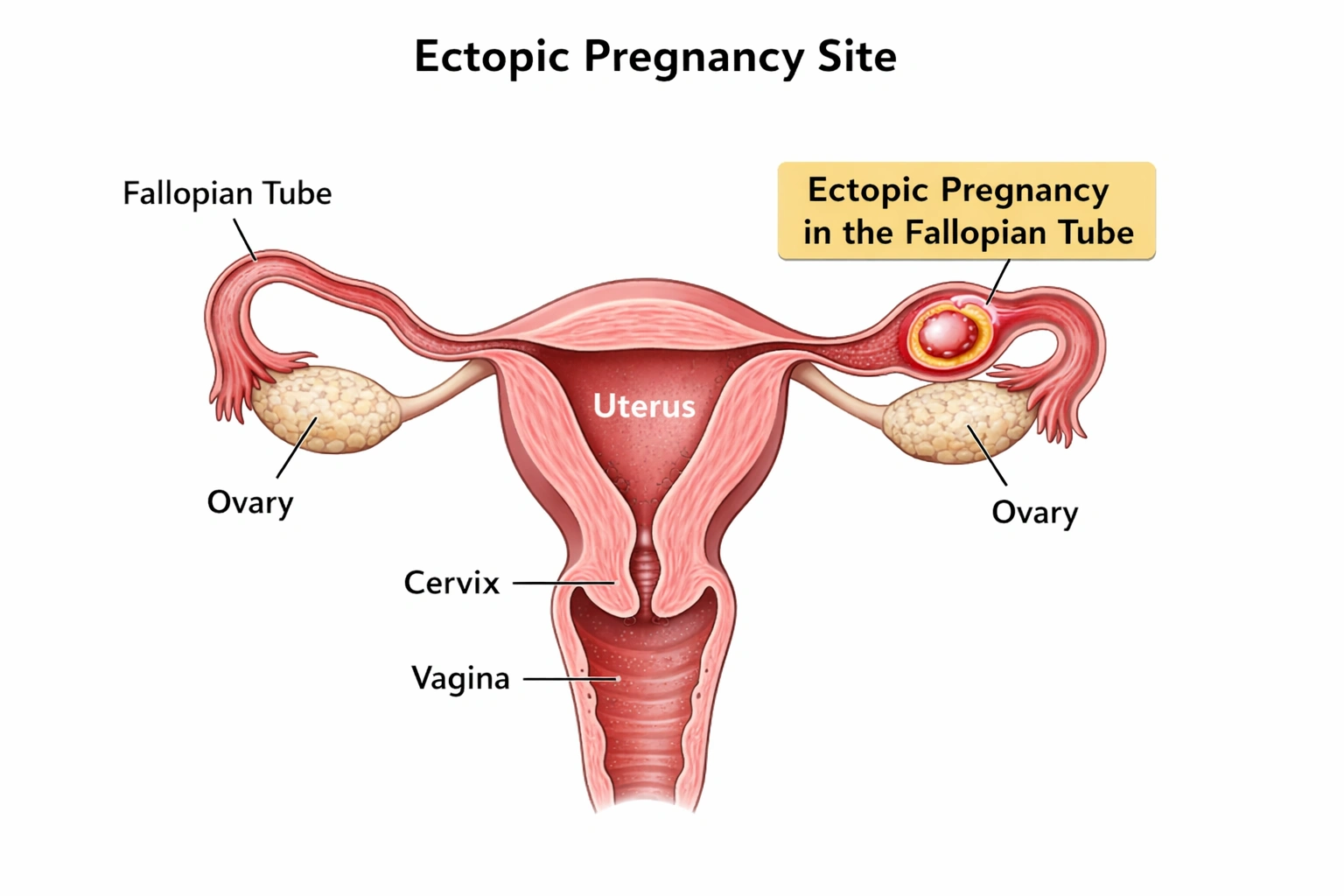
In most ectopic pregnancies, where does the embryo implant?
-
A
In the uterus
-
B
In the pelvic bone
-
C
In the vagina
-
D
In the fallopian tube
In most ectopic pregnancies, the embryo implants in the fallopian tube.
An ectopic pregnancy occurs when a fertilized ovum implants outside the uterine cavity. Under normal circumstances, fertilization takes place in the fallopian tube, and the developing embryo then travels to the uterus, where it implants into the endometrial lining. When this migration is delayed or fails, the embryo may implant in an abnormal location. Clinically and statistically, the fallopian tube is by far the most common site of ectopic implantation, accounting for the majority of cases.
A) In the uterus
The uterus is the normal and appropriate site for embryo implantation in a healthy pregnancy. Its endometrial lining is highly specialized to support implantation, placental development, and long-term fetal growth.
By definition, an ectopic pregnancy is one that occurs outside the uterus. If implantation takes place within the uterine cavity, the pregnancy is classified as an intrauterine pregnancy, not an ectopic pregnancy. Therefore, this option directly contradicts the definition of ectopic pregnancy and is incorrect.
B) In the pelvic bone
Bone tissue cannot support embryonic implantation. The pelvic bones are composed of dense, mineralized connective tissue and lack the soft, vascularized endometrial lining required for trophoblastic invasion and placental formation.
Although extremely rare abdominal ectopic pregnancies can implant on structures within the pelvic cavity, such as the peritoneum or organs near the pelvis, implantation does not occur within bone tissue itself. The pelvic bone does not provide the blood supply or cellular environment necessary to sustain embryonic development. Therefore, this option is physiologically impossible and incorrect.
C) In the vagina
The vagina is a muscular canal lined with stratified squamous epithelium and functions as a passageway for menstrual flow, sexual intercourse, and childbirth. It does not contain endometrial tissue and lacks the glandular and vascular characteristics required to support implantation.
Additionally, the vaginal lining is too thick and structurally unsuitable for trophoblast invasion and placental attachment. There are no documented cases of a viable pregnancy implanting within the vaginal wall. For these anatomical and physiological reasons, this option is incorrect.
D) In the fallopian tube
The fallopian tube is the most common site of ectopic pregnancy, accounting for more than 90 percent of cases. The ampullary region of the tube, where fertilization normally occurs, is the most frequent location of abnormal implantation.
The fallopian tube is lined with ciliated epithelium and contains a vascular mucosa that can mistakenly allow implantation if the embryo does not reach the uterus in time. However, unlike the uterus, the fallopian tube is narrow and lacks the muscular and structural capacity to expand as the embryo grows.
As the pregnancy progresses, the tube may rupture, leading to severe internal bleeding, hypovolemic shock, and potentially death if not treated promptly. Because of this high risk, tubal ectopic pregnancies are considered medical emergencies and are nonviable. This makes the fallopian tube the most accurate and clinically correct answer.
Conclusion:
An ectopic pregnancy is defined as implantation of a fertilized ovum outside the uterus. The uterus represents normal implantation, the pelvic bone cannot support embryonic growth, and the vagina lacks the anatomical structures required for implantation. The fallopian tube, however, provides tissue that can temporarily support implantation and is the location where the vast majority of ectopic pregnancies occur.
For these reasons, the embryo most commonly implants in the fallopian tube in cases of ectopic pregnancy.
Topic Flashcards
Click to FlipWhat is the medical term for a pregnancy implanted outside the uterine cavity?
Ectopic pregnancy.
Which part of the fallopian tube is the most common site for an ectopic pregnancy?
The ampulla (the wider, middle section).
What is the most serious acute complication of a tubal ectopic pregnancy?
Rupture of the fallopian tube, leading to severe internal hemorrhage.
Name a common risk factor for developing an ectopic pregnancy.
Prior pelvic inflammatory disease (PID) or a history of a previous ectopic pregnancy. (Other factors: tubal surgery, endometriosis, smoking).
What is the standard of care for a ruptured ectopic pregnancy?
Emergency surgery (typically a salpingectomy or salpingostomy).