Where does gas exchange take place in the lungs?
-
A
Alveoli
-
B
Bronchioles
-
C
Trachea
-
D
Pleura
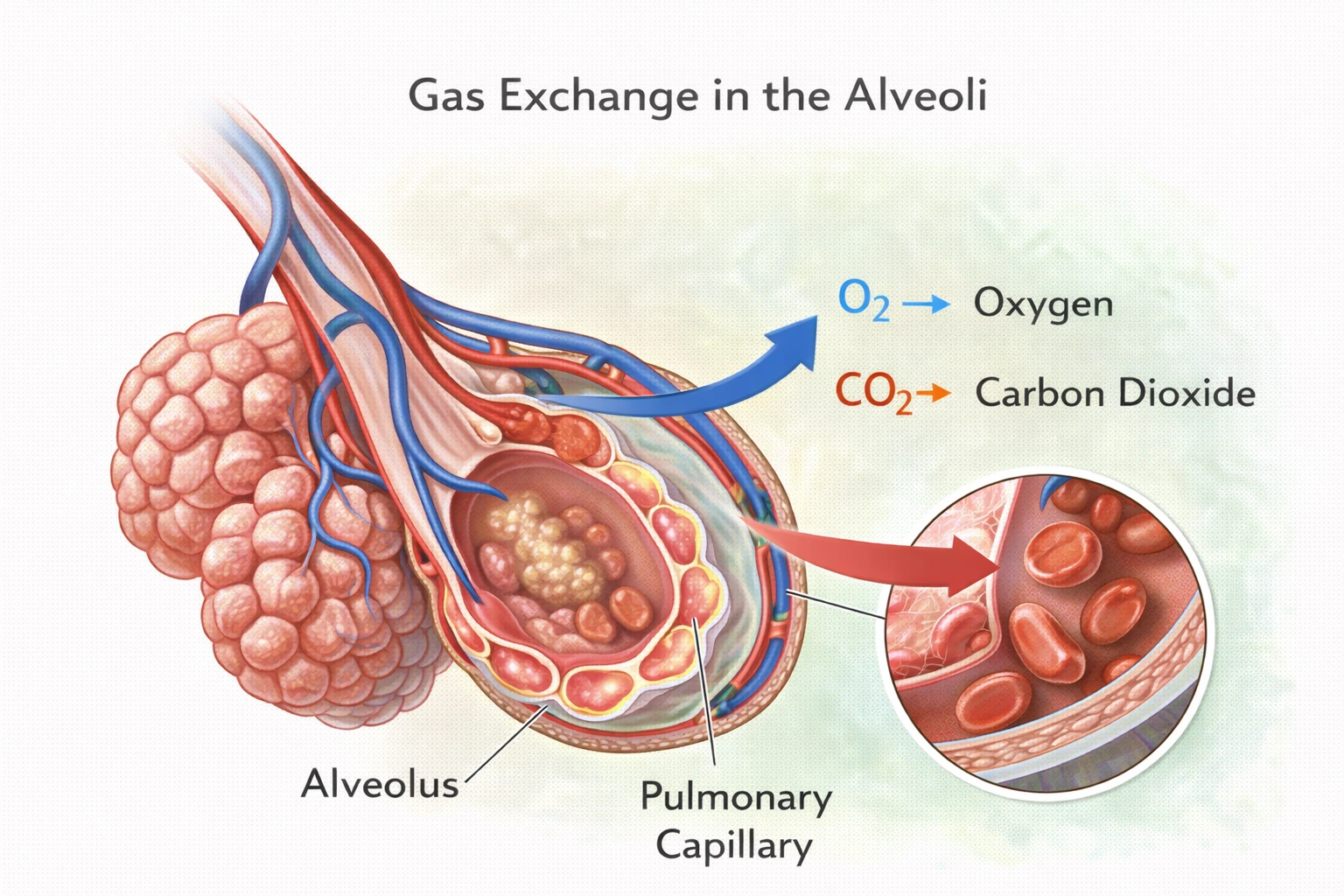
Gas exchange in the lungs takes place in the alveoli.
The lungs are designed with specialized microscopic structures that allow oxygen to enter the bloodstream and carbon dioxide to be removed efficiently. These structures must have extremely thin walls, a large surface area, and close contact with blood vessels to permit rapid diffusion of gases. The alveoli meet all of these anatomical and physiological requirements, making them the primary and exclusive site of gas exchange in the respiratory system.
A) Alveoli
Each lung contains approximately 300 million alveoli, which are tiny, balloon-like air sacs located at the ends of the respiratory bronchioles and alveolar ducts. Their walls are composed primarily of a single layer of simple squamous epithelial cells known as type I pneumocytes. These thin walls are tightly surrounded by pulmonary capillaries.
Together, the alveolar wall and capillary wall form the respiratory membrane, which is only about 0.5 micrometers thick. This extremely short diffusion distance allows oxygen to move from inhaled air into the blood and carbon dioxide to move from the blood into the alveoli down their respective partial pressure gradients.
In addition, alveoli provide an enormous total surface area, estimated at 60–80 square meters in adults, further enhancing the efficiency of gas exchange. Because of their thin structure, rich blood supply, and direct exposure to inhaled air, alveoli are uniquely suited for this function.
B) Bronchioles
Bronchioles are small conducting airways that branch from the bronchi and lead toward the alveoli. Their primary role is to transport air and regulate airflow through smooth muscle contraction and relaxation.
Although bronchioles are important for directing air to the alveoli, they do not participate in gas exchange. Their walls are thicker than alveolar walls and lack the dense capillary networks necessary for diffusion. Additionally, they do not form a blood–air barrier. For these reasons, bronchioles cannot serve as sites of oxygen and carbon dioxide exchange.
C) Trachea
The trachea is a rigid tube reinforced by C-shaped cartilage rings that connects the larynx to the bronchi. Its main function is to provide a clear, open passageway for air to move in and out of the lungs.
The trachea is lined with ciliated epithelium and mucus-producing cells that trap and remove debris, but it has thick walls and no specialized diffusion membrane. It is structurally designed for air conduction and protection, not for gas exchange. Therefore, it is not a site where oxygen or carbon dioxide enters or leaves the bloodstream.
D) Pleura
The pleura consists of two thin serous membranes: the visceral pleura, which covers the lungs, and the parietal pleura, which lines the chest wall. These membranes produce pleural fluid that reduces friction during breathing and helps maintain negative pressure to keep the lungs expanded.
The pleura does not come into contact with inhaled air and does not contain structures that allow diffusion of gases into the blood. It serves a protective and mechanical role rather than a respiratory exchange function. Therefore, it is not involved in gas exchange.
Conclusion:
Gas exchange requires an extremely thin membrane, close contact with blood vessels, and a large surface area to allow efficient diffusion of oxygen and carbon dioxide. The alveoli alone meet all of these anatomical and physiological conditions. Bronchioles and the trachea function as air-conducting passages, while the pleura serves a protective role.
For these reasons, gas exchange in the lungs takes place in the alveoli.

Topic Flashcards
Click to FlipWhat is the name of the thin, two-layered membrane where gases diffuse between the alveoli and the blood?
The respiratory membrane (or alveolar-capillary membrane)
What are the flattened, thin cells that form the structure of the alveolar walls called?
Type I pneumocytes (or Type I alveolar cells).
What is the primary force that drives the diffusion of oxygen and carbon dioxide across the respiratory membrane?
Differences in partial pressure (concentration gradients).
Besides gas exchange, what critical function is performed by Type II pneumocytes in the alveoli?
They produce pulmonary surfactant, which reduces surface tension and prevents alveolar collapse.
What is the functional unit of the lung where respiration occurs?
The pulmonary acinus, which includes the respiratory bronchioles, alveolar ducts, and alveoli.