What is the end product of translation?
-
A
Amino acids
-
B
Stop codons
-
C
Transfer RNA
-
D
Messenger RNA
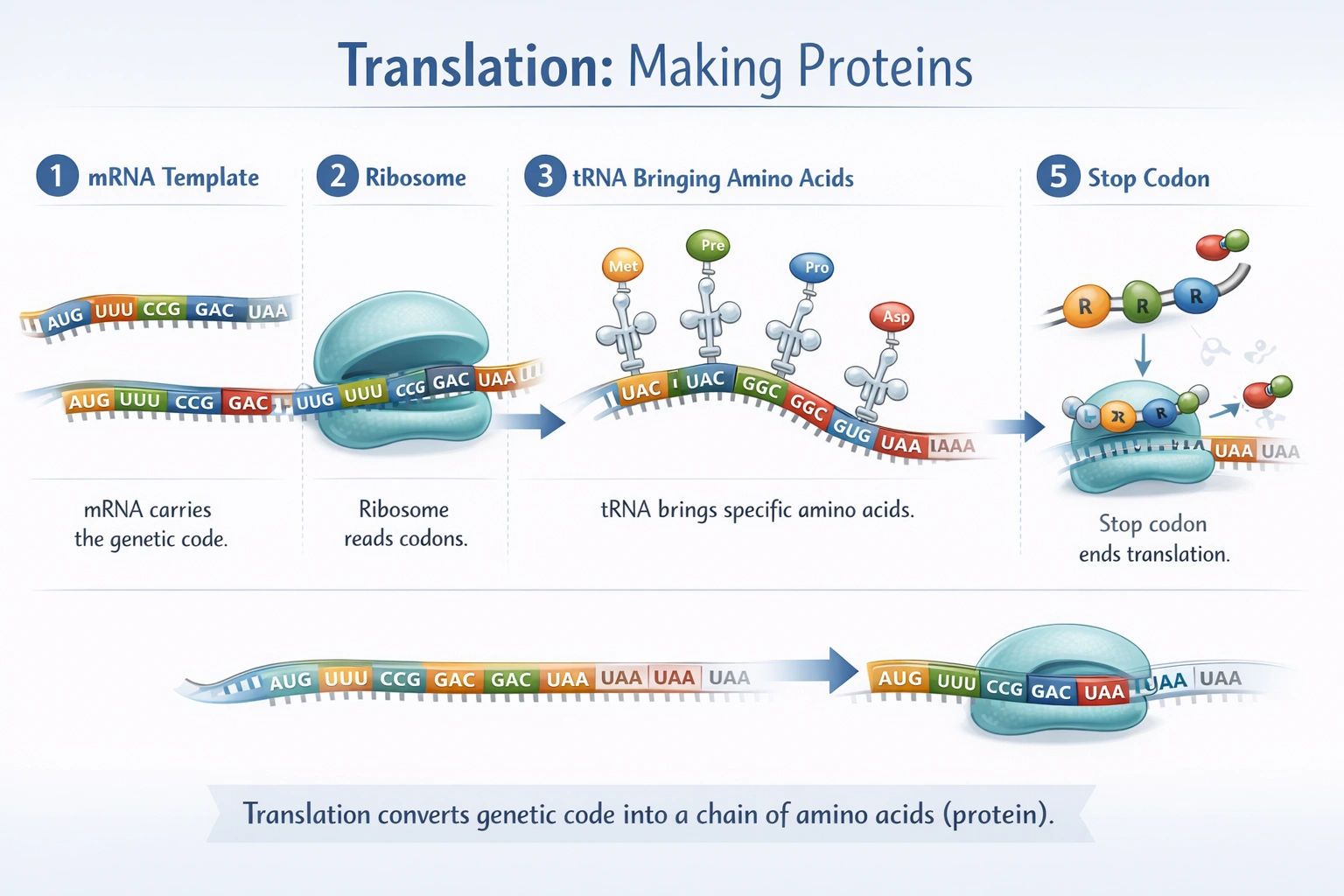
Translation is the process of protein synthesis where the sequence of nucleotides in mRNA is decoded to specify the sequence of amino acids in a polypeptide chain.
The end product is a chain of polymerized amino acids, a polypeptide. While free amino acids are the input monomers, the central action of translation is to assemble them into a specific, genetically determined sequence via peptide bonds. The tangible output is this polymerized chain, which may then fold into a functional protein.
A) Amino acids
In this context, "amino acids" refers to the polymerized chain, the polypeptide, which is the direct product of translation. The process sequentially joins individual amino acids delivered by tRNA.
B) Stop codons
Stop codons (UAA, UAG, UGA) are specific nucleotide triplets on the mRNA that signal the termination of translation. They are signals within the process that cause the release of the polypeptide, but they are not a product synthesized by translation.
C) Transfer RNA
Transfer RNA (tRNA) is a crucial adapter molecule that brings amino acids to the ribosome. Each tRNA has an anticodon complementary to an mRNA codon and is attached to its corresponding amino acid. tRNAs are essential components or tools of the translation machinery, but they are recycled and are not the final product.
D) Messenger RNA
Messenger RNA (mRNA) is the template for translation. It carries the genetic instructions from DNA to the ribosome. The ribosome reads the mRNA sequence. The mRNA is the informational blueprint that is "read" during translation, not the structure that is physically built. It is a reactant, not a product.
Conclusion:
Translation uses mRNA as a template and tRNA as an adapter to assemble amino acids into a polypeptide. Stop codons are termination signals. The final, synthesized output is a chain of amino acids linked by peptide bonds, the polypeptide.
Topic Flashcards
Click to FlipWhat is the end product of translation?
A polypeptide (protein).
What molecule serves as the template during translation?
Messenger RNA (mRNA).
Which molecule delivers amino acids to the ribosome?
Transfer RNA (tRNA).
What type of bond links amino acids during translation?
Peptide bonds.
Where does translation occur in eukaryotic cells?
On ribosomes in the cytoplasm or rough endoplasmic reticulum.