What is the function of a centromere?
-
A
To connect the two chromatids
-
B
To keep the chromosome stable
-
C
To act as a relay point for genetic information
-
D
To transmit genetic codes between other chromosomes
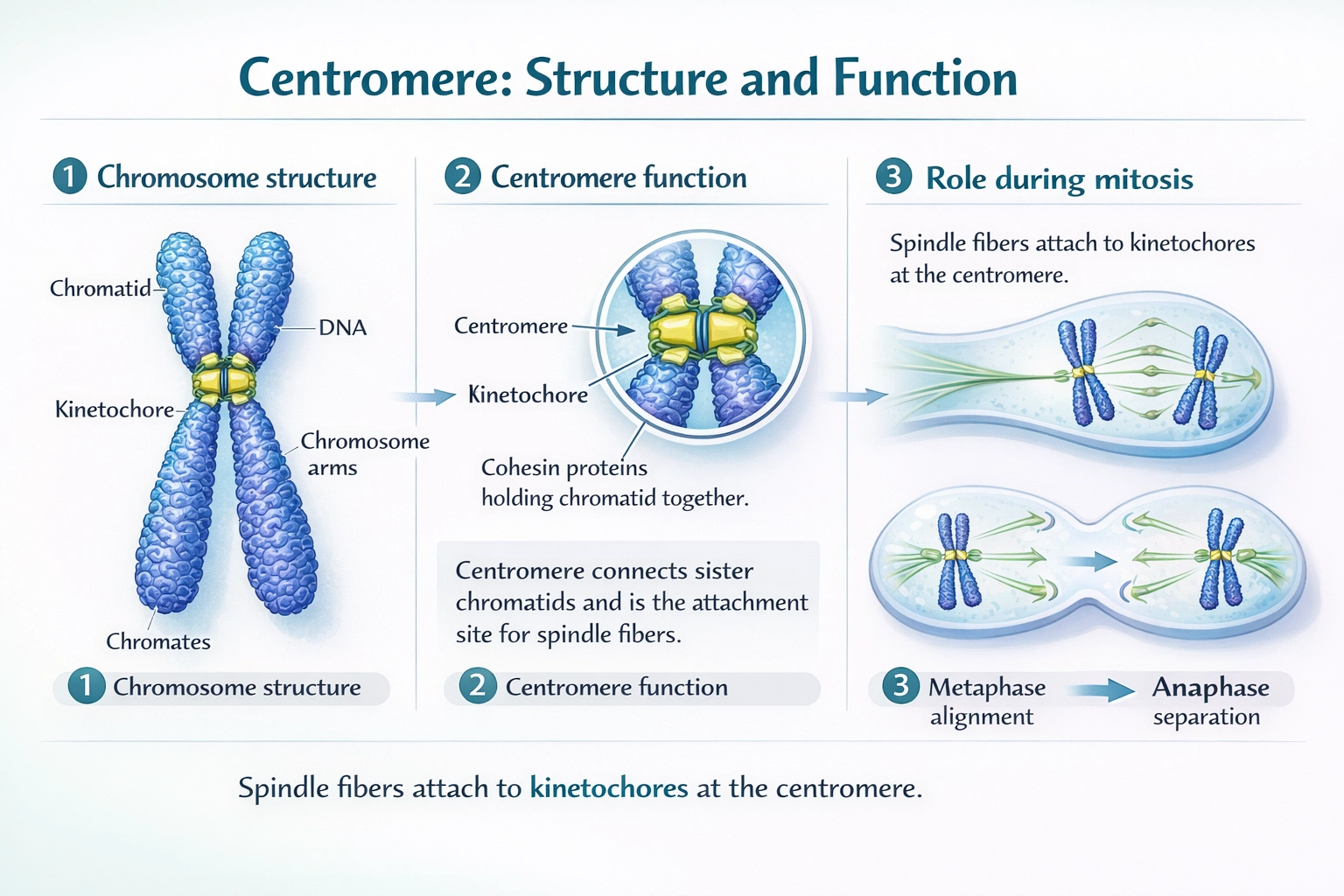
The centromere is a specialized chromosomal region that serves as the primary attachment point holding sister chromatids together after DNA replication until anaphase.
After replication, a chromosome consists of two identical DNA molecules (sister chromatids). Protein complexes called cohesins bind most tightly at the centromere, physically connecting the two chromatids. This connection is maintained from S phase through metaphase and is essential for ensuring that replicated chromosomes are properly recognized as pairs and separated accurately during cell division.
A) To connect the two chromatids
This is the primary structural function. The centromere provides the site where cohesin proteins hold sister chromatids together, ensuring they do not separate prematurely.
B) To keep the chromosome stable
While the centromere contributes to overall chromosome integrity by serving as the anchor for the kinetochore (which attaches to spindle microtubules), this is a broader and secondary description. Chromosome stability is also maintained by telomeres and overall chromatin structure. The centromere's unique, definitive function is specifically to provide the site for sister chromatid attachment and microtubule binding.
C) To act as a relay point for genetic information
Genetic information is encoded in the specific DNA sequence along the chromosome arms. The centromere itself typically consists of repetitive, non-coding DNA and does not contain genes that relay information for protein synthesis. Its function is mechanical and regulatory in cell division, not informational.
D) To transmit genetic codes between other chromosomes
Genetic exchange between homologous chromosomes occurs during prophase I of meiosis through crossing over, which involves recombination between chromatid arms, not centromeres. The centromere is involved in the movement of its own chromosome but does not transmit genetic information between different chromosomes.
Conclusion:
The centromere has several roles, including kinetochore assembly for spindle attachment. However, its fundamental structural function is to serve as the connection point where sister chromatids are held together. This ensures accurate segregation during mitosis and meiosis, which is critical for genomic stability. It is not an informational relay nor a site for inter-chromosomal genetic transfer.
Topic Flashcards
Click to FlipWhat is the primary function of a centromere?
To connect the two sister chromatids.
Which proteins hold sister chromatids together at the centromere?
Cohesin proteins.
What structure forms at the centromere for spindle attachment?
The kinetochore.
When do sister chromatids separate from the centromere?
During anaphase.
Is the centromere primarily involved in genetic coding?
No, it is mainly a structural and mechanical region.