What is the function of a peptide bond?
-
A
To connect proteins together
-
B
To connect nucleotides together
-
C
To connect amino acids together
-
D
To connect nucleic acids together
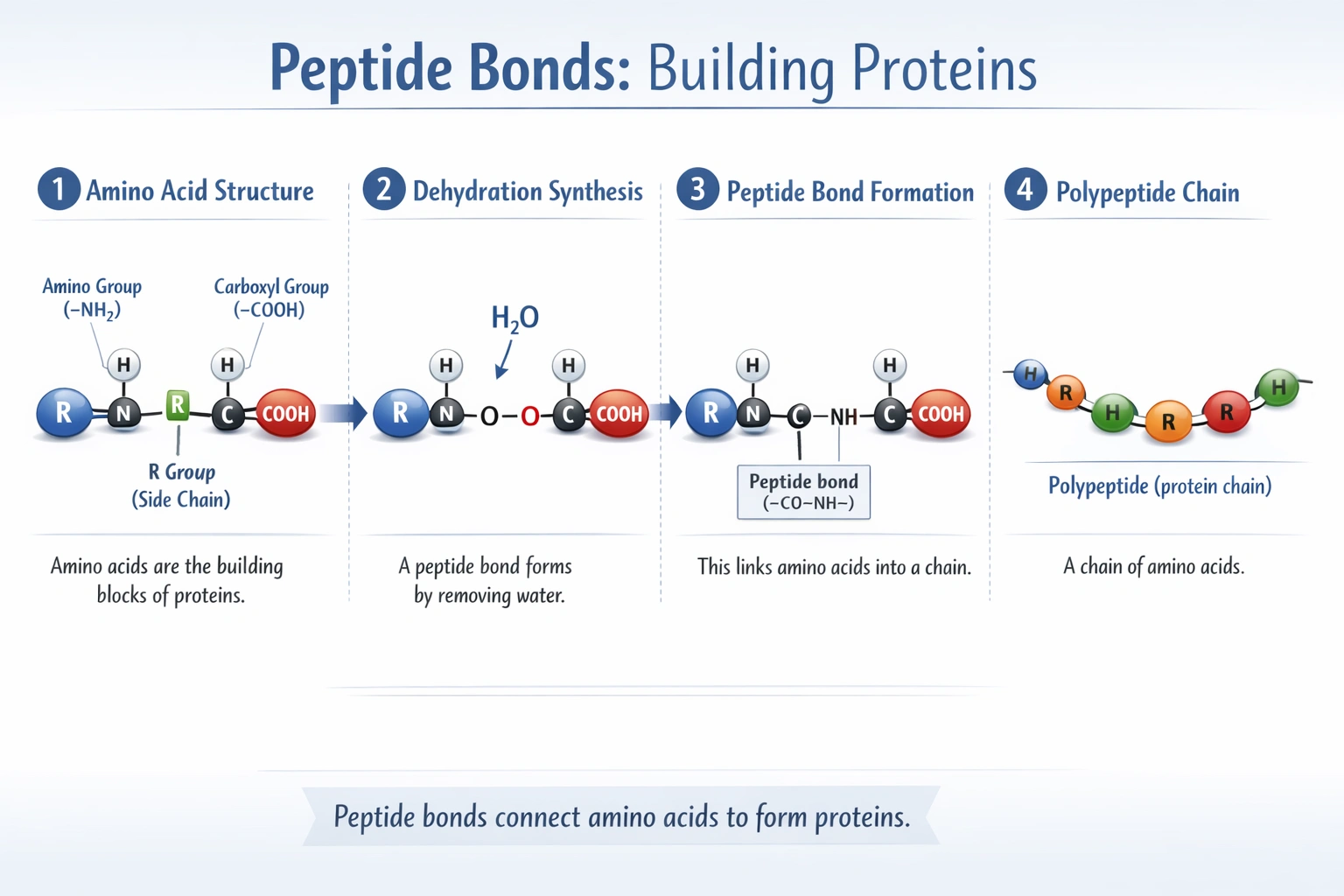
A peptide bond is a specific type of covalent bond formed between the carboxyl group of one amino acid and the amino group of another, linking them during protein synthesis.
The formation of a peptide bond is a dehydration synthesis (condensation) reaction that releases a water molecule. The resulting -C(O)NH- linkage is the backbone of a polypeptide chain. Repeating this process connects amino acids into a sequence that folds into a functional protein.
A) To connect proteins together
Peptide bonds form within a single polypeptide chain, linking its constituent amino acids. They do not connect separate, fully folded protein molecules to each other. Connections between different protein molecules are mediated by other interactions like disulfide bridges, hydrogen bonds, and hydrophobic effects.
B) To connect nucleotides together
Nucleotides, the monomers of nucleic acids, are connected by phosphodiester bonds. This bond forms between the 3' hydroxyl group of one nucleotide's sugar and the 5' phosphate group of the next, creating the sugar-phosphate backbone of DNA or RNA. Peptide bonds are not involved in nucleic acid polymerization.
C) To connect amino acids together
This is the precise function. During translation on the ribosome, amino acids are linked via peptide bonds to form a polypeptide chain. This forms the primary structure of a protein.
D) To connect nucleic acids together
This phrase is ambiguous. "Nucleic acids" are polymers (DNA, RNA). Connecting them could refer to hydrogen bonding between complementary strands or enzymatic joining of DNA fragments. In no case is a peptide bond involved; hydrogen bonds or phosphodiester bonds fulfill these roles.
Conclusion:
Different covalent bonds are responsible for linking the monomers of different macromolecules. Phosphodiester bonds link nucleotides into nucleic acids. Peptide bonds exclusively and specifically link amino acids into polypeptide chains, forming the primary structure of proteins. They do not connect whole proteins to each other or have any role in nucleic acid structure.
Topic Flashcards
Click to FlipWhat is the primary function of a peptide bond?
To connect amino acids together into a polypeptide chain.
Between which two groups does a peptide bond form?
The carboxyl group of one amino acid and the amino group of another.
What type of reaction forms a peptide bond?
Dehydration synthesis (condensation reaction).
What level of protein structure is defined by peptide bonds?
Primary structure.
Where in the cell are peptide bonds formed during protein synthesis?
At the ribosome during translation.