What is the purpose of phloem tissue in plant stems?
-
A
It conducts water up through the stem.
-
B
It conducts the energy of light to leaves.
-
C
It conducts food throughout the plant.
-
D
It conducts carbon dioxide throughout the plant.
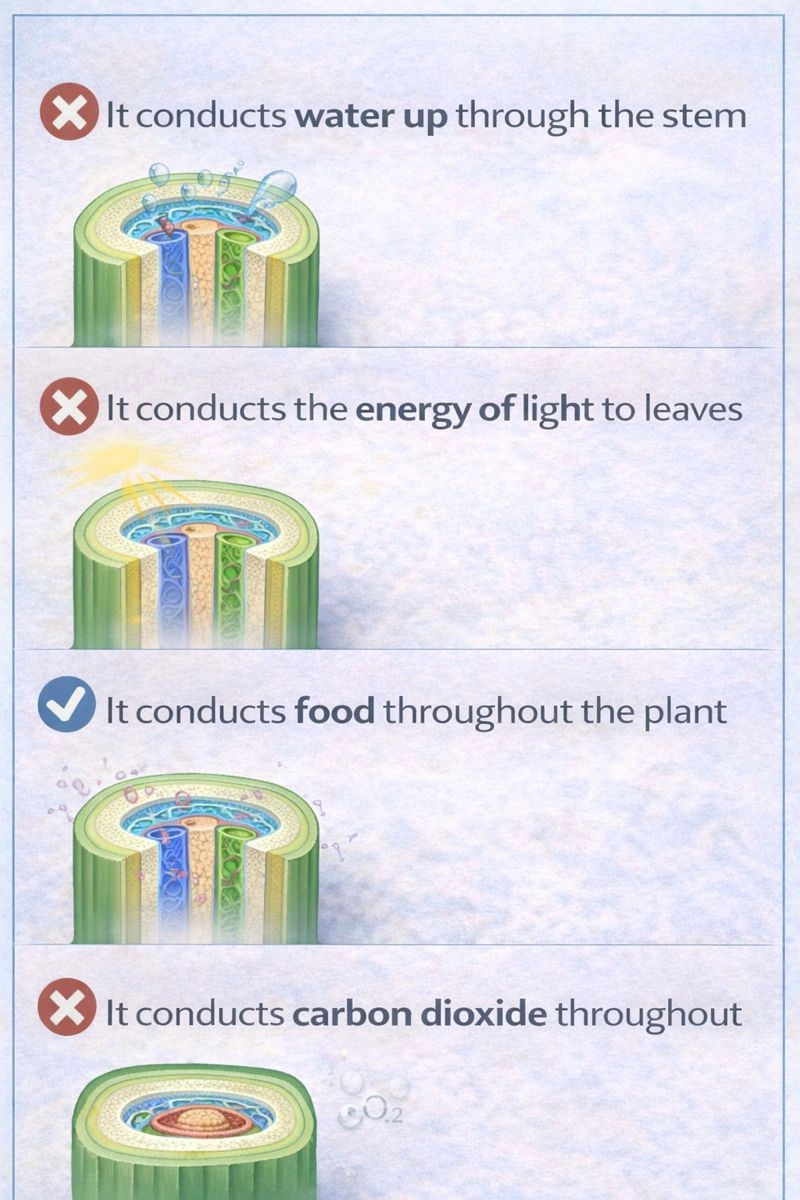
The purpose of phloem tissue is to conduct food throughout the plant.
Phloem is a living vascular tissue responsible for transporting organic nutrients, mainly sugars produced during photosynthesis, from areas where they are made to areas where they are needed for growth, storage, and metabolism.
A) It conducts water up through the stem
Transporting water and dissolved mineral salts from the roots to the rest of the plant is the function of xylem tissue, not phloem.
Xylem consists of dead, hollow cells that form continuous tubes allowing upward movement of water through transpiration pull and root pressure. Phloem does not carry water as its primary function.
Therefore, this option is incorrect.
B) It conducts the energy of light to leaves
Light energy is not transported through plant tissues.
Instead, light is absorbed directly by chlorophyll in the chloroplasts of leaf cells during photosynthesis. No vascular tissue is capable of conducting light energy through the stem or other plant parts.
Thus, this option is biologically incorrect.
C) It conducts food throughout the plant
Phloem transports organic nutrients, mainly sucrose and other carbohydrates, synthesized in the leaves during photosynthesis.
This process, called translocation, moves sugars:
- From sources (leaves or storage organs releasing sugars)
- To sinks (roots, fruits, seeds, buds, and growing tissues)
Phloem tissue is composed of sieve tube elements and companion cells, which work together to actively move nutrients throughout the plant in multiple directions as needed.
Because this accurately describes the primary function of phloem, this option is correct.
D) It conducts carbon dioxide throughout the plant
Carbon dioxide enters plant leaves directly from the atmosphere through tiny pores called stomata.
Once inside, it diffuses short distances to photosynthetic cells. It is not transported through vascular tissues such as xylem or phloem.
Therefore, this option is incorrect.
Conclusion:
Plant vascular tissue is divided into two main types: xylem, which carries water and minerals, and phloem, which carries organic nutrients produced by photosynthesis.
Phloem’s role is to distribute food from the leaves to all parts of the plant that require energy or building materials for growth and storage.
For this reason, the correct answer is that phloem conducts food throughout the plant.

Topic Flashcards
Click to FlipWhat is the primary function of phloem tissue in plants?
To conduct food (organic nutrients like sugars) throughout the plant, a process called translocation.
How does the function of phloem differ from that of xylem?
Phloem transports sugars from sources to sinks; xylem transports water and minerals upward from roots.
What are "source" and "sink" in the context of phloem transport?
A source (e.g., leaf) produces/releases sugars. A sink (e.g., root, fruit) uses or stores sugars.
Are the conducting cells of phloem alive or dead at maturity?
Alive (sieve tube elements are living but lack nuclei; companion cells support them).
Does phloem transport primarily in one direction like xylem?
No. Phloem transport is bidirectional, moving sugars to wherever they are needed.