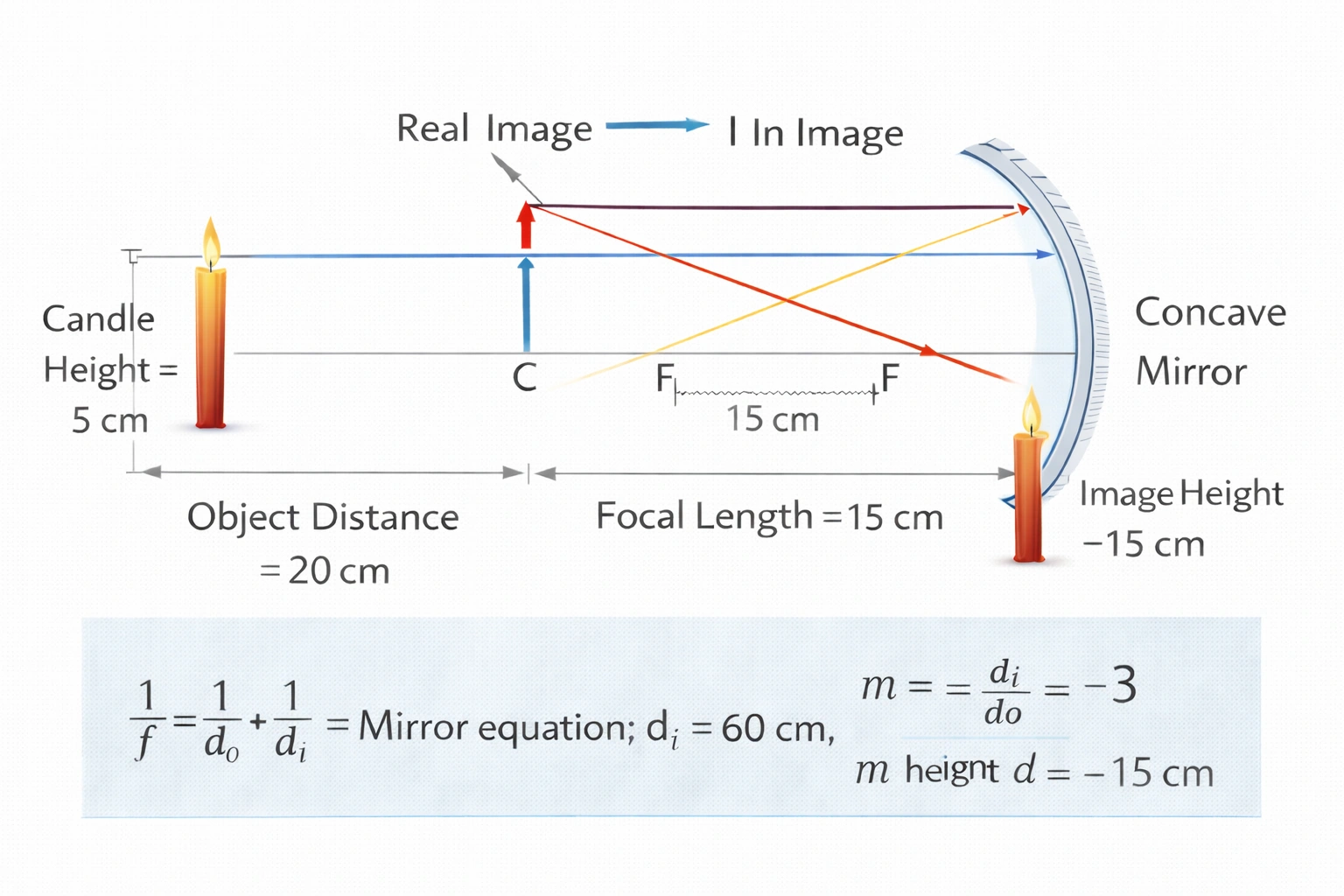
A 5-cm candle is placed 20 cm away from a concave mirror with a focal length of 15 cm. About what is the image height of the candle in the mirror?
-
A
30.5 cm
-
B
15.625 cm
-
C
–15 cm
-
D
–30.5 cm
A 5-cm candle placed 20 cm from a concave mirror with a 15-cm focal length produces an inverted real image with a height of approximately –15 cm.
Using the mirror equation 1f=1do+1dif1=do1+di1, the image distance is found to be 60 cm, and magnification m=−dido=−3m=−dodi=−3 yields an image height of –15 cm, where the negative sign indicates inversion.
A) 30.5 cm
This value significantly overestimates the image size and does not result from proper application of the mirror equation. It may arise from arithmetic errors or incorrect sign conventions, but it fails to match the calculated magnification of –3 for the given object and focal distances.
B) 15.625 cm
This appears to stem from a miscalculation of image distance, possibly using 62.5 cm instead of the correct 60 cm. Such a deviation lacks justification from the mirror formula and does not align with the geometric optics of concave mirrors under these conditions.
C) –15 cm
This is consistent with the laws of reflection for concave mirrors. The object lies beyond the focal point but within twice the focal length, producing a real, inverted, and magnified image. The computed magnification of –3 applied to a 5-cm object gives exactly –15 cm, matching both magnitude and sign convention for real images.
D) –30.5 cm
This doubles the expected image height and likely results from incorrectly assuming a magnification of –6.1 or misreading the object distance. It contradicts the mirror equation solution and overstates the optical effect.
Conclusion
The image formed is real, inverted, and three times the object height, resulting in a height of –15 cm. The correct answer is C) –15 cm

Topic Flashcards
Click to FlipWhat is the mirror equation, and what do each of the variables represent?
1/f = 1/do + 1/di, where f is focal length, do is object distance, and di is image distance.
How is magnification (m) for a mirror calculated using object and image distances?
m = - (di / do). A negative m indicates an inverted image.
How do you calculate the image height (hi) if you know the object height (ho) and the magnification?
hi = m * ho
For a concave mirror, where must an object be placed to form a real, inverted, and magnified image?
Between the focal point (F) and the center of curvature (C), i.e., where f < do < 2f.
In the sign convention for mirrors, what does a negative image distance (di) or image height (hi) signify?
A negative di means the image is real and in front of the mirror. A negative hi means the image is inverted relative to the object.