HESI ADMISSION ASSESSMENT A2 EXAM PHYSICS
This HESI Physics Practice Test provides a realistic simulation of the physics questions found on the HESI A2 exam. It is designed to test your understanding of fundamental physical principles and problem-solving skills.
Topics Covered
Motion and Forces
Energy and Work
Electricity and Magnetism
Heat and Temperature
Basic Mechanics
00:00
Which one has the lowest density?
A.
Water
B. Cork
C. Aluminum
D. Steel
Rationale
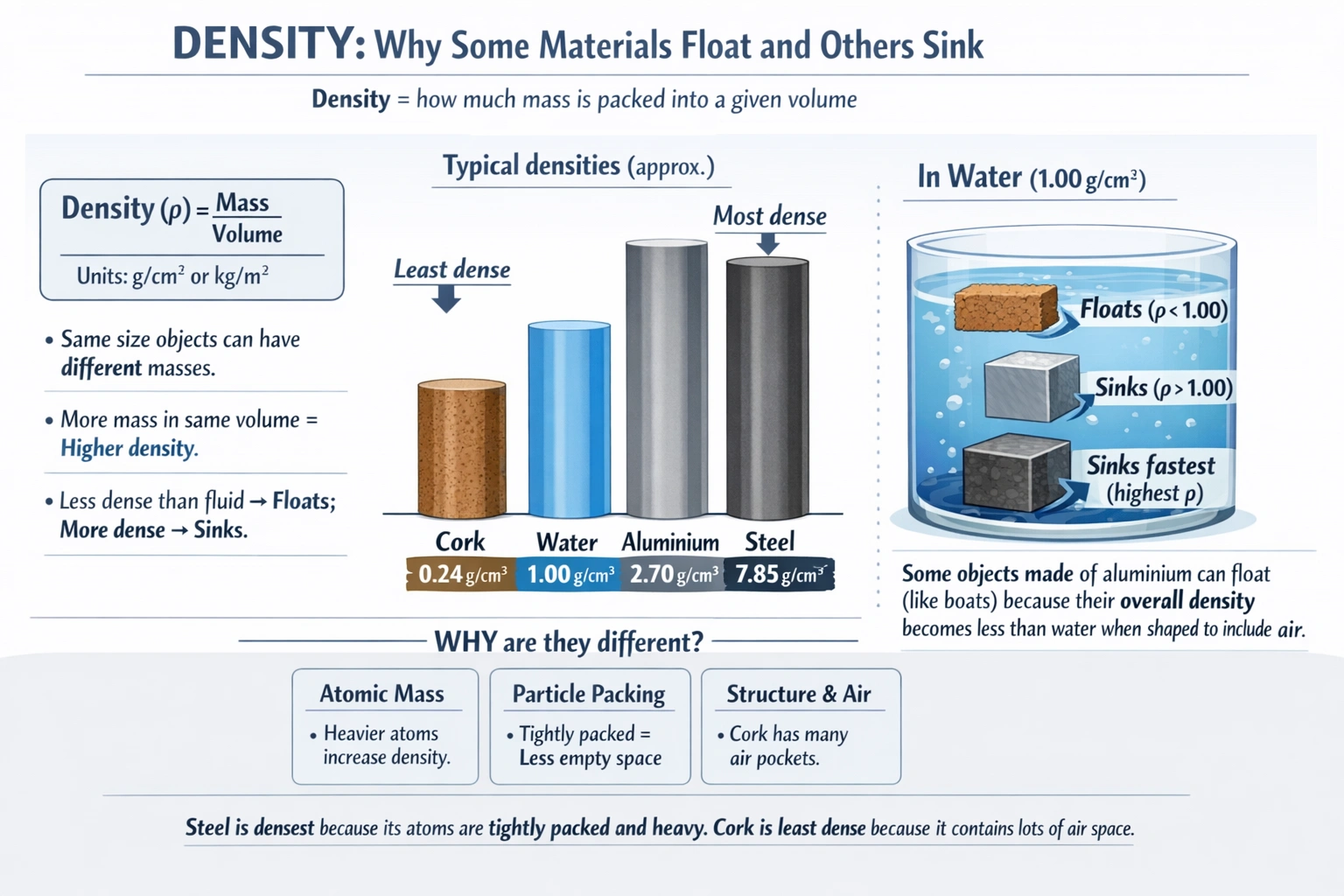
Cork possesses the lowest density among the listed materials, making it the lightest option per unit volume and explaining its characteristic buoyancy in water.
A) Water Water has a density of approximately 1 g/cm³ (or 1000 kg/m³) at standard conditions, serving as a common reference point for density comparisons. While less dense than many metals, water's density exceeds that of cork by roughly an order of magnitude, placing it higher on the density spectrum among the given choices.
B) Cork Cork, harvested from the bark of cork oak trees, exhibits an exceptionally low density ranging from 0.2 to 0.3 g/cm³ due to its cellular structure filled with air pockets. This lightweight property enables cork to float readily on water and makes it ideal for applications requiring buoyancy or insulation. Among water, aluminum, steel, and cork, this material definitively holds the minimum density value.
C) Aluminum Aluminum represents a lightweight metal with a density of approximately 2.7 g/cm³, roughly three times that of water and nearly ten times that of cork. While aluminum's favorable strength-to-weight ratio makes it valuable in aerospace and construction, its density remains substantially higher than cork's, eliminating it as the lowest-density option.
D) Steel Steel, an iron-carbon alloy, possesses a density near 7.8 g/cm³, making it the densest material among the four choices. This high density contributes to steel's structural strength and durability but also results in significant weight, clearly distinguishing it from the lightweight characteristics of cork.
Conclusion Density, defined as mass per unit volume, varies dramatically across materials due to differences in atomic packing and internal structure. Cork's porous, air-filled cellular architecture yields the lowest density among the options, while metals like aluminum and steel exhibit progressively higher densities due to tightly packed atomic lattices. Understanding density relationships enables practical applications from material selection in engineering to predicting buoyancy behavior in fluids.
An object has a constant velocity of 50 m/s and travels for 10 s. What is the acceleration of the object?
A.
0 m/s2
B. 5 m/s2
C. 60 m/s2
D. 500 m/s2
Rationale
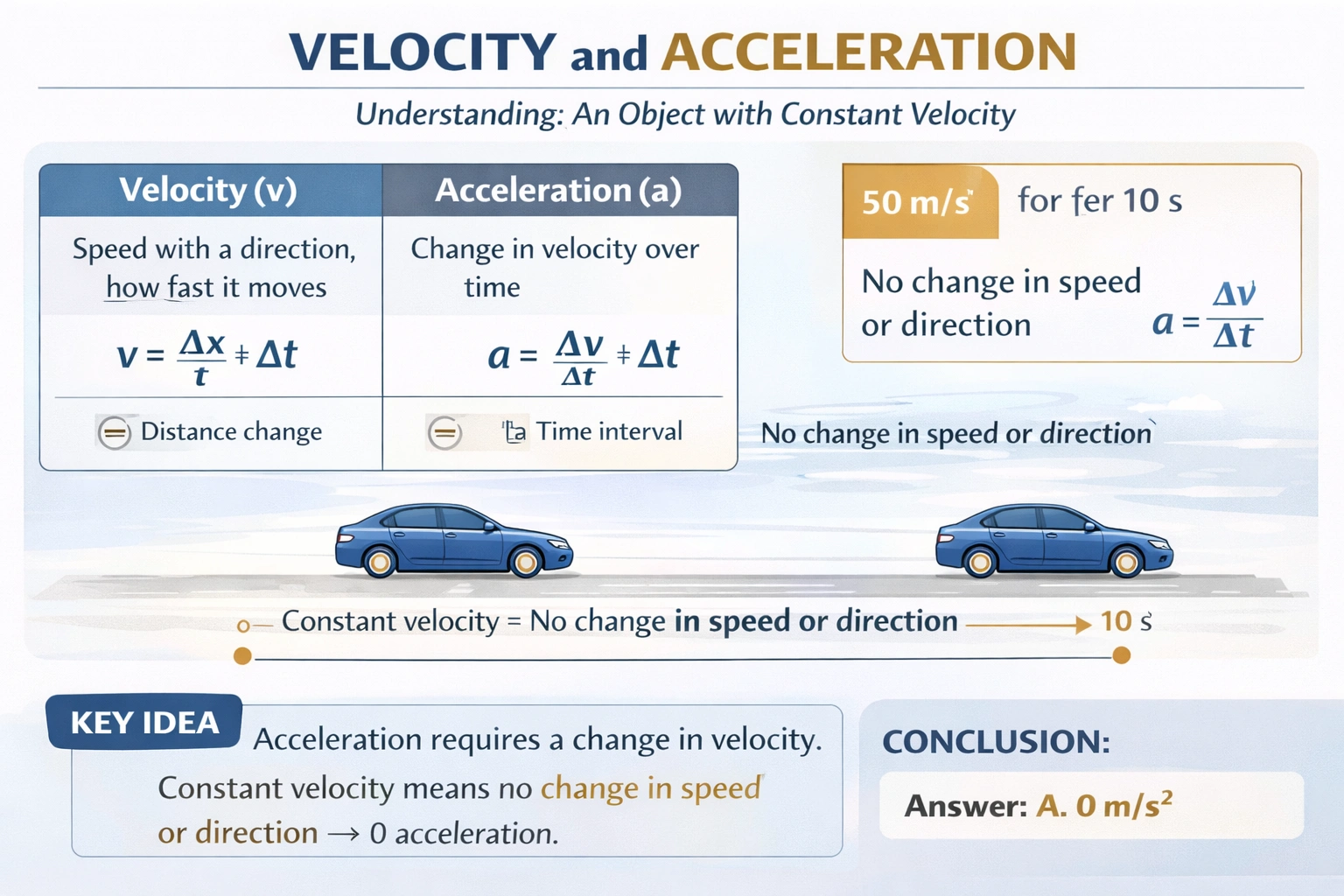
An object maintaining constant velocity experiences zero acceleration, as acceleration quantifies the rate of velocity change over time.
A) 0 m/s² Acceleration measures how velocity changes with time (a = Δv/Δt). When velocity remains constant at 50 m/s, the change in velocity (Δv) equals zero, yielding zero acceleration regardless of travel duration. This reflects Newton's first law: objects in uniform motion remain so unless acted upon by a net external force.
B) 5 m/s² This value incorrectly divides velocity by time (50 m/s ÷ 10 s = 5 m/s²), confusing acceleration with a velocity-time ratio. Acceleration requires a change in velocity, not merely the presence of velocity over time. Without velocity variation, this calculation lacks physical meaning in the context of acceleration.
C) 60 m/s² Adding velocity and time values (50 + 10 = 60) produces a dimensionally inconsistent result with no basis in kinematic equations. Acceleration units (m/s²) derive from velocity change per time, not arithmetic combinations of velocity and duration, making this option physically invalid.
D) 500 m/s² Multiplying velocity by time (50 m/s x 10 s = 500 m) yields a distance value, not acceleration. This misapplication of kinematic relationships confuses displacement calculations with acceleration determination, highlighting the importance of dimensional analysis in physics problem-solving.
Conclusion Acceleration fundamentally describes velocity change, not velocity itself. Constant velocity implies no change in speed or direction, resulting in zero acceleration€”a key concept for understanding inertia, equilibrium, and force-free motion. Recognizing this distinction enables accurate analysis of moving objects, from vehicles cruising at steady speeds to celestial bodies in uniform orbital motion.
100 N?m of work is done over 20 m. What force was applied to the object that was moved?
A.
5 N
B. 80 N
C. 120 N
D. 2,000 N
Rationale
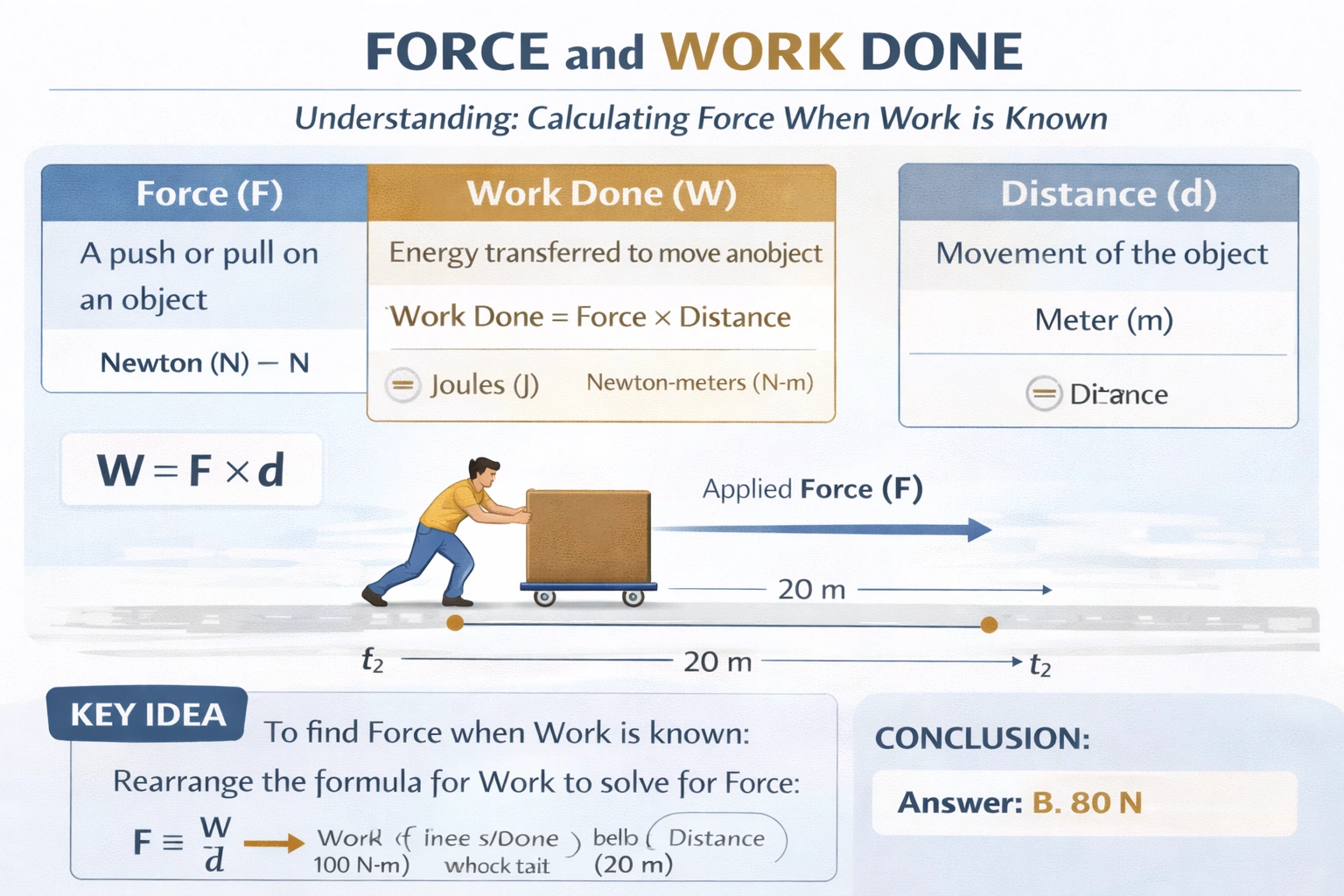
A force of 5 N was applied to move the object, derived from the work-energy relationship where work equals force multiplied by displacement in the force's direction.
A) 5 N Work (W) equals force (F) multiplied by displacement (d) when force and motion align: W = F x d. Rearranging yields F = W/d. Substituting the given values: F = 100 N÷m / 20 m = 5 N. This calculation correctly applies the definition of mechanical work and yields the force magnitude responsible for the energy transfer.
B) 80 N This value incorrectly subtracts displacement from work (100 ˆ’ 20 = 80), violating the multiplicative relationship between force, distance, and work. Such arithmetic lacks physical basis and produces a force value inconsistent with the work-energy principle.
C) 120 N Adding work and displacement (100 + 20 = 120) misapplies the work formula and combines quantities with incompatible units (N÷m + m). This operation yields a dimensionally invalid result that cannot represent force in newtons.
D) 2,000 N Multiplying work by displacement (100 N÷m x 20 m = 2,000 N÷m²) produces units of energy-times-distance, not force. This misapplication of the work equation fundamentally misunderstands the relationship between the three quantities and yields a physically meaningless value.
Conclusion The work-energy principle (W = F x d) provides a direct method to determine force when work and displacement are known. This relationship is foundational in mechanics, enabling calculations for engines, simple machines, and human-powered tasks. Recognizing how to rearrange and apply this formula allows precise determination of forces in practical scenarios from lifting objects to propelling vehicles.
What is the kinetic energy of a 500-kg wagon moving at 10 m/s?
A.
50 J
B. 250 J
C. 2.5 x 10⁴ J
D. 5.0 x 10⁵ J
Rationale
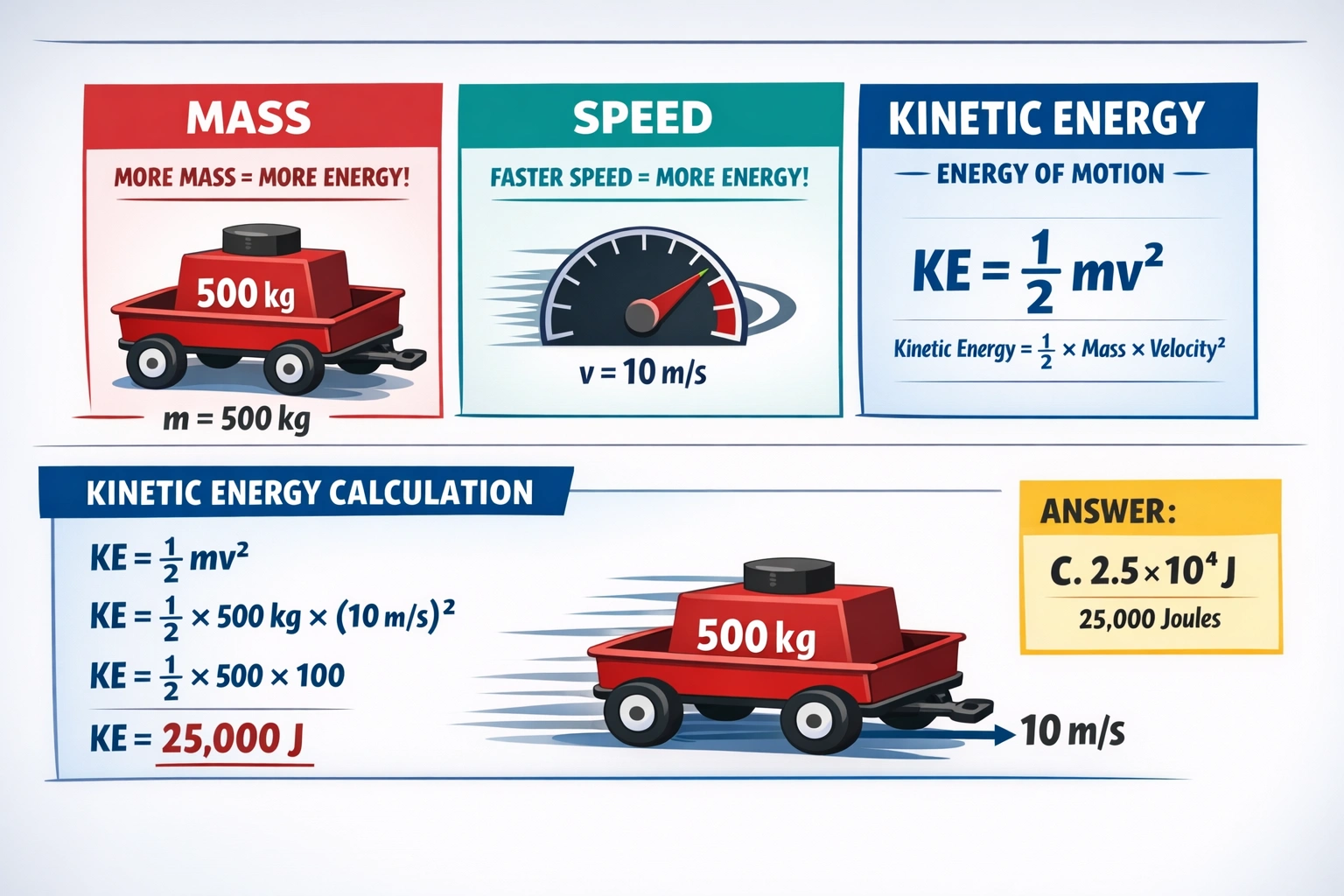
The wagon possesses 2.5 x 10? J of kinetic energy, calculated using the formula for translational kinetic energy based on mass and velocity.
A) 50 J This value incorrectly multiplies mass and velocity (500 kg x 10 m/s = 5,000 kg÷m/s), yielding momentum rather than energy, then further mis-scales the result. Kinetic energy requires squaring velocity and multiplying by half the mass, making this option orders of magnitude too small.
B) 250 J Dividing mass by velocity (500 ÷ 10 = 50) or misapplying the kinetic energy formula without squaring velocity produces this underestimated value. Proper calculation requires KE = ½mv², where velocity squared (10² = 100) significantly amplifies the energy relative to linear momentum.
C) 2.5 x 10? J Kinetic energy equals one-half mass times velocity squared: KE = ½mv². Substituting values: KE = ½ x 500 kg x (10 m/s)² = 250 x 100 = 25,000 J = 2.5 x 10? J. This calculation correctly applies the kinetic energy formula, quantifying the energy associated with the wagon's motion.
D) 5.0 x 10µ J This value omits the one-half factor and possibly mis-squares velocity: 500 x 10² = 50,000 J, then erroneously multiplies by 10 again. While closer in magnitude, it overestimates kinetic energy by a factor of 20, demonstrating the importance of precise formula application and unit tracking.
Conclusion Kinetic energy (KE = ½mv²) quantifies the energy of motion, scaling linearly with mass but quadratically with velocity€”doubling speed quadruples kinetic energy. This relationship explains why high-speed collisions are dramatically more destructive and informs safety designs in transportation, sports equipment, and mechanical systems. Mastering this formula enables accurate energy analysis across physics and engineering contexts.
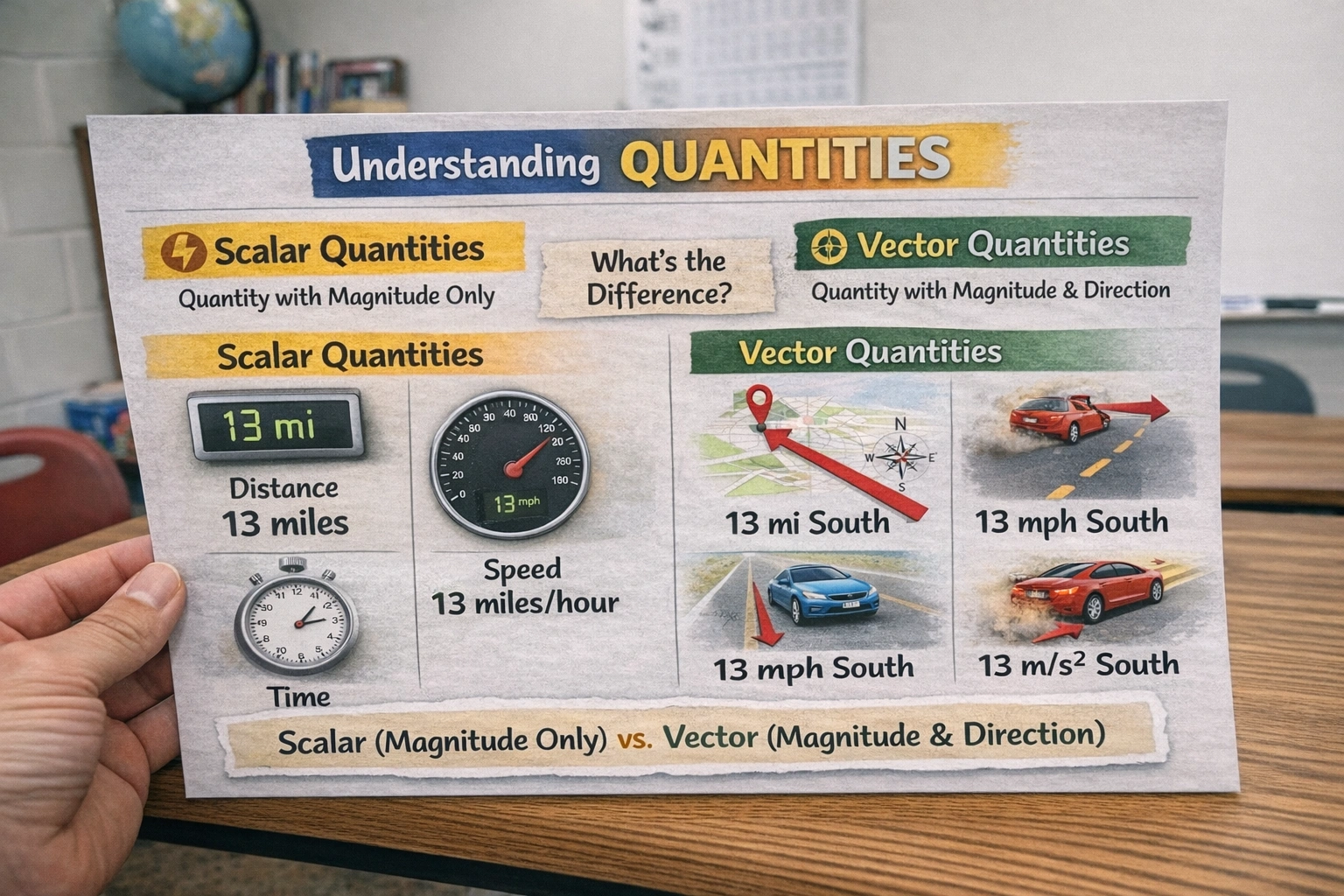
Which of the following describes a vector quantity?
A.
13 miles
B. 13 miles per hour
C. 13 miles south
D. 13 miles more
Rationale
"13 miles south" describes a vector quantity, as it specifies both magnitude (13 miles) and direction (south), fulfilling the two essential components of vector representation.
A) 13 miles This phrase specifies only magnitude (distance) without direction, defining a scalar quantity. Scalars like distance, mass, or time require only numerical value and units, lacking the directional component essential for vector classification.
B) 13 miles per hour This expression denotes speed€”a scalar quantity representing magnitude of velocity without directional information. While velocity (a vector) includes direction, speed alone omits this component, making this option insufficient for vector description.
C) 13 miles south This statement provides both magnitude (13 miles) and direction (south), satisfying the definition of a vector quantity. Displacement, force, and velocity are vectors precisely because they require directional specification alongside magnitude to fully describe physical situations.
D) 13 miles more This comparative phrase lacks both precise magnitude context and any directional information. It functions as an ambiguous scalar addition rather than a well-defined physical quantity, vector or otherwise.
Conclusion Vector quantities require both magnitude and direction for complete specification, enabling accurate description of physical phenomena like displacement, force, and velocity. Scalars, by contrast, need only magnitude. This distinction underpins vector algebra in physics, allowing precise analysis of motion, forces, and fields in two and three dimensions€”essential for engineering, navigation, and scientific modeling.
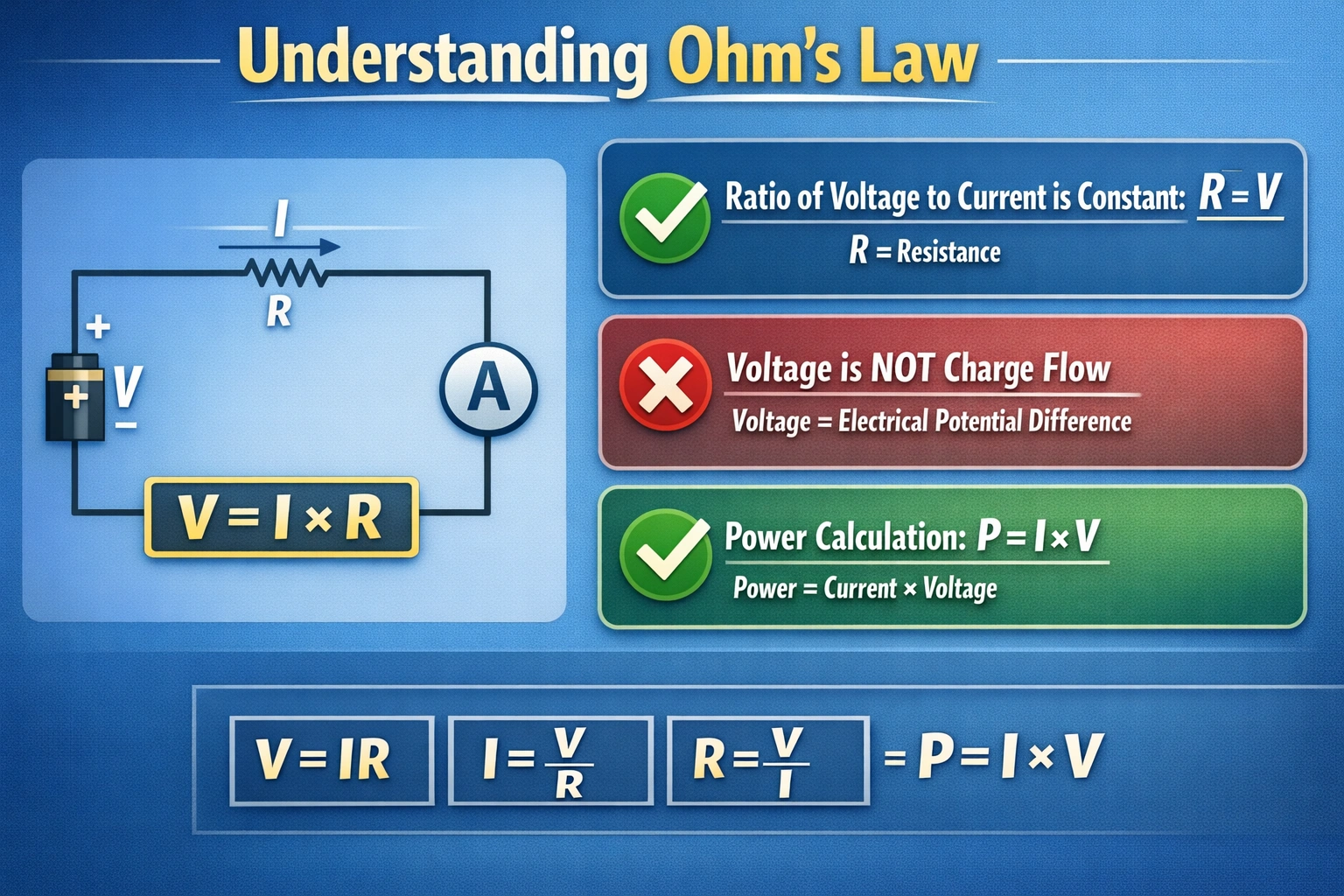
Which of these can you conclude from Ohm's law?
A.
Voltage and current are inversely proportional when resistance is constant.
B. The ratio of the potential difference between the ends of a conductor to current is a constant, R.
C. Voltage is the amount of charge that passes through a point per second.
D. Power (P) can be calculated by multiplying current (I) by voltage (V).
Rationale
Ohm's law establishes that the ratio of potential difference across a conductor to the current flowing through it equals a constant resistance, defining the fundamental voltage-current relationship for ohmic materials.
A) Voltage and current are inversely proportional when resistance is constant. This statement misrepresents Ohm's law. With constant resistance, voltage and current are directly proportional (V = IR), not inversely. Inverse proportionality would imply increasing voltage reduces current, contradicting both the equation and experimental observations of resistive circuits.
B) The ratio of the potential difference between the ends of a conductor to current is a constant, R. This statement precisely expresses Ohm's law: R = V/I, where resistance R remains constant for ohmic materials regardless of applied voltage or resulting current. This definition enables prediction of circuit behavior, component selection, and analysis of electrical systems from simple circuits to complex electronics.
C) Voltage is the amount of charge that passes through a point per second. This description confuses voltage with current. Current (I = Q/t) measures charge flow per time, while voltage represents electrical potential energy per charge. Conflating these distinct concepts undermines accurate circuit analysis and violates fundamental definitions in electromagnetism.
D) Power (P) can be calculated by multiplying current (I) by voltage (V). While P = IV is a valid power formula, it derives from energy conservation principles, not Ohm's law itself. Ohm's law (V = IR) relates voltage, current, and resistance; power calculations represent a separate, though related, electrical relationship. This option misattributes the source of the power equation.
Conclusion Ohm's law (V = IR) defines the linear relationship between voltage, current, and resistance for ohmic conductors, enabling circuit design, troubleshooting, and component specification. Recognizing that resistance equals the voltage-to-current ratio provides a foundational tool for analyzing electrical systems, from household wiring to microelectronic devices, while distinguishing Ohm's law from related but distinct principles like power calculation.
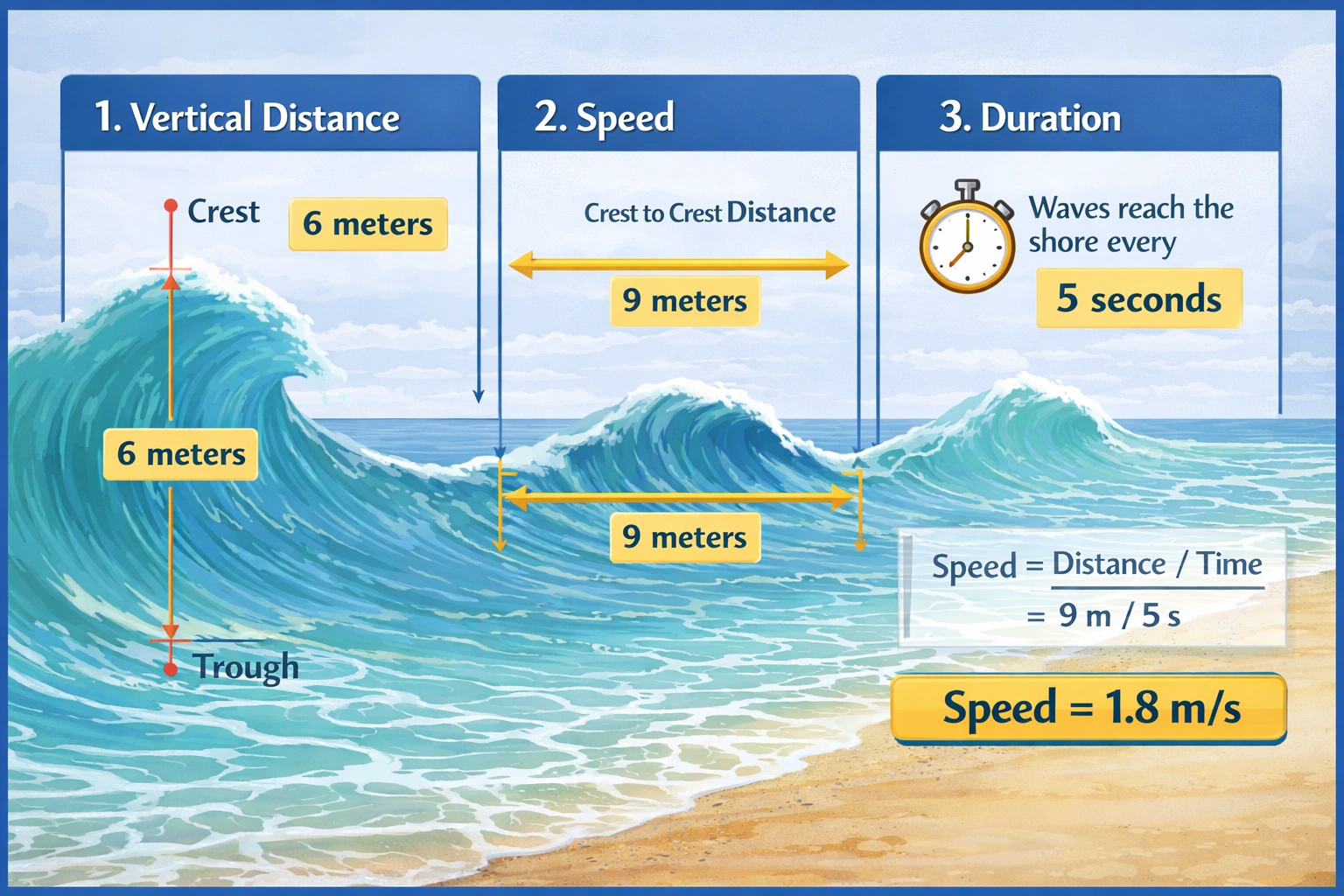
Ocean waves build during a storm until there is a vertical distance from high point to low of 6 meters and a horizontal distance of 9 meters between adjacent crests. The waves hit the shore every 5 seconds. What is the speed of the waves?
A.
1.2 m/s
B. 1.8 m/s
C. 2.0 m/s
D. 2.4 m/s
Rationale
The waves travel at 1.8 m/s, calculated by dividing the wavelength (9 meters between crests) by the period (5 seconds between wave arrivals).
A) 1.2 m/s This value incorrectly uses wave height (6 meters vertical distance) as wavelength or misapplies the wave speed formula. Wave speed depends on wavelength and period, not amplitude; using height instead of crest-to-crest distance yields an underestimated speed.
B) 1.8 m/s Wave speed (v) equals wavelength (λ) divided by period (T): v = λ/T. The horizontal distance between adjacent crests defines wavelength: λ = 9 m. The time between wave arrivals at shore defines period: T = 5 s. Thus, v = 9 m / 5 s = 1.8 m/s. This calculation correctly applies the fundamental wave relationship.
C) 2.0 m/s This option may arise from misreading wavelength as 10 meters or period as 4.5 seconds, but neither matches the given values. Accurate substitution of provided parameters into v = λ/T yields 1.8 m/s, not 2.0 m/s, highlighting the need for careful data extraction.
D) 2.4 m/s Multiplying wavelength and period (9 m x 5 s = 45 m÷s) or confusing frequency with period could produce this value, but such operations violate the wave speed formula. Speed requires division of wavelength by period, not multiplication or other combinations.
Conclusion Wave speed relates wavelength and period through v = λ/T (or equivalently v = fλ, where f = 1/T). This relationship enables prediction of wave behavior in oceans, sound, light, and other wave phenomena. Recognizing which measurements correspond to wavelength versus amplitude versus period prevents common errors and supports accurate analysis of wave energy transport and interference patterns.
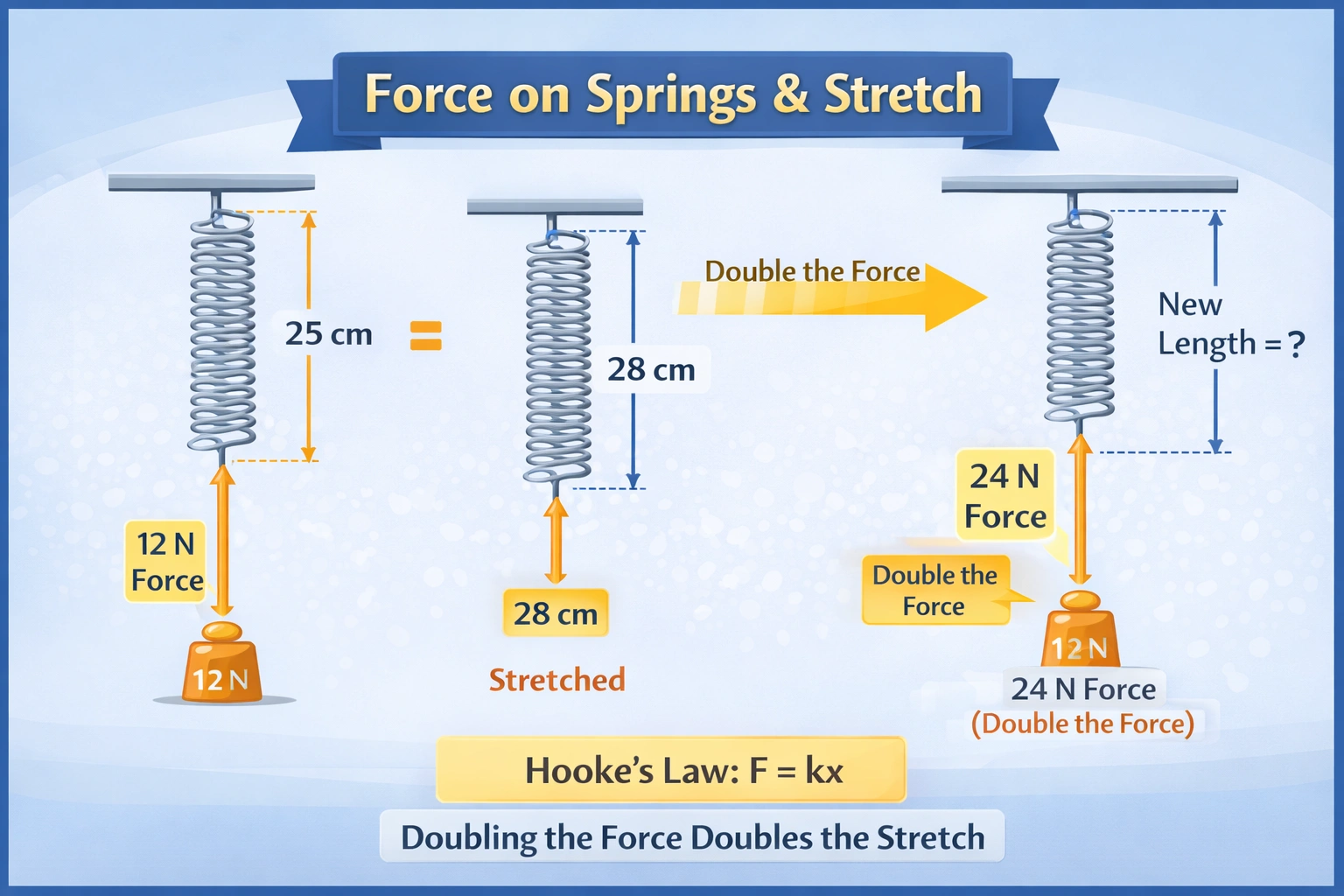
A 25-cm spring stretches to 28 cm when a force of 12 N is applied. What would its length be if that force were doubled?
A.
31 cm
B. 40 cm
C. 50 cm
D. 56 cm
Rationale
Doubling the applied force to 24 N extends the spring to 31 cm total length, as Hooke's law predicts linear extension proportional to force within elastic limits.
A) 31 cm Hooke's law states F = kx, where x is extension beyond natural length. Initial extension: 28 cm ˆ’ 25 cm = 3 cm under 12 N. Doubling force to 24 N doubles extension to 6 cm (assuming linear elasticity). Total length becomes natural length plus new extension: 25 cm + 6 cm = 31 cm. This calculation correctly applies proportional reasoning within Hookean behavior.
B) 40 cm This value incorrectly assumes extension scales with force squared or misapplies the spring constant. Doubling force should double extension (not quadruple it), making 40 cm an overestimate inconsistent with linear elastic response.
C) 50 cm Quintupling the extension (from 3 cm to 25 cm) would require quintupling the force (to 60 N), not doubling it. This option grossly overestimates the extension-force relationship, violating Hooke's law proportionality.
D) 56 cm Doubling the total length (28 cm †’ 56 cm) ignores that only the extension€”not the entire length€”scales with force. This misapplication of proportionality fails to distinguish natural length from elastic deformation, yielding a physically unrealistic result.
Conclusion Hooke's law (F = kx) describes linear elastic behavior: extension proportional to applied force within material limits. This principle enables spring design in suspensions, scales, and mechanical sensors. Recognizing that only the deformation (not total length) scales with force prevents common errors and supports accurate prediction of elastic system behavior under varying loads.
An object with a charge of 3 μC is placed 30 cm from another object with a charge of 2 μC. What is the magnitude of the resulting force between the objects?
A.
0.6 N
B. 0.18 N
C. 180 N
D. 9 x 10??? N
Rationale
The magnitude of the electrostatic force between the objects is 0.6 N, calculated using Coulomb's law with proper unit conversions for charge and distance.
A) 0.6 N Coulomb's law: F = k|q‚q‚‚|/r², where k = 8.99 x 10¹ N÷m²/C². Convert charges: 3 μC = 3 x 10»¶ C, 2 μC = 2 x 10»¶ C. Convert distance: 30 cm = 0.3 m. Calculate: F = (8.99x10¹) x (3x10»¶) x (2x10»¶) / (0.3)² = (8.99x10¹ x 6x10»¹²) / 0.09 = (5.394x10»²) / 0.09 ‰ˆ 0.599 N ‰ˆ 0.6 N. This calculation correctly applies Coulomb's law with SI unit conversions.
B) 0.18 N This value may arise from omitting the square on distance (using r instead of r²) or misplacing decimal points in charge conversion. Proper application of the inverse-square dependence and microcoulomb-to-coulomb conversion yields ~0.6 N, not 0.18 N.
C) 180 N Forgetting to convert centimeters to meters (using r = 30 instead of 0.3) inflates the denominator by 100² = 10,000, yielding a force 10,000x too large: ~0.6 N x 10,000 = 6000 N, not 180 N. Alternatively, misplacing exponents in charge conversion could produce intermediate errors, but 180 N remains inconsistent with correct calculation.
D) 9 x 10»¹² N This extremely small value suggests multiplying charges without Coulomb's constant or misapplying exponents. Coulomb's constant (‰ˆ9x10¹) amplifies the tiny microcoulomb products to measurable force levels; omitting it yields nonsensically small results unrelated to actual electrostatic interactions.
Conclusion Coulomb's law quantifies electrostatic force between point charges, requiring careful attention to unit conversions (μC to C, cm to m) and the inverse-square distance dependence. This fundamental law explains atomic structure, chemical bonding, and macroscopic electric phenomena. Mastering its application with proper dimensional analysis enables accurate prediction of electric forces across scales from subatomic particles to industrial electrostatic systems.
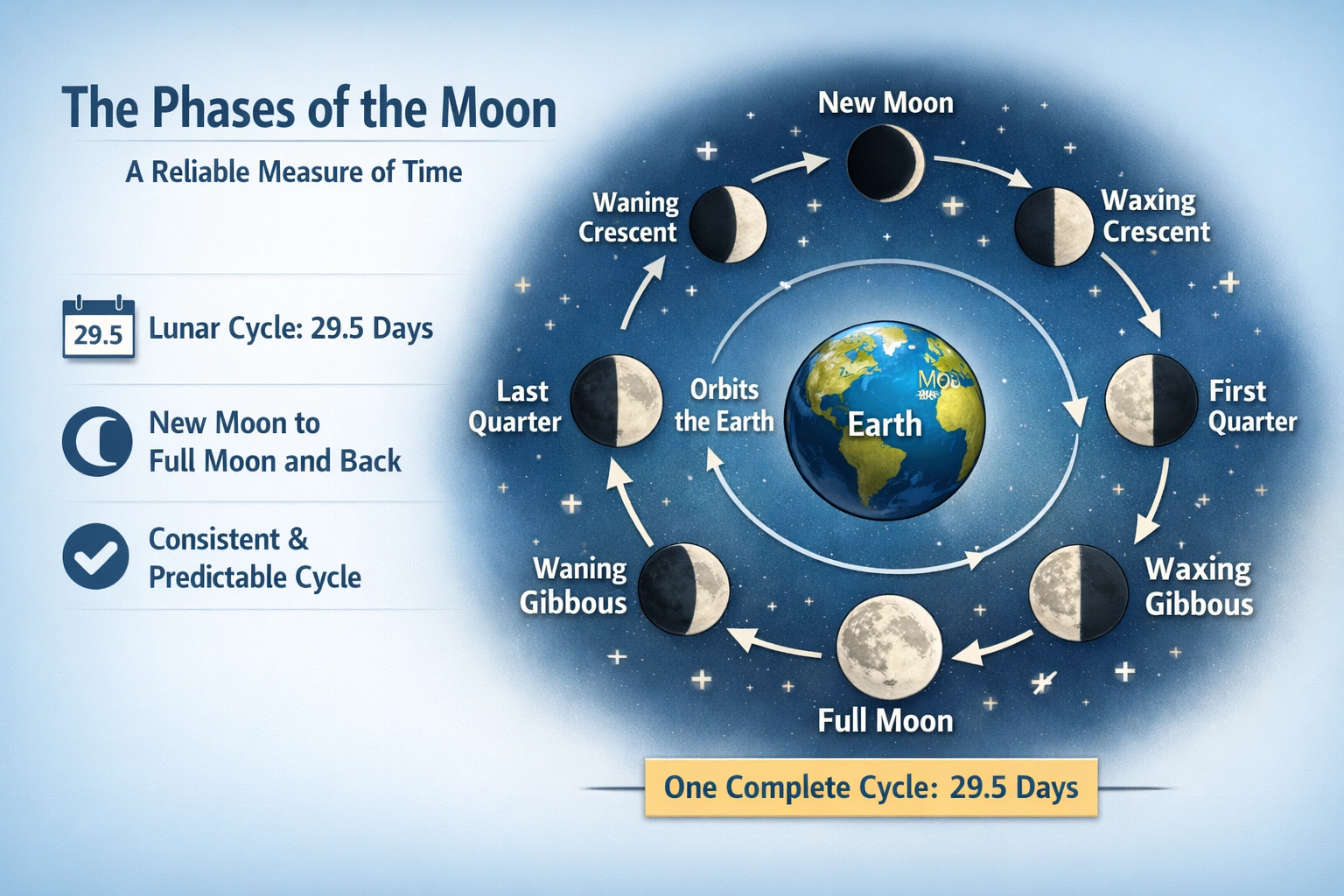
Which process could serve as a way to consistently measure time?
A.
The growth of a tree
B. The phases of the moon
C. The chirping of a cricket
D. The water height of a river
Rationale
The phases of the moon can consistently measure time.
A reliable measure of time requires a process that is periodic, predictable, and repeatable over long durations. The lunar cycle, from new moon to new moon, is an astronomical phenomenon with a remarkably stable period of approximately 29.5 days. This consistency arises from the precise orbital mechanics of the Moon around the Earth. Historical and cultural practices across civilizations have used lunar phases to construct calendars and mark the passage of months because the cycle offers a regular, observable, and celestial clock that is largely unaffected by terrestrial conditions.
A) The growth of a tree
Tree growth is influenced by a vast array of environmental and biological variables. Factors such as seasonal changes, availability of sunlight, water, soil nutrients, temperature fluctuations, and the presence of diseases or pests cause growth rates to vary significantly from year to year and even within a single season. A tree may exhibit rapid growth during a wet, nutrient-rich spring and almost no growth during a drought. This irregularity and dependence on uncontrolled external conditions make it impossible to use tree growth as a standard for marking equal, consistent intervals of time. It can indicate the passage of years in a general sense but cannot provide a precise, quantifiable unit for timekeeping.
B) The phases of the moon
The cyclical progression of the moon's phases€”new, waxing crescent, first quarter, waxing gibbous, full, waning gibbous, third quarter, waning crescent€”is governed by the moon's position relative to the Earth and Sun. This cycle is exceptionally regular due to the predictability of orbital motion. The synodic month (the time between successive new moons) averages 29.53 days, with minimal variation. This dependable periodicity allows the phases to serve as a consistent long-term timekeeper, enabling the tracking of weeks and months. Unlike biological or hydrological processes, the moon's motion is not subject to local environmental changes, making it a universal and stable reference.
C) The chirping of a cricket
The rate at which a cricket chirps is primarily a function of ambient temperature, a relationship formalized by Dolbear's Law. While this can be used to estimate temperature, it is an unsuitable standard for time. Chirping frequency varies with the immediate thermal environment, the species of cricket, its age, health, and even its immediate behavioral state. It is a biological response to a stimulus, not an intrinsic, invariant periodic process. Two crickets in different environments will chirp at different rates, and the same cricket will chirp faster on a warm night than a cool one. This variability precludes its use as a consistent timekeeping process.
D) The water height of a river
River height, or stage, is one of the most variable natural indicators. It is subject to dramatic and unpredictable fluctuations driven by rainfall, snowmelt, upstream dam releases, seasonal droughts, and human water usage. A river may rise rapidly during a storm and fall slowly over subsequent dry weeks. There is no regular, repeating cycle of equal time intervals associated with river height. While it can indicate seasonal patterns over many years, its day-to-day and even hour-to-hour changes are erratic and driven by highly variable weather and human activity, making it useless for consistent time measurement.
Conclusion
For a process to serve as a consistent timekeeper, it must be regular and independent of local, variable conditions. The growth of a tree, chirping of crickets, and height of a river are all intimately tied to environmental factors that change unpredictably. In contrast, the phases of the moon are governed by celestial mechanics, providing a stable, predictable, and observable cycle that repeats with great regularity. This astronomical predictability makes the lunar cycle a valid and historically significant process for consistently measuring the passage of time.
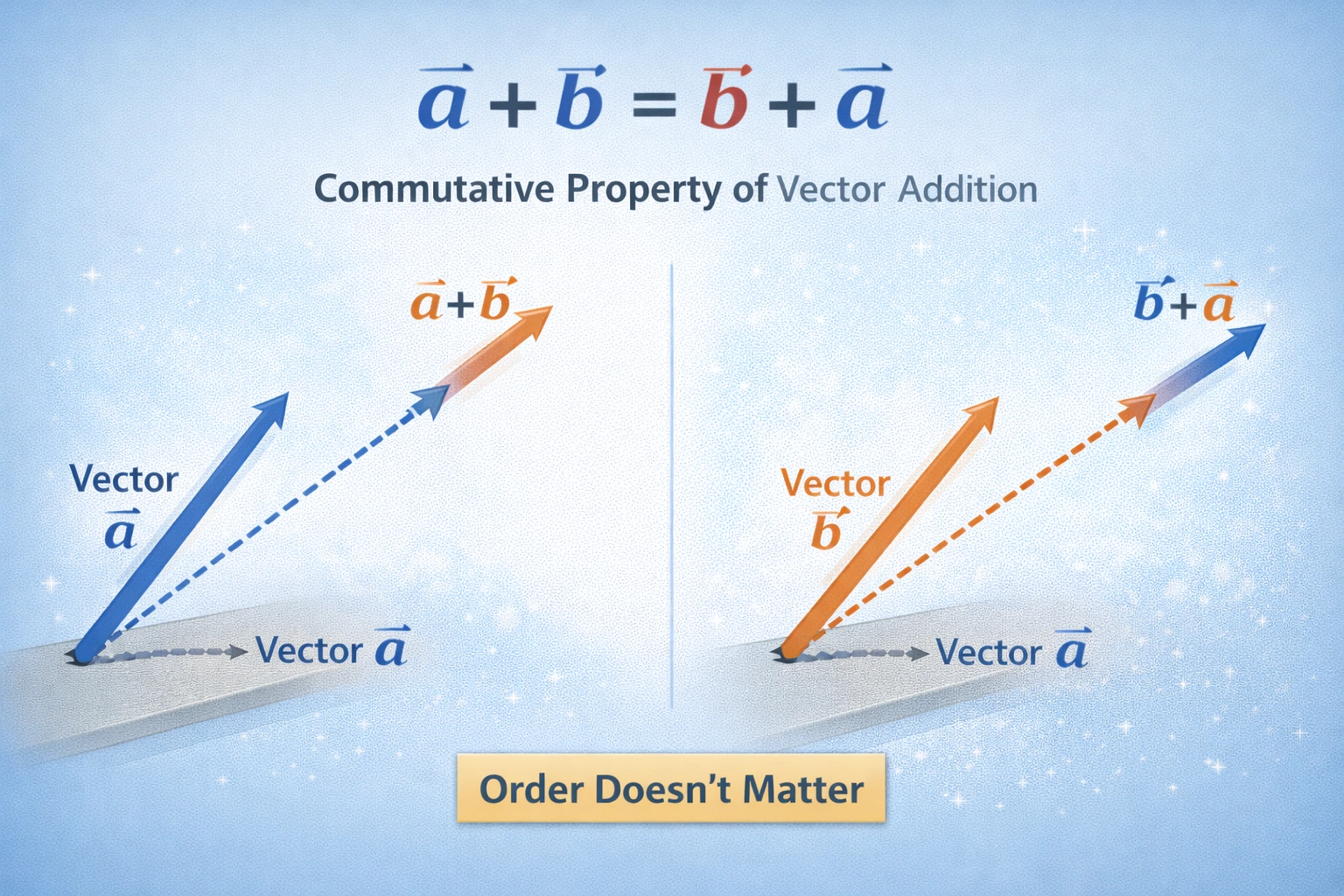
Given any two vectors a and b and any scalar c, which expression is always true?
A.
ca = cb
B. a + b = c
C. a - b = b - a
D. a + b = b + a
Rationale
The expression a + b = b + a is always true.
This question tests fundamental axioms of vector algebra. A statement that is "always true" for any vectors and any scalar must be a universal property, independent of the specific magnitudes, directions, or values chosen. Vector operations have defined rules concerning addition, subtraction, and scalar multiplication that are analogous to, but distinct from, regular arithmetic.
A) ca = cb
This equation is not an identity; it is a conditional statement that would only be true if the vectors a and b were themselves equal. Multiplying two different vectors by the same scalar results in two new vectors that are scaled versions of the originals. If a and b point in different directions or have different magnitudes, their scaled versions will also differ. This is not a property that holds for all arbitrary vectors.
B) a + b = c
This expression commits a dimensional or categorical error. The sum of two vectors (a + b) is another vector, a quantity possessing both magnitude and direction. A scalar (c) is a single real number with magnitude only. A vector cannot be universally equal to a scalar; they are different mathematical entities. This would be like saying "the displacement from New York to Boston equals the number 5."
C) a - b = b - a
Vector subtraction is not commutative. The operation a - b yields a vector that, when added to b, gives a. Conversely, b - a yields a vector that, when added to a, gives b. These two results are negatives of each other: a - b = -(b - a). They have equal magnitudes but point in exactly opposite directions. They are only equal in the special case where both are the zero vector, which requires a = b. This is not true for any two vectors.
D) a + b = b + a
This expresses the commutative property of vector addition. The order in which two vectors are added does not affect the resultant vector. Geometrically, whether you place the tail of b at the head of a, or the tail of a at the head of b, the vector from the start point to the end point (the resultant) is the same. This is a foundational rule in vector mathematics and is always valid.
Conclusion
Among the given expressions, only one represents a fundamental, universally applicable law of vector operations. The commutative property of addition is an axiom that holds for all vectors, regardless of their nature. The other options either impose unstated conditions (A), confuse different types of quantities (B), or assert a false property of subtraction (C). Therefore, a + b = b + a is the expression that is always true.
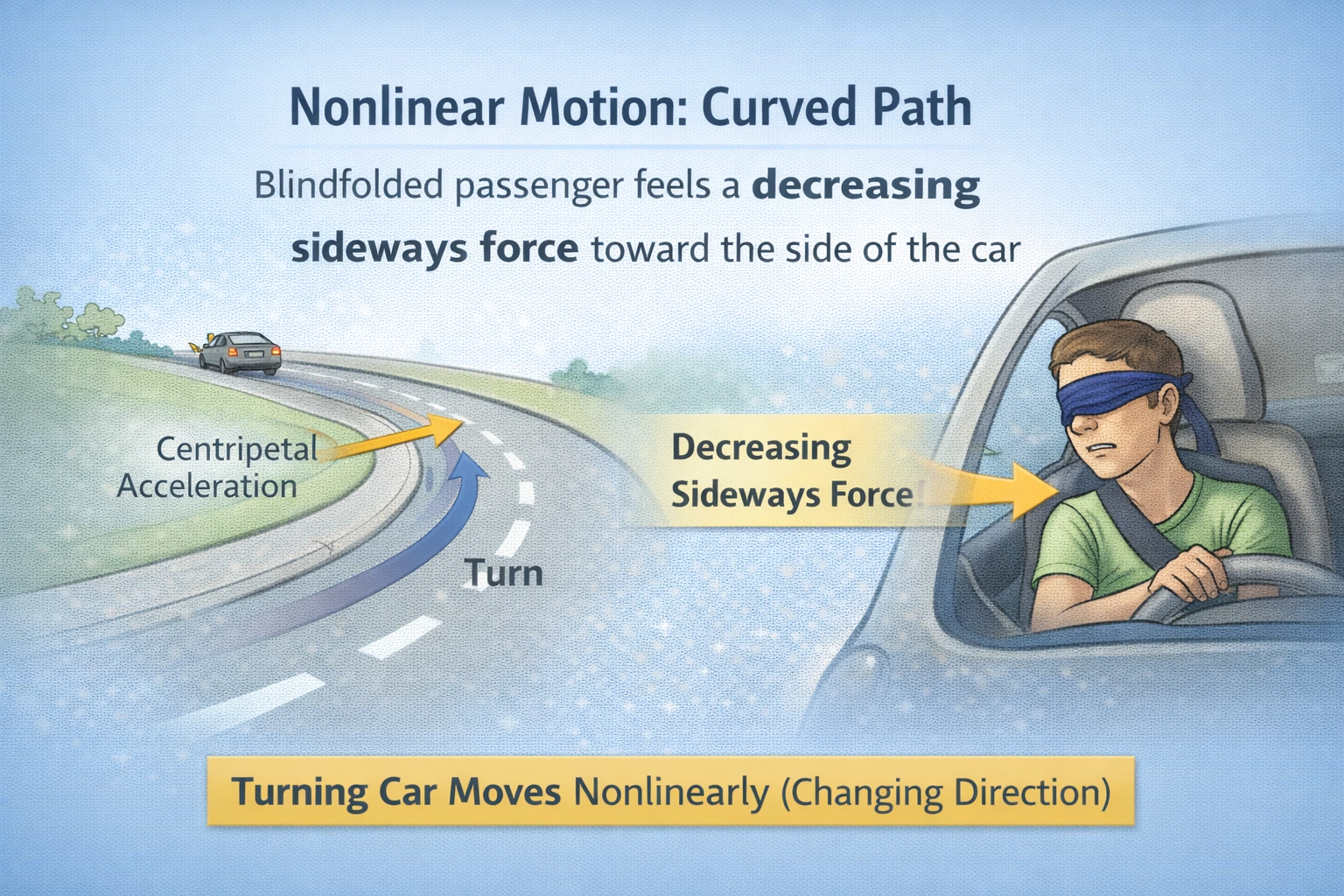
A student conducting a physics experiment drives a car with a blindfolded passenger and asks that passenger to determine whether the car's motion is linear or nonlinear. Which experience tells the passenger that the car is moving nonlinearly?
A.
The passenger feels no forces.
B. The passenger feels a constant backward force.
C. The passenger feels an increasing forward force.
D. The passenger feels a decreasing sideways force.
Rationale
The passenger feels a decreasing sideways force.
Linear motion is motion along a straight line, which can be at constant velocity or with acceleration/deceleration along that line. Nonlinear motion involves a change in direction, meaning the path is curved. According to Newton's laws, a passenger feels a force when the car accelerates (changes velocity). This "felt" force is often a reaction force from the seat or door as the passenger's body resists the change in motion due to inertia. The direction of the felt force indicates the direction of the car's acceleration relative to its current path.
A) The passenger feels no forces.
The sensation of feeling no net force occurs when the car is in an inertial frame of reference€”either at rest or moving with constant velocity in a straight line. This is the definition of linear motion without acceleration. Therefore, this experience indicates linear, not nonlinear, motion.
B) The passenger feels a constant backward force.
A constant force pushing the passenger back into the seat suggests the car is accelerating forward in a straight line. The passenger's body, due to inertia, tends to stay at rest relative to the ground, so the seat must push forward on the passenger to accelerate them with the car. The passenger perceives this as a backward force. Constant linear acceleration is still linear motion.
C) The passenger feels an increasing forward force.
An increasing forward force, perhaps from a seatbelt pressing against the chest, indicates the car is decelerating (negative acceleration) in a straight line. As the car slows down, the passenger's body continues forward at the original speed until restrained. The restraining force is directed forward relative to the passenger. Changing speed in a straight line is still linear motion.
D) The passenger feels a decreasing sideways force.
A sideways force is the critical indicator. When a car turns, it undergoes centripetal acceleration toward the inside of the curve. The passenger's body, due to inertia, tends to continue in a straight line, causing them to press against the side of the car (the door on the outside of the turn). The door exerts an inward (sideways) force on the passenger to keep them moving in the circle. Feeling any sideways force means the car's direction is changing, which is nonlinear motion. The fact that the force is decreasing suggests the turn is becoming gentler (the radius is increasing or speed is decreasing), but the mere presence of a sideways component confirms the path is curved at that moment.
Conclusion
Forces aligned with the car's forward-backward axis correspond to changes in speed along a straight path. Only a force with a component perpendicular to the car's forward axis€”a sideways force€”provides direct physical evidence that the car's direction is changing. Therefore, the sensation of a sideways force, even if it is decreasing, is the experience that informs the blindfolded passenger the motion is nonlinear.
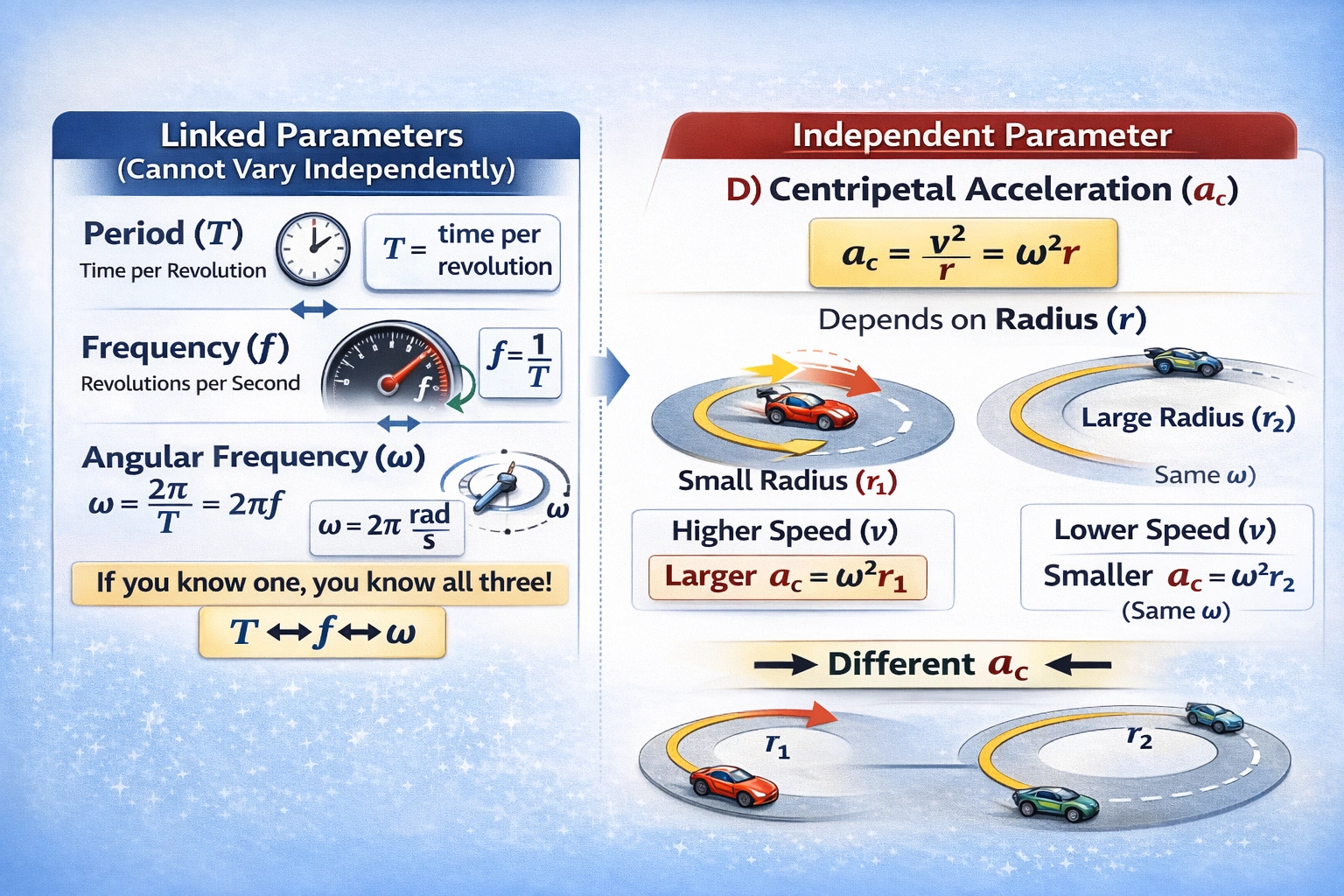
Which parameter of uniform circular motion can vary independently of the other three?
A.
Period
B. Frequency
C. Angular frequency
D. Centripetal acceleration
Rationale
Centripetal acceleration can vary independently of the period, frequency, and angular frequency.
In uniform circular motion, several kinematic parameters are rigidly linked by definition, describing the rate of rotation. However, centripetal acceleration depends not only on this rotational rate but also on the size of the circle (the radius). This introduces a second independent variable, allowing centripetal acceleration to change even if the rotational rate is fixed.
A) Period (T)
The period is the time to complete one full revolution. It is fundamentally linked to frequency and angular frequency. Specifically, T = 1/f and ω = 2π/T. If you specify the period, the frequency and angular frequency are immediately determined. They cannot vary independently of each other.
B) Frequency (f)
Frequency is the number of revolutions per unit time. It is the reciprocal of the period (f = 1/T) and is proportional to angular frequency (ω = 2πf). Like period, fixing the frequency automatically fixes the period and angular frequency. These three are different expressions of the same rotational rate.
C) Angular frequency (ω)
Angular frequency (or angular speed) measures the angle swept out per unit time, usually in radians per second. It is defined as ω = 2πf = 2π/T. It is inextricably tied to period and frequency; a change in one necessitates a proportional change in the others. They are a dependent set.
D) Centripetal acceleration (a_c)
Centripetal acceleration is given by a_c = ω²r or equivalently a_c = v²/r, where r is the radius. Crucially, it depends on two factors: the rotational rate (ω or v) and the radius r. Consider two objects in uniform circular motion with the same period (same T, f, and ω). If one moves in a circle with a larger radius, it must have a higher tangential speed (v = 2Ï€r/T). Because a_c = v²/r and v is proportional to r for constant T, the acceleration actually increases with radius (a_c = (4Ï€²/T²)r). Therefore, even with a fixed period/frequency/angular frequency, centripetal acceleration can be varied by changing the radius.
Conclusion
The period, frequency, and angular frequency are three faces of the same coin€”the rotational rate. They are locked in a fixed mutual relationship. Centripetal acceleration, however, incorporates an additional degree of freedom: the radius of the circular path. This allows centripetal acceleration to change independently of the other three parameters. For example, a car taking a tight turn at a given speed (high a_c) and a ship making a wide turn at the same rotational rate (low a_c) can have the same period but different centripetal accelerations.
Which situation falls in the domain of optics?
A.
Magnification of an object by a lens
B. Propagation of sound through a solid material
C. Diffraction of ocean waves at the entrance to a cove
D. Refraction of seismic waves caused by an earthquake
Rationale
The magnification of an object by a lens falls in the domain of optics.
Optics is the branch of physics that studies the behavior and properties of light, including its interactions with matter and the instruments used to detect or manipulate it. It encompasses phenomena such as reflection, refraction, diffraction, interference, and polarization of light, as well as the design and function of optical devices like lenses, mirrors, prisms, and telescopes.
A) Magnification of an object by a lens
This is a quintessential topic in geometric optics. Lenses are transparent objects with curved surfaces that refract light rays to form images. The principles governing magnification€”how much larger or smaller an image appears compared to the object€”are central to the design of eyeglasses, microscopes, cameras, and binoculars. This is firmly within the domain of optics.
B) Propagation of sound through a solid material
Sound is a mechanical wave that requires a physical medium (solid, liquid, or gas) for propagation. The study of sound waves, including their speed, reflection, refraction, and absorption, belongs to the field of acoustics, which is a sub-discipline of mechanics or wave physics, not optics. Optics deals specifically with electromagnetic waves, primarily in the visible spectrum.
C) Diffraction of ocean waves at the entrance to a cove
Diffraction is a general wave phenomenon where waves spread out as they pass through an opening or around an obstacle. While light also exhibits diffraction, the diffraction of ocean (water) waves is studied in fluid dynamics and coastal engineering. This is a topic in geophysics or classical wave mechanics, not in optics, which is concerned with light waves.
D) Refraction of seismic waves caused by an earthquake
Seismic waves are mechanical waves generated by earthquakes that travel through the Earth's layers. Their refraction (bending) occurs when they pass between materials of different densities and elastic properties. This is a key concept in seismology and geology, used to probe Earth's internal structure. Refraction of light is optical, but refraction of seismic waves is not.
Conclusion
The defining scope of optics is the study of light. Magnification by a lens is a classic example of manipulating light rays. The other options involve different types of waves€”sound, water, and seismic€”each studied in their own distinct branches of physics (acoustics, fluid dynamics, and seismology, respectively).

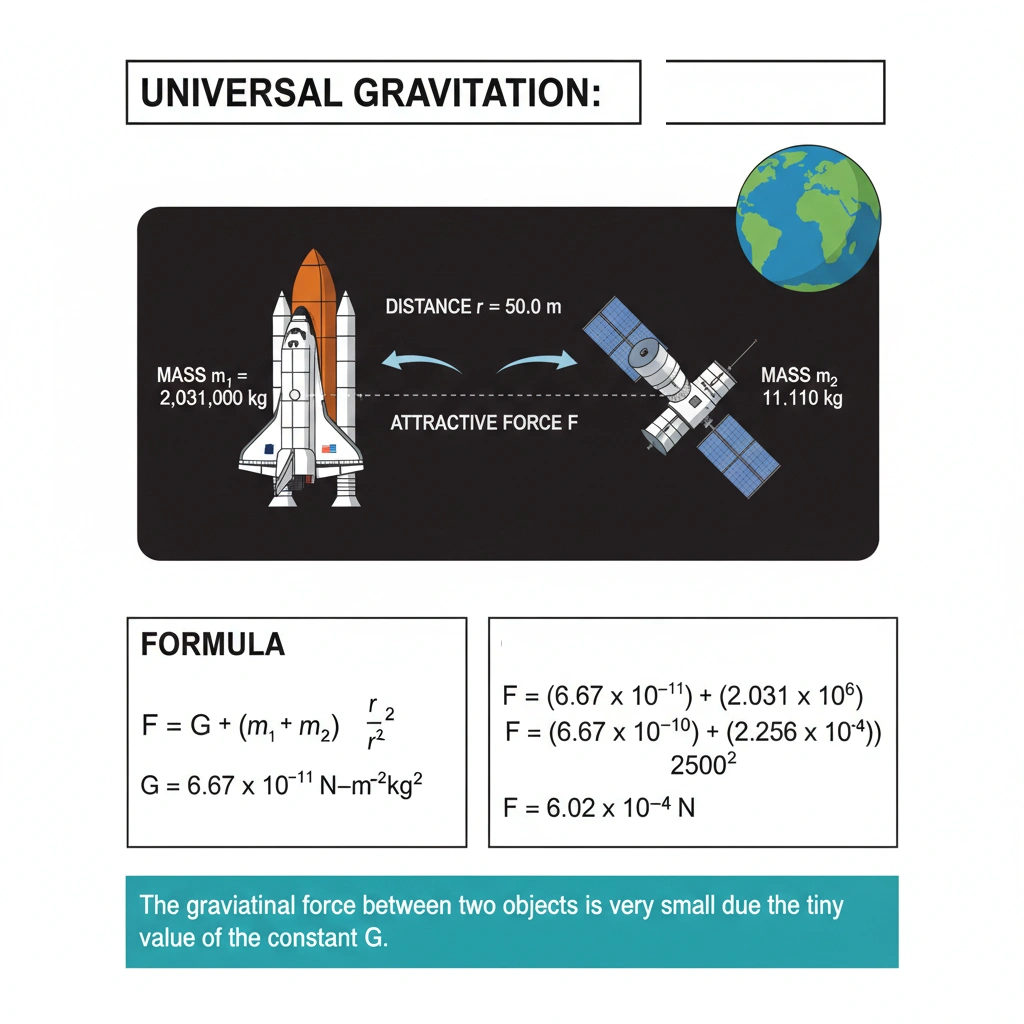
What is the gravitational attraction force between the space shuttle (2,031,000 kg) and the Hubble Space Telescope (11,110 kg) when they are 50.0 m apart?
A.
6.02x10?? N
B. 6.02 N
C. 60.2 N
D. 6.02x10? N
Rationale
The gravitational attraction force is 6.02×10?? N.
Newton's Law of Universal Gravitation states that every two masses attract each other with a force proportional to the product of their masses and inversely proportional to the square of the distance between their centers: F = Gm?m?/r². The gravitational constant G is very small: G = 6.67×10?¹¹ N·m²/kg². This results in extremely weak forces for human-scale masses unless they are planetary in size.
A) 6.02×10?? N
Perform the calculation:
m? = 2.031×10? kg
m? = 1.111×10? kg
r = 50.0 m
First, compute the product of the masses: (2.031×10?)(1.111×10?) = 2.256×10¹? kg².
Then, divide by r² = (50.0)² = 2500 m²: (2.256×10¹?)/2500 = 9.024×10? kg².
Now multiply by G: (6.67×10?¹¹) × (9.024×10?) ? 6.02×10?? N.
This tiny force, about 0.0006 newtons, is equivalent to the weight of a few grains of sand on Earth. It is imperceptible but non-zero.
B) 6.02 N
This is off by a factor of 10,000 from the correct answer. It might result from forgetting to square the distance in the denominator or from a major error in handling the powers of ten, such as using G = 6.67×10??.
C) 60.2 N
This is off by a factor of 100,000. It could come from miscalculating the product of the masses as 2.2×10¹¹ or from using r = 5.0 m instead of 50.0 m.
D) 6.02×10? N (60,200 N)
This enormous force, equivalent to the weight of a 6-metric-ton object on Earth, is off by a factor of 10?. This would result from essentially ignoring the 10?¹¹ exponent in G (treating G as roughly 1), or from a severe calculation error like multiplying masses and G but forgetting to divide by r².
Conclusion
The extreme smallness of the gravitational constant G means gravitational forces between everyday or even large human-made objects are minuscule unless the masses are astronomical. The precise calculation using the law of universal gravitation yields a force on the order of 10?? newtons for these masses separated by 50 meters.
What is the height above ground of a 55 g egg that possesses 0.27 J of potential energy?
A.
0.00050 m
B. 0.0050 m
C. 0.050 m
D. 0.50 m
Rationale
The height of the egg is 0.50 meters.
Gravitational potential energy (PE) near Earth's surface is given by PE = mgh, where m is mass, g is the acceleration due to gravity (approximately 9.8 m/s²), and h is the height above a reference point (ground). To find height, rearrange the formula: h = PE/(mg). The crucial step is converting the mass from grams to kilograms before calculation, as the joule (J) is a kg·m²/s² unit.
A) 0.00050 m (0.5 mm)
This very small height results from a critical unit error: using mass as 55 kg instead of 0.055 kg. Calculation: h = 0.27/(55 x 9.8) ‰ˆ 0.27/539 ‰ˆ 0.0005m. This mistake uses grams directly without conversion.
B) 0.0050 m (5.0 mm)
This is also too small. It could come from using g = 10m/s² and making a decimal error: h = 0.27/(0.055 x 10) = 0.27/0.55 ‰ˆ 0.49m, but then incorrectly reporting it as 0.005 m. Or, it might result from dividing by 1000 twice during conversion.
C) 0.050 m (5.0 cm)
This is an order of magnitude too low. It might stem from using g = 98m/s² (forgetting the decimal in 9.8) in the calculation: h = 0.27/(0.055 x 98) ‰ˆ 0.27/5.39 ‰ˆ 0.050m.
D) 0.50 m (50 cm)
First, convert mass: 55g = 0.055kg.
Then, h = PE/(mg) = 0.27J/(0.055kg x 9.8m/s²).
Compute denominator: 0.055 x 9.8 = 0.539 kg·m/s² (or N).
Then, h = 0.27/0.539 ‰ˆ 0.501m, which rounds to 0.50 m.
This is a reasonable height from which to drop an egg.
Conclusion
Correct application of the potential energy formula requires consistent SI units. Converting 55 g to 0.055 kg and using g = 9.8m/s² yields a height of approximately 0.50 meters for the egg to have 0.27 J of energy. The incorrect options primarily arise from unit conversion errors or mistakes in handling the gravitational constant.
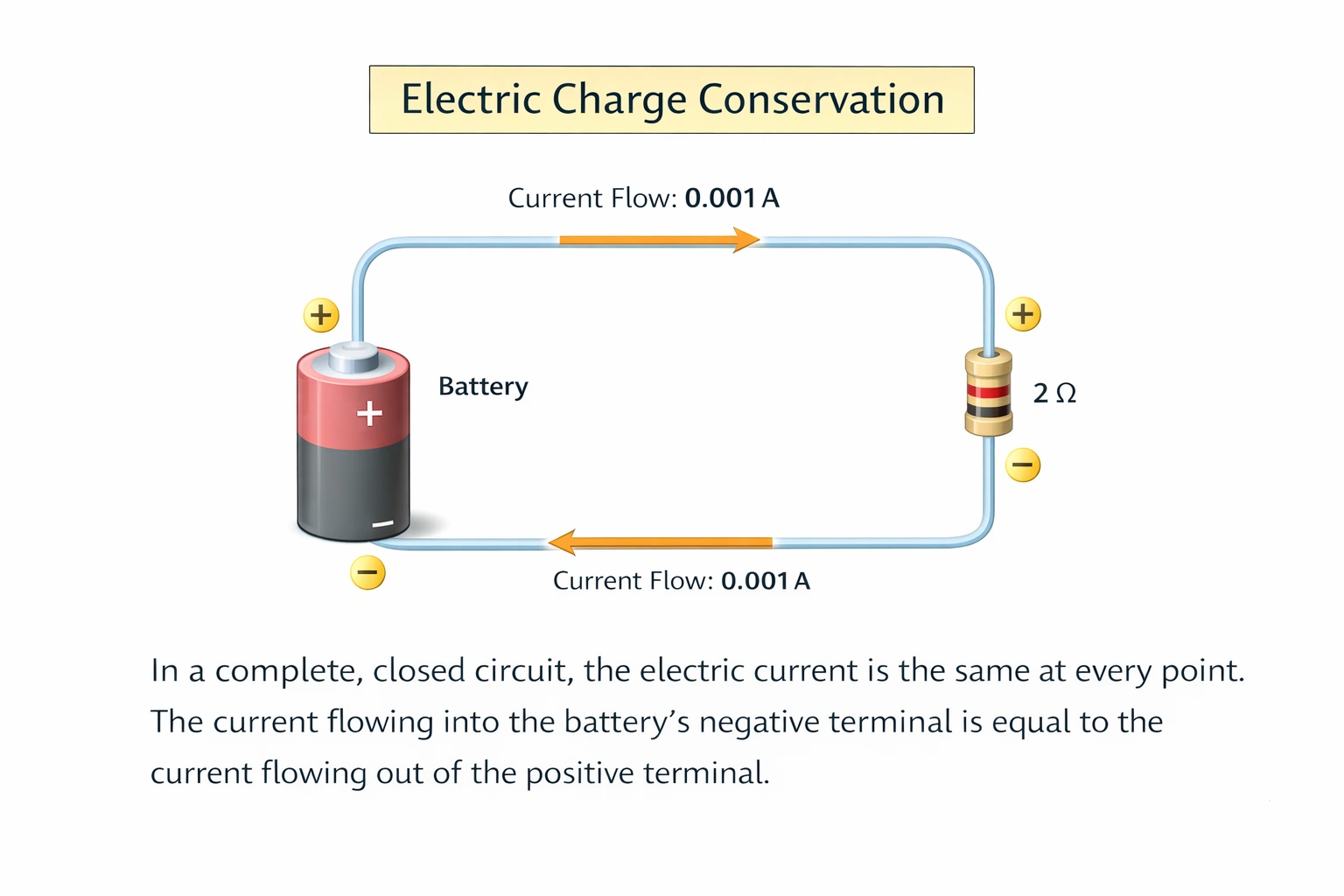
A circuit contains a battery and a 2-ohm resistor. If 0.001 amps of current flow from the battery's positive terminal how much current flows back into its negative terminal?
A.
0 amps
B. 0.0005 amps
C. 0.001 amps
D. 0.002 amps
Rationale
The current flowing back into the battery's negative terminal is 0.001 amps.
This question tests the principle of charge conservation in a simple series circuit. In a steady-state direct current (DC) circuit with a single, continuous loop, charge is neither created nor destroyed, and it does not accumulate at any point. Therefore, the rate at which charge leaves the battery's positive terminal must equal the rate at which charge returns to the negative terminal. The current, which is the rate of charge flow, is constant throughout the entire loop. This is true regardless of the components (like resistors) in the loop; they reduce voltage (potential) but do not "use up" current.
A) 0 amps
This would imply that charge exiting the positive terminal never returns, violating the law of conservation of electric charge. In a closed circuit, charge must complete a loop; otherwise, it would quickly build up on one terminal, stopping the flow almost instantly.
B) 0.0005 amps
There is no physical mechanism in a simple series circuit that halves the current at the return point. Current is determined by the battery's voltage and the total resistance (Ohm's Law: I = V/R). This value is constant at every point in a series circuit. Splitting or halving of current only occurs at junctions in parallel circuits, which are not present here.
C) 0.001 amps
This is correct. In a single-loop series circuit, the current is the same everywhere. The 0.001 A measured leaving the positive terminal is the same current that flows through the 2-ohm resistor and the same current that flows back into the negative terminal. The battery's role is to provide energy to the charges, not to consume them; it pumps them around the loop at a constant rate.
D) 0.002 amps
This would imply the current doubles upon return, which would require the creation of additional charge within the circuit€”an impossibility. It might stem from mistakenly thinking that current adds up from different branches, but there is only one path here.
Conclusion
For a continuous, unbranched conductor forming a closed loop with a battery, the current is uniform at all points due to conservation of charge. Therefore, the current returning to the battery's negative terminal is identical to the current leaving its positive terminal: 0.001 A.
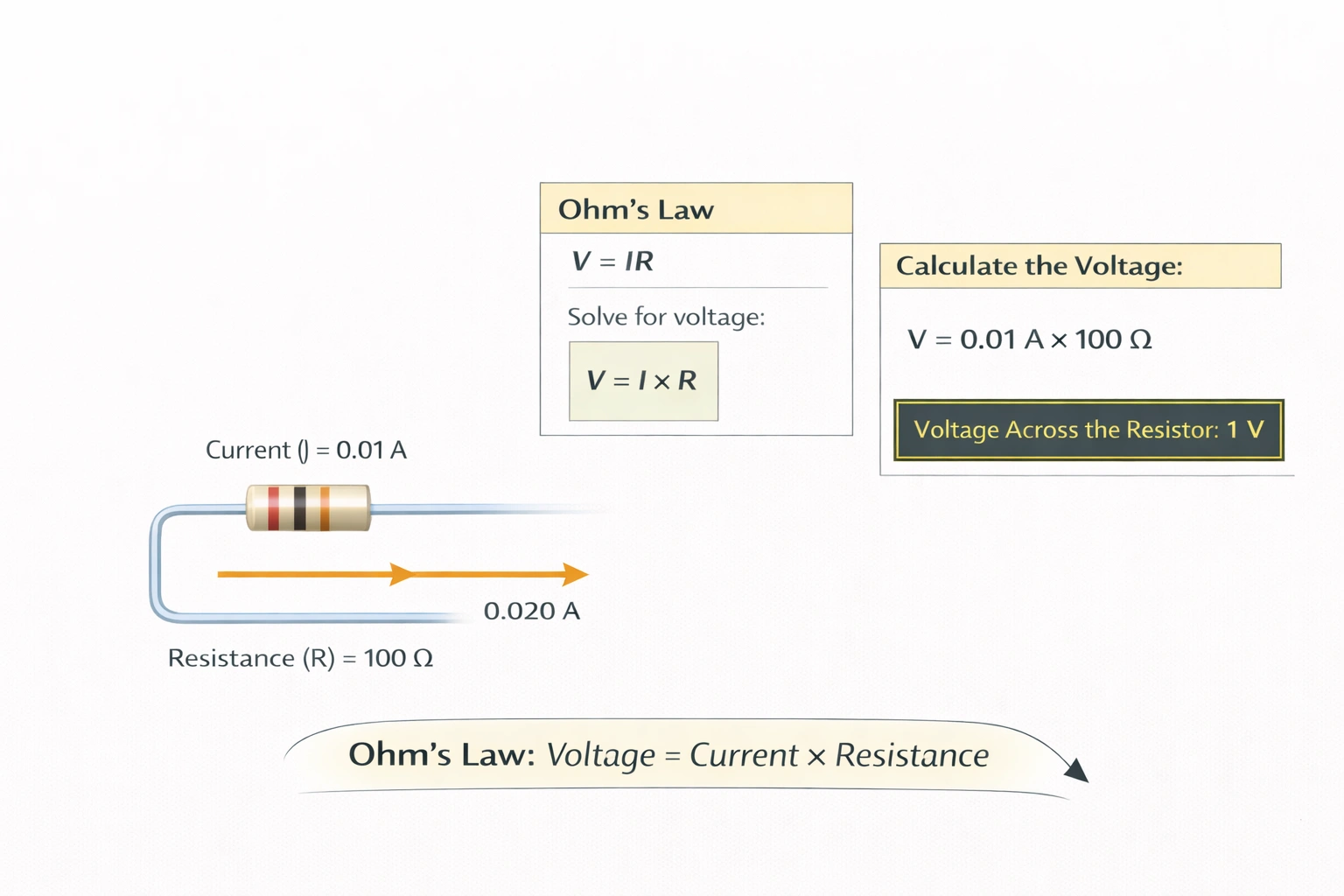
A 100-ohm resistor has a current of 0.01 amps flowing through it. What is the voltage across the resistor?
A.
0.01 volts
B. 1 volt
C. 100 volts
D. 10,000 volts
Rationale
The voltage across the resistor is 1 volt.
Again, this is a direct use of Ohm's Law: V = IR. Multiply the current by the resistance to find the voltage drop across the resistor.
A) 0.01 volts
This results from either using the current value alone (0.01 V) or from dividing resistance by current (R/I = 100/0.01 = 10,000) and then misinterpreting the result. It does not follow the correct formula.
B) 1 volt
Correct calculation: V = IR = 0.01A x 100Ω = 1.0V. This is a simple multiplication: 0.01 times 100 equals 1.
C) 100 volts
This is the resistance value itself, not the product. It comes from ignoring the current or mistakenly setting V = R.
D) 10,000 volts
This results from dividing resistance by current: 100Ω/0.01A = 10,000V/A = 10,000V. This inverts Ohm's Law. Such a high voltage across a 100 Ω resistor would produce a current of 100 A, not 0.01 A.
Conclusion
Ohm's Law is fundamental to circuit analysis. For a resistor, the voltage is the product of current and resistance. With I = 0.01A and R = 100Ω, the voltage is 1.0 V. The other answers represent common errors: using the wrong operand, ignoring one variable, or inverting the relationship.
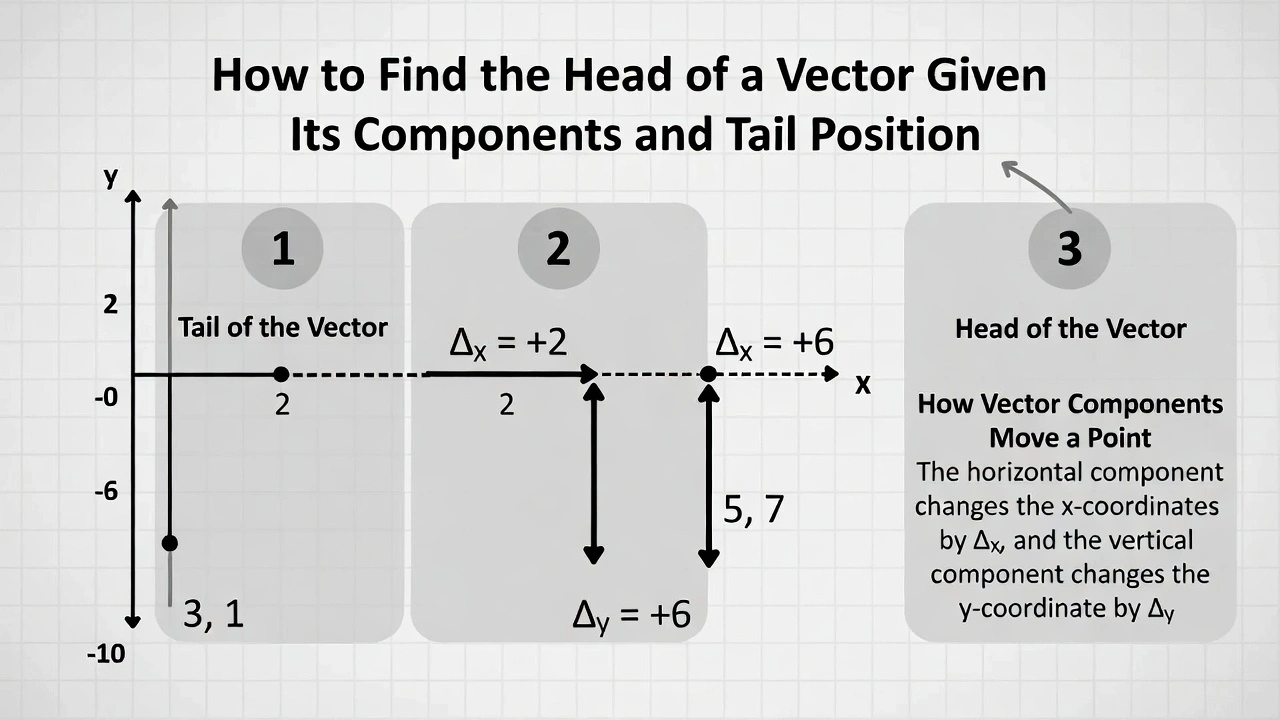
Vector (2, 6) appears on a graph with its tail at (3, 1). What are the coordinates of its head?
A.
(-1, 5)
B. (1, -5)
C. (5, 7)
D. (6, 6)
Rationale
The head of the vector is located at the coordinates (5, 7).
A vector in a coordinate plane is defined by its components, which specify the change in the x-coordinate and the change in the y-coordinate from its tail to its head. The vector (2, 6) indicates a displacement of +2 units horizontally and +6 units vertically. To find the terminal point (head), this displacement is added to the initial point (tail). This process is a direct application of translating a point by a given vector.
A) (-1, 5)
These coordinates are derived from incorrectly subtracting the vector's components from the tail's coordinates: 3 ? 2 = 1 and 1 ? 6 = -5. This does not yield (-1, 5) with the given numbers, but more importantly, the method itself is flawed. Subtracting the displacement finds a point such that the vector from that new point to the tail would be (2, 6). This reverses the intended direction of the vector. The operation effectively solves for a starting point given an endpoint and a displacement, which is not the task.
B) (1, -5)
This result comes from the same erroneous subtraction operation: x_head = 3 ? 2 = 1, y_head = 1 ? 6 = -5. The point (1, -5) lies in the fourth quadrant. Given the positive components of the vector (2, 6), the head should be located in the first quadrant relative to the tail at (3, 1). This outcome represents a fundamental misinterpretation of how vectors are positioned graphically; it provides the coordinates of a different vector's tail, not the head of the given vector.
C) (5, 7)
This is obtained through the correct calculation: adding the vector's components to the tail's coordinates.
x_head = x_tail + v_x = 3 + 2 = 5
y_head = y_tail + v_y = 1 + 6 = 7
The point (5, 7) is precisely two units to the right and six units above the point (3, 1). This perfectly represents the graphical translation dictated by the vector (2, 6).
D) (6, 6)
These coordinates do not correspond to any standard vector addition or subtraction with the given numbers. It might stem from an arithmetic error, such as mistakenly adding the x-component to both coordinates (3+2=5, 1+2=3, not 6) or from incorrectly swapping or doubling components. No valid manipulation of the numbers (3,1) and (2,6) yields (6,6) as the head.
Conclusion
The location of a vector's head is found by applying the vector's displacement to its tail. Subtraction finds a different point in the vector's lineage. For a tail at (3, 1) and a displacement of (2, 6), the only coherent result for the head is (5, 7).
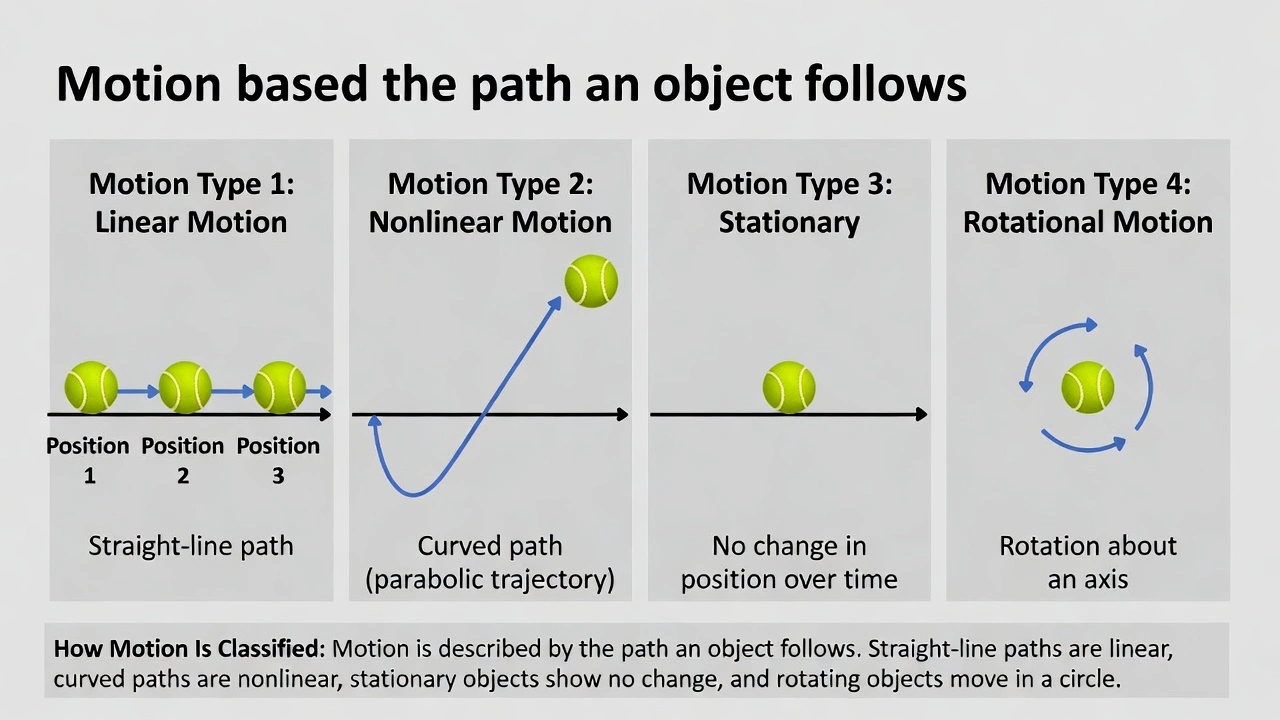
A softball player throws a ball at a moderately upward angle to the ground. Which term best describes the motion of the ball?
A.
Linear
B. Nonlinear
C. Stationary
D. Rotational
Rationale
The motion of the ball is best described as nonlinear.
Categorizing motion depends on the path an object follows. A ball thrown at an angle to the horizontal is a projectile. Its trajectory is governed by an initial velocity and the constant downward acceleration due to gravity. The path resulting from this combination is a curve, specifically a parabola. Any motion that is not along a straight line is classified as nonlinear or curvilinear.
A) Linear
Linear motion implies movement along a straight-line path, where the direction of the velocity vector does not change. For a thrown ball, gravity acts perpendicular to the initial horizontal motion, continuously altering the vertical component of velocity. This change in the velocity vector's direction causes the path to bend. Even if thrown perfectly vertically, the motion would be linear only in one dimension, but a "moderately upward angle" implies both horizontal and vertical components, guaranteeing a curved path. Therefore, linear is an inaccurate descriptor.
B) Nonlinear
This term encompasses any motion where the path is not a straight line. The ball's parabolic arc is a specific, smooth example of nonlinear motion. The label "nonlinear" is broad and accurate; it does not specify the type of curve but correctly identifies that the trajectory deviates from linearity. In physics, projectile motion is a standard example of two-dimensional motion with a curved, nonlinear trajectory.
C) Stationary
A stationary object is at rest; its position does not change with time. A thrown ball is clearly in motion it leaves the thrower's hand, travels through the air, and changes its position continuously. It possesses kinetic energy and momentum. Describing it as stationary contradicts the very act of throwing.
D) Rotational
Rotational motion specifically refers to an object spinning around an internal axis (like a rotating wheel) or revolving around an external point at a fixed distance (like a planet in orbit). While the softball may have rotational spin about its own center, the question concerns the motion of the ball's center of mass through space. This translational motion is along a curved path, but it is not orbital or revolving around a fixed external center point. The path is a parabola under gravity, not a circle or ellipse centered on another body.
Conclusion
The defining characteristic is the shape of the path. Gravity ensures the path is curved, disqualifying linear motion. The ball is visibly moving, so it is not stationary. The curvature is not due to revolution around an external point, so it is not rotational. The most accurate and encompassing term for any curved path, including a parabola, is nonlinear.
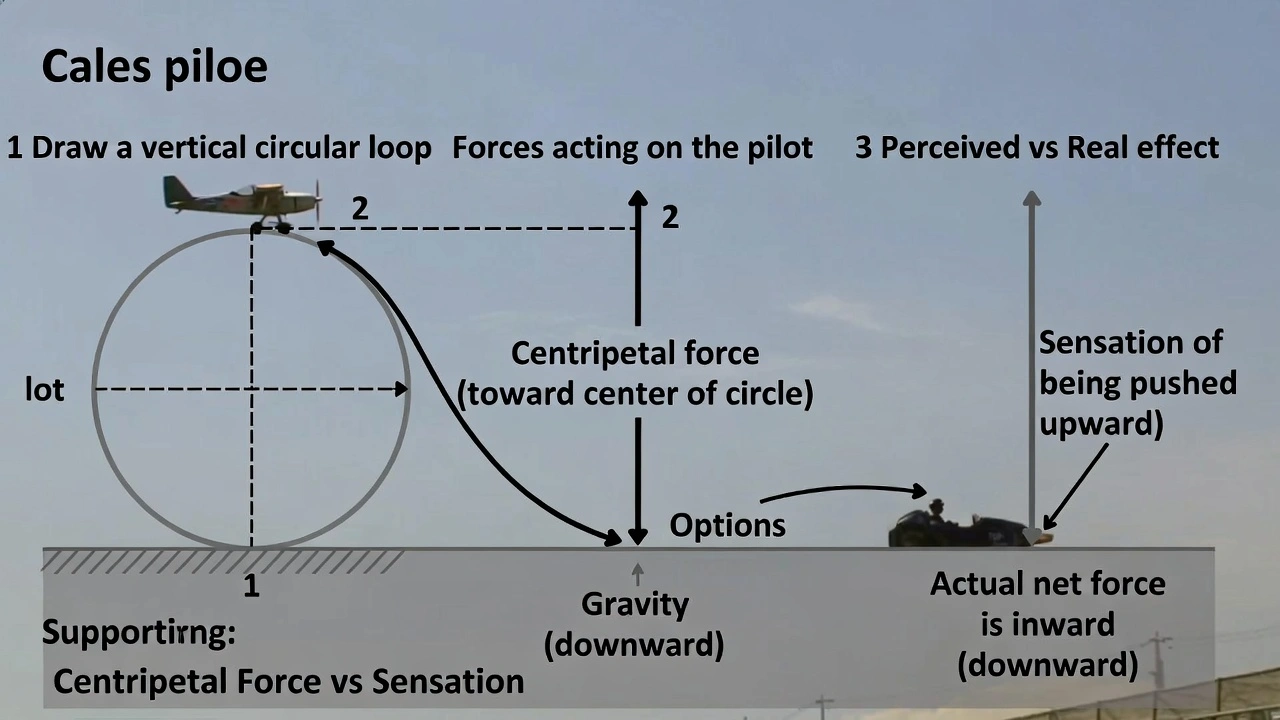
If a stunt airplane pilot is performing a circular loop and at a certain point feels like she is being pushed upward by a force, what is the direction of the centripetal force?
A.
Up
B. Down
C. Lateral
D. Forward
Rationale
The centripetal force is directed downward.
This question distinguishes between the real, physical centripetal force causing circular motion and the apparent, inertial (centrifugal) force felt in the accelerating reference frame of the pilot. The sensation of being "pushed" is not due to a real outward force but is the body's inertia resisting the change in direction. The real net force is centripetal, directed inward toward the center of the loop.
A) Up
The feeling of being pushed upward against her seat is the apparent centrifugal sensation. In the pilot's non-inertial frame of reference (the plane), it feels as if a force is pushing her upward. However, no such external upward force exists. This sensation is a consequence of her body's tendency to continue moving in a straight line tangent to the circle, while the seat pushes her inward. The actual force from the seat is downward.
B) Down
At the top of a vertical loop, the center of the circle is located below the airplane. To keep the plane moving in its circular path, the net force acting on it (and the pilot) must be directed downward, toward that center. This net force is the centripetal force. It is provided by a combination of factors: gravity acts downward, and the lift from the wings or the seat's restraint provides an additional downward force component. This inward (downward) net force causes the pilot to feel pressed upward into her seat—the seat is pushing down on her, and she experiences the equal and opposite reaction force upward.
C) Lateral
A lateral (sideways) force would not produce a vertical circular loop. It would cause the plane to bank or turn horizontally. For a vertical loop in a single plane, the centripetal force must lie within that vertical plane. At the very top of the loop, any lateral component would tilt the plane out of its intended vertical path.
D) Forward
A forward force in the direction of motion would be a tangential force, changing the plane's speed but not its direction. Circular motion requires a force perpendicular to the velocity to change direction, not one parallel to it. Thrust provides forward force to overcome drag and maintain speed, but it is not the centripetal force responsible for the turn.
Conclusion
The physical force responsible for circular motion is always centripetal radially inward. The sensation of an outward push is an inertial effect. At the top of a loop, the center is below, so the inward radial direction is downward. Therefore, the centripetal force is downward.
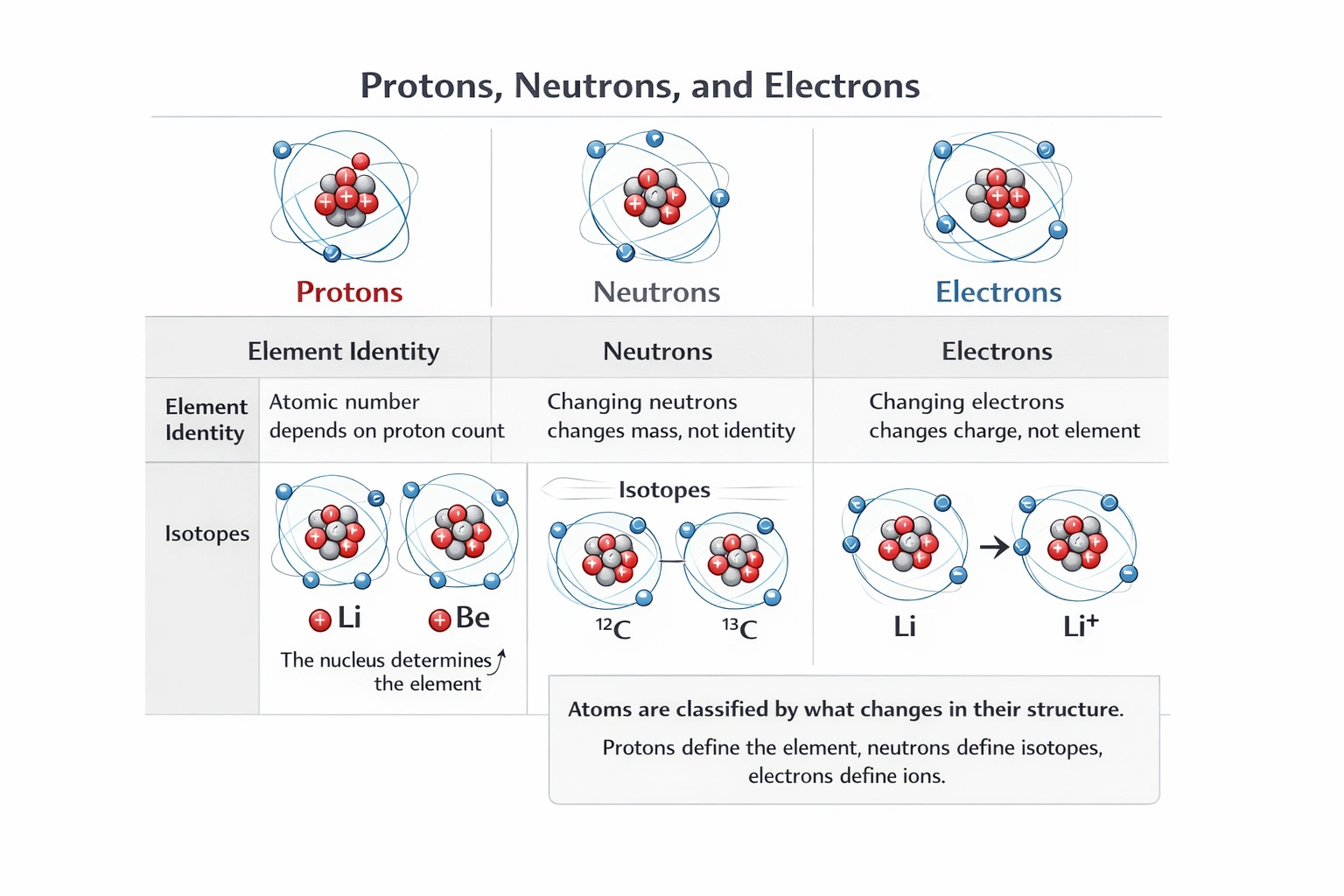
Which two atoms are the same element?
A.
One atom with 4 protons, 4 neutrons, and 3 electrons, and one atom with 3 protons, 4 neutrons, and 3 electrons
B. One atom with 3 protons, 4 neutrons, and 3 electrons, and one atom with 3 protons, 3 neutrons, and 3 electrons
C. One atom with 3 protons, 4 neutrons, and 3 electrons, and one atom with 4 protons, 3 neutrons, and 3 electrons
D. One atom with 4 protons, 4 neutrons, and 3 electrons, and one atom with 3 protons, 3 neutrons, and 4 electrons
Rationale
Both atoms in option B have 3 protons, identifying them as the same element.
The identity of an element is determined solely by the number of protons in its nucleus, known as the atomic number. This number defines the element's place in the periodic table and its fundamental chemical properties. Variations in neutron count create different isotopes of the same element, which have the same atomic number but different mass numbers. Variations in electron count create ions, which are charged atoms of the same element.
A) One atom with 4 protons, 4 neutrons, and 3 electrons, and one atom with 3 protons, 4 neutrons, and 3 electrons
These atoms have different atomic numbers (4 and 3). An atom with 4 protons is beryllium (Be), while an atom with 3 protons is lithium (Li). Different proton counts mean different elements, regardless of any similarities in neutron or electron numbers.
B) One atom with 3 protons, 4 neutrons, and 3 electrons, and one atom with 3 protons, 3 neutrons, and 3 electrons
Both atoms have an atomic number of 3 (3 protons). This defines them as atoms of lithium. The first has 4 neutrons (mass number 7, potentially â·Li), and the second has 3 neutrons (mass number 6, potentially â¶Li). They are isotopes of lithium. The equal electron count (3) indicates both are neutral lithium atoms. They are the same element.
C) One atom with 3 protons, 4 neutrons, and 3 electrons, and one atom with 4 protons, 3 neutrons, and 3 electrons
This pair has 3 protons vs. 4 protons. As in option A, this represents two different elements: lithium (3 protons) and beryllium (4 protons).
D) One atom with 4 protons, 4 neutrons, and 3 electrons, and one atom with 3 protons, 3 neutrons, and 4 electrons
The proton numbers differ (4 vs. 3), so they are different elements (beryllium and lithium). The electron counts are also different (3 vs. 4), indicating different charge states: the beryllium atom has lost one electron (Beâº), and the lithium atom has gained one electron (Liâ»). The differing proton number remains the deciding factor for elemental identity.
Conclusion
Elemental identity is anchored in the proton count. Neutron number determines the isotope, and electron number determines the ionization state. Only when two atoms share the same number of protons are they guaranteed to be atoms of the same element. Therefore, the pair with identical proton counts (3 protons each) consists of atoms of the same element.
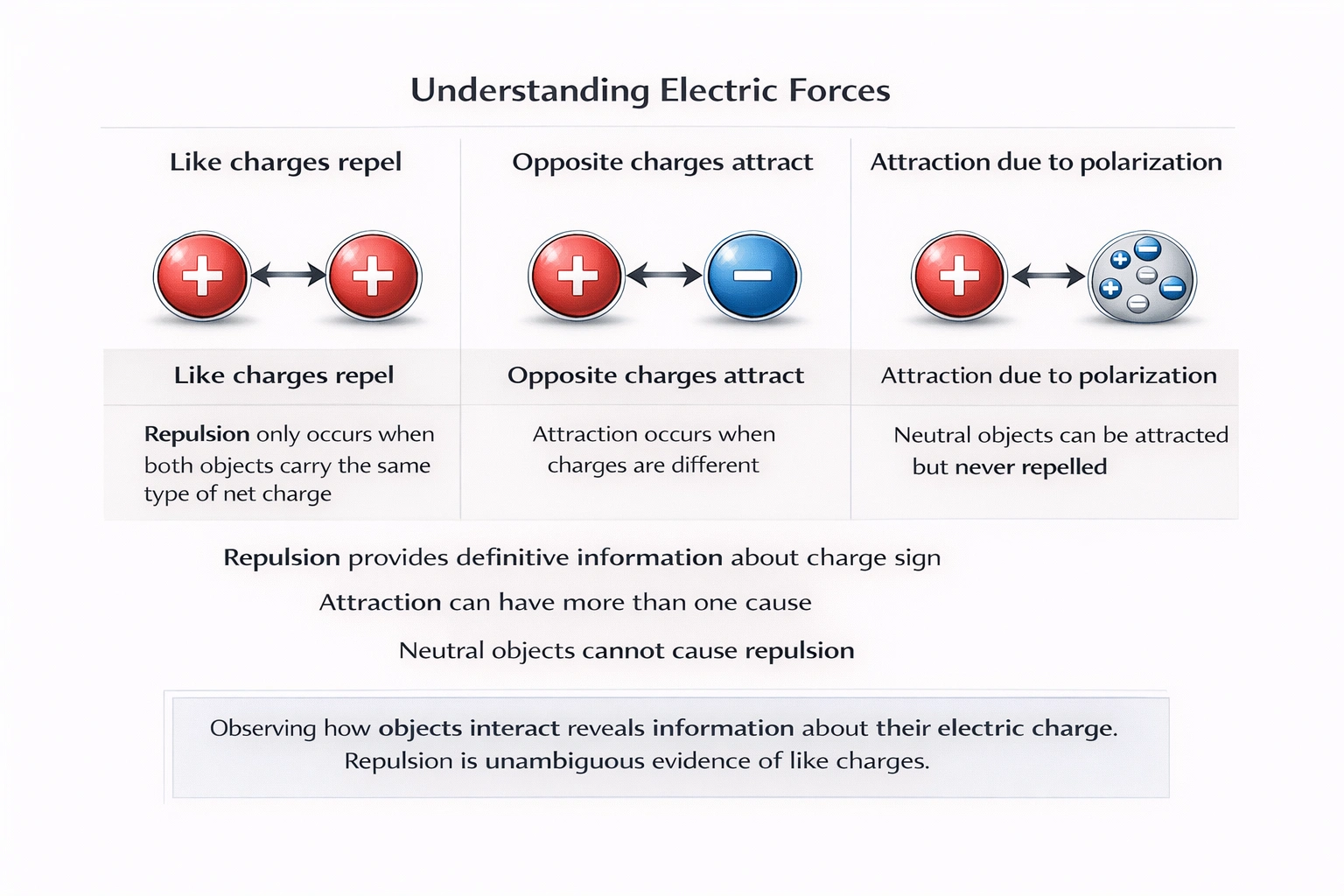
An experimenter has two objects and knows that one of them is positively charged. If that object pushes away the other object when the two are brought into proximity, what can he conclude?
A.
The other object is positively charged.
B. The other object is negatively charged.
C. The other object carries no electric charge.
D. The other object may be either positively or negatively charged.
Rationale
The other object must also possess a positive electric charge.
Electrostatic interactions are governed by Coulomb's law: like electric charges repel each other, and unlike electric charges attract each other. This is a fundamental and unambiguous rule. Observing a repulsive force between two objects provides direct information about the relative signs of their net charges. Repulsion can only occur if both objects have net charges of the same sign (both positive or both negative).
A) The other object is positively charged.
Since the known charge is positive, and a repulsive force is observed, the other object must also have a net positive charge. This is a direct deduction from the law of electrostatics. There is no other interpretation for repulsion from a known positive charge.
B) The other object is negatively charged.
Opposite charges attract. If the other object were negatively charged, the known positive charge would exert an attractive force on it, causing the objects to pull toward each other. The observation of "pushes away" explicitly rules out attraction and therefore rules out a negative charge on the other object.
C) The other object carries no electric charge.
A neutral object (with no net charge) can interact with a charged object through polarization. The charged object induces a temporary separation of charge within the neutral object, resulting in a weak attractive force. A neutral object does not experience a net repulsive force from a charged object. Repulsion requires both objects to have a net charge of the same sign. Therefore, neutrality is incompatible with the observation of pushing away.
D) The other object may be either positively or negatively charged.
This would be true if the observed interaction were attraction. Attraction can occur between opposite charges or between a charged object and a neutral object (via polarization). Thus, attraction is ambiguous. Repulsion, however, is not ambiguous; it is definitive evidence of like charges. The observation of repulsion removes all ambiguity about the sign of the other object's charge relative to the known charge.
Conclusion
The nature of the electrostatic force allows for a conclusive inference only when repulsion is observed. Attraction permits multiple hypotheses, but repulsion permits only one: the charges are alike. Given that one object is known to be positive, the repulsive force guarantees the other object is also positive.
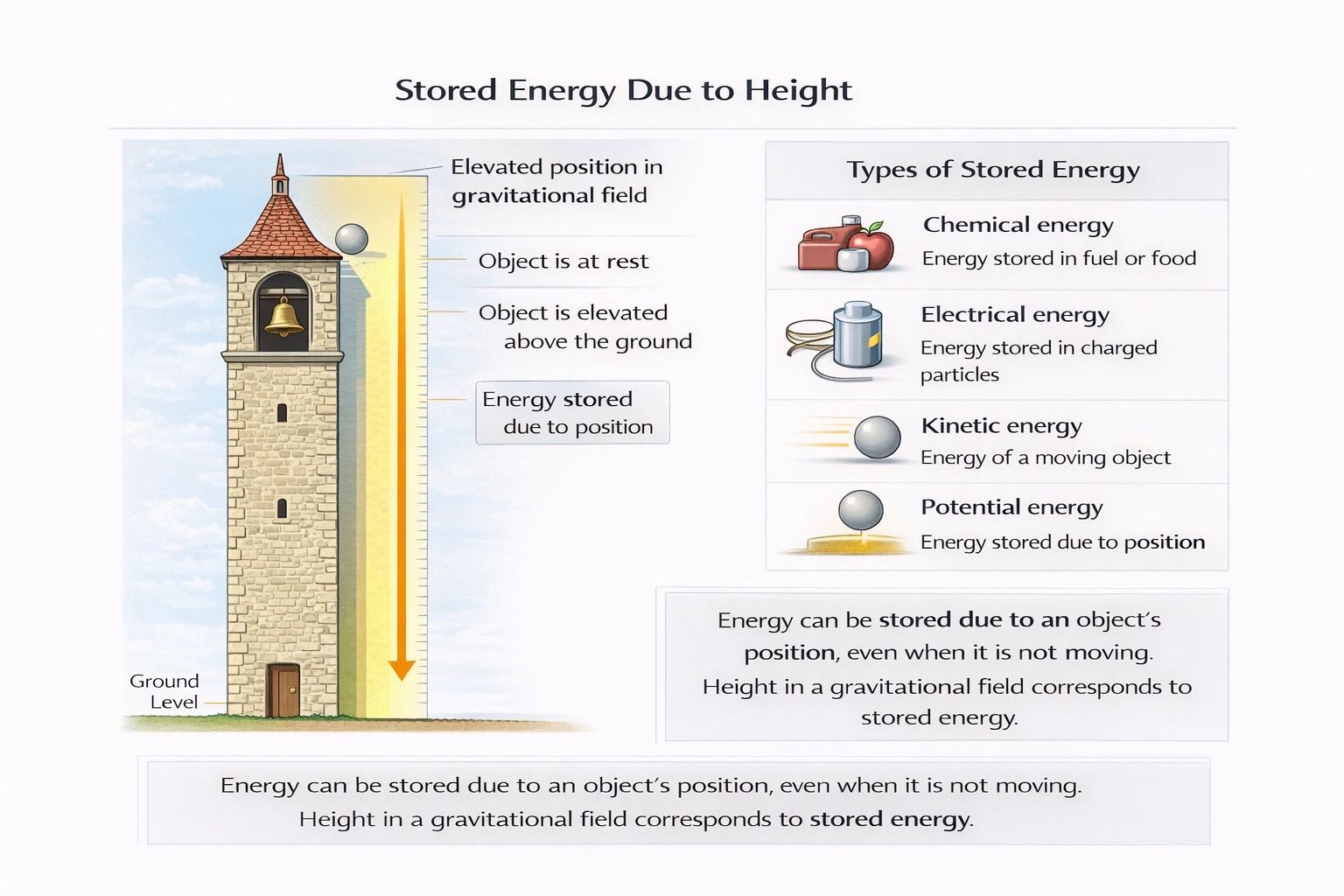
A bell tower is 52 m tall. The bell weighs 201 N. What type of energy does the bell have?
A.
Chemical
B. Electrical
C. Kinetic
D. Potential
Rationale
The bell possesses gravitational potential energy.
The type of energy is determined by the object's state and configuration. The bell is described as being in a tower, implying it is stationary and elevated above the ground. Its weight (the force of gravity on it) is given, and its height is specified. Energy associated with an object's position in a gravitational field is gravitational potential energy.
A) Chemical
Chemical energy is stored in the bonds between atoms within molecules and is released during chemical reactions. Examples include the energy in food, fuel, or batteries. The bell, as a solid metal object, is not undergoing any chemical reaction, and its energy is not stored in a chemical form.
B) Electrical
Electrical energy involves the movement of electric charges (current) or energy stored in electric fields (as in a capacitor). The description of the bell does not mention any electrical charge, current, or connection to an electrical system.
C) Kinetic
Kinetic energy is the energy of motion. The problem describes the bell's location (in the tower) and its weight but does not indicate it is moving. It is presumably hanging at rest. Therefore, its kinetic energy is zero. If it were swinging, it would have both kinetic and potential energy, but the scenario implies a stationary bell.
D) Potential
Gravitational potential energy is the energy an object possesses due to its height above a reference level (like the ground). It is calculated as the product of the object's weight (force of gravity) and its height: PE = weight × height = 201 N × 52 m. This energy is stored and can be converted into kinetic energy if the bell falls. It is a direct consequence of the bell's position in the Earth's gravitational field.
Conclusion
An object at rest at an elevated position stores energy by virtue of its height. This is gravitational potential energy. The bell's weight and height are the explicit quantities used to calculate this form of energy, making "potential" the correct classification.
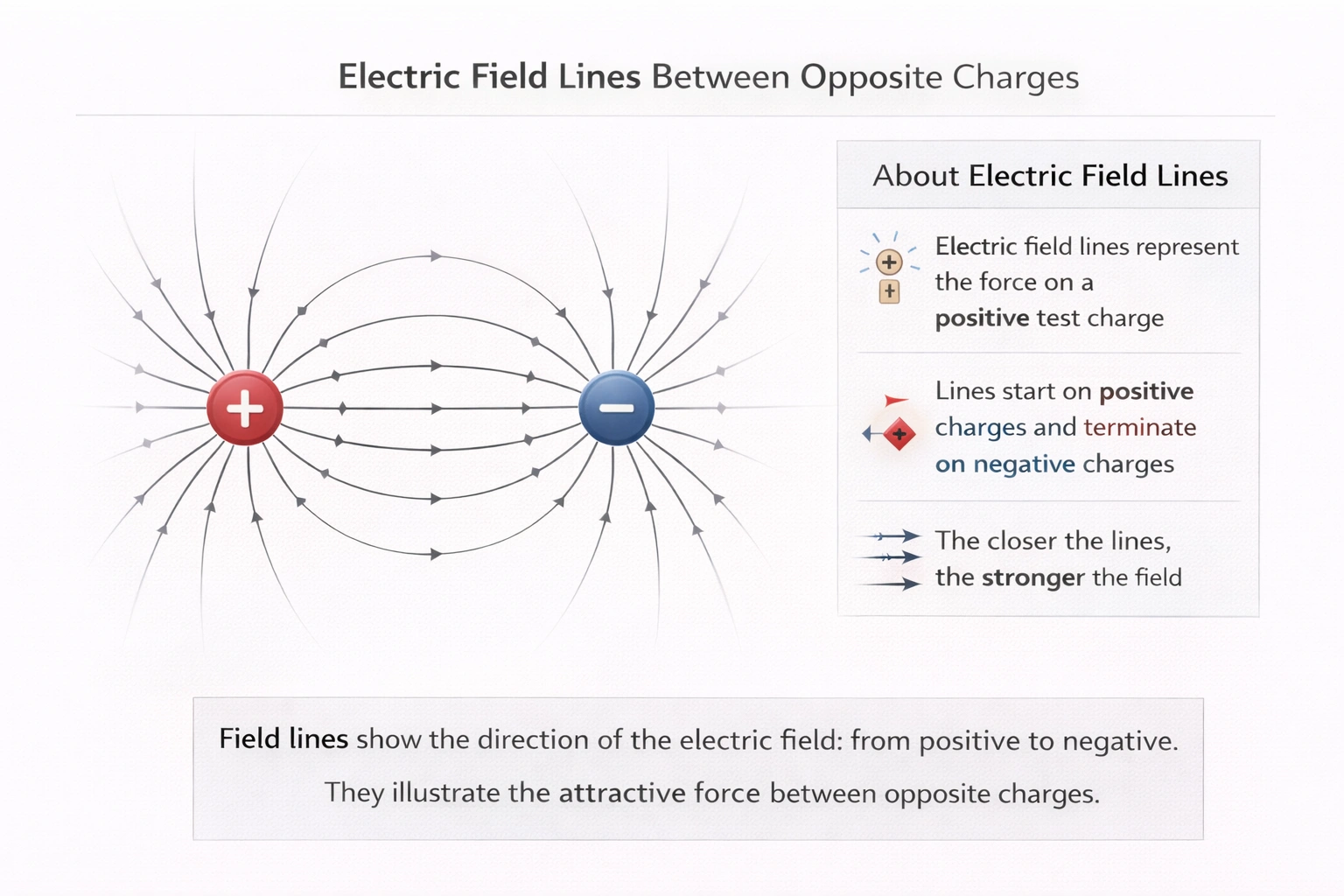
A positive charge and a negative charge are in close proximity. Which statement best describes the field lines around the charges?
A.
No field lines exist between positive and negative charges.
B. The field lines start at the negative charge and end at the positive charge.
C. The field lines start at the positive charge and end at the negative charge.
D. The field lines associated with the positive charge do not connect with the field lines associated with the negative charge.
Rationale
Electric field lines originate on positive charges and terminate on negative charges.
Electric field lines are a conceptual tool used to visualize the direction and strength of the electric field. By convention, the direction of a field line at any point shows the direction of the force that would act on a positive test charge placed at that point. Field lines begin on positive source charges and end on negative source charges (or extend to/from infinity).
A) No field lines exist between positive and negative charges.
This is false. The region between opposite charges has a strong electric field because the fields from each charge reinforce each other. Field lines are densely packed in this area, connecting the two charges. They vividly illustrate the attractive force.
B) The field lines start at the negative charge and end at the positive charge.
This reverses the standard convention. If field lines started on negative charges, they would indicate the direction of force on a negative test charge. The universal convention in physics is to define the field based on the force experienced by a positive test charge. A positive test charge is repelled from a positive source charge (so lines emanate outward) and attracted to a negative source charge (so lines converge inward). Therefore, lines must start on positive charges and end on negative charges.
C) The field lines start at the positive charge and end at the negative charge.
This is the correct convention. For a pair of opposite charges, field lines emanate radially outward from the positive charge. They curve through space, following the net field direction, and converge radially inward onto the negative charge. These continuous lines map the path a positive test charge would take if released: away from the positive charge and toward the negative charge.
D) The field lines associated with each charge do not connect.
For an isolated single charge, field lines begin or end at infinity. However, for a pair of opposite charges, many of the field lines that start on the positive charge connect directly to the negative charge, forming continuous, unbroken lines that bridge the gap. Some lines from the positive charge may go to infinity, and some lines ending on the negative charge may come from infinity, but a significant set of lines connect the two charges directly, illustrating their mutual attraction.
Conclusion
The convention for electric field lines is defined relative to a positive test charge. This dictates that lines originate from positive charges and terminate on negative charges. This pattern correctly illustrates the attractive force between opposites, with lines connecting the charges. The other options either reverse the convention, deny the existence of connecting lines, or incorrectly state that no lines exist between the charges.
A proton has an electron on either side of it such that all three particles lie on a line and each electron is 1 millimeter from the proton. What is the direction of the net electric force on the proton?
A.
No net force acts on the proton.
B. The force is toward one of the electrons.
C. Electrons and protons exert no electric force on each other.
D. The force is perpendicular to the line on which the three particles lie.
Rationale
The net electric force on the centrally located proton is zero.
This is an electrostatic force superposition problem. The net force on the proton is the vector sum of the forces exerted on it by each of the two electrons. Coulomb's Law states that the force between two point charges is proportional to the product of their charges and inversely proportional to the square of the distance between them. The force is attractive for opposite charges and repulsive for like charges.
A) No net force acts on the proton.
The proton has a positive charge. Each electron has a negative charge. Opposite charges attract. Each electron exerts an attractive force on the proton. Since the electrons are positioned symmetrically—one on each side of the proton at equal distances (1 mm)—the two force vectors act along the same line but in opposite directions. The force from the left electron pulls the proton to the left. The force from the right electron pulls the proton to the right. These forces have equal magnitude (because distances and charge magnitudes are equal) and opposite directions. Therefore, they cancel each other out, resulting in a net force of zero on the proton.
B) The force is toward one of the electrons.
This would be true only if the symmetry were broken—for example, if one electron were closer, or if the other electron were absent. With perfect symmetry in charge and distance, the forces are balanced, and there is no preferred direction.
C) Electrons and protons exert no electric force on each other.
This contradicts the fundamental law of electrostatics—Coulomb's Law. Electrons and protons have opposite charges and exert strong attractive forces on each other. This attraction is what binds electrons to the nucleus in atoms. The force is certainly nonzero for each individual electron-proton pair.
D) The force is perpendicular to the line.
The force between two point charges acts along the straight line connecting them. All three particles lie on the same line. Therefore, the force exerted by each electron on the proton is along this line. There is no component of force perpendicular to the line in this configuration. The vector sum of two collinear forces is also collinear, not perpendicular.
Conclusion
Symmetry is crucial in electrostatics. With identical electrons equidistant on opposite sides of a proton, the attractive forces are equal in magnitude and opposite in direction. Their vector sum is zero. The proton experiences no net electric force in this symmetric arrangement.

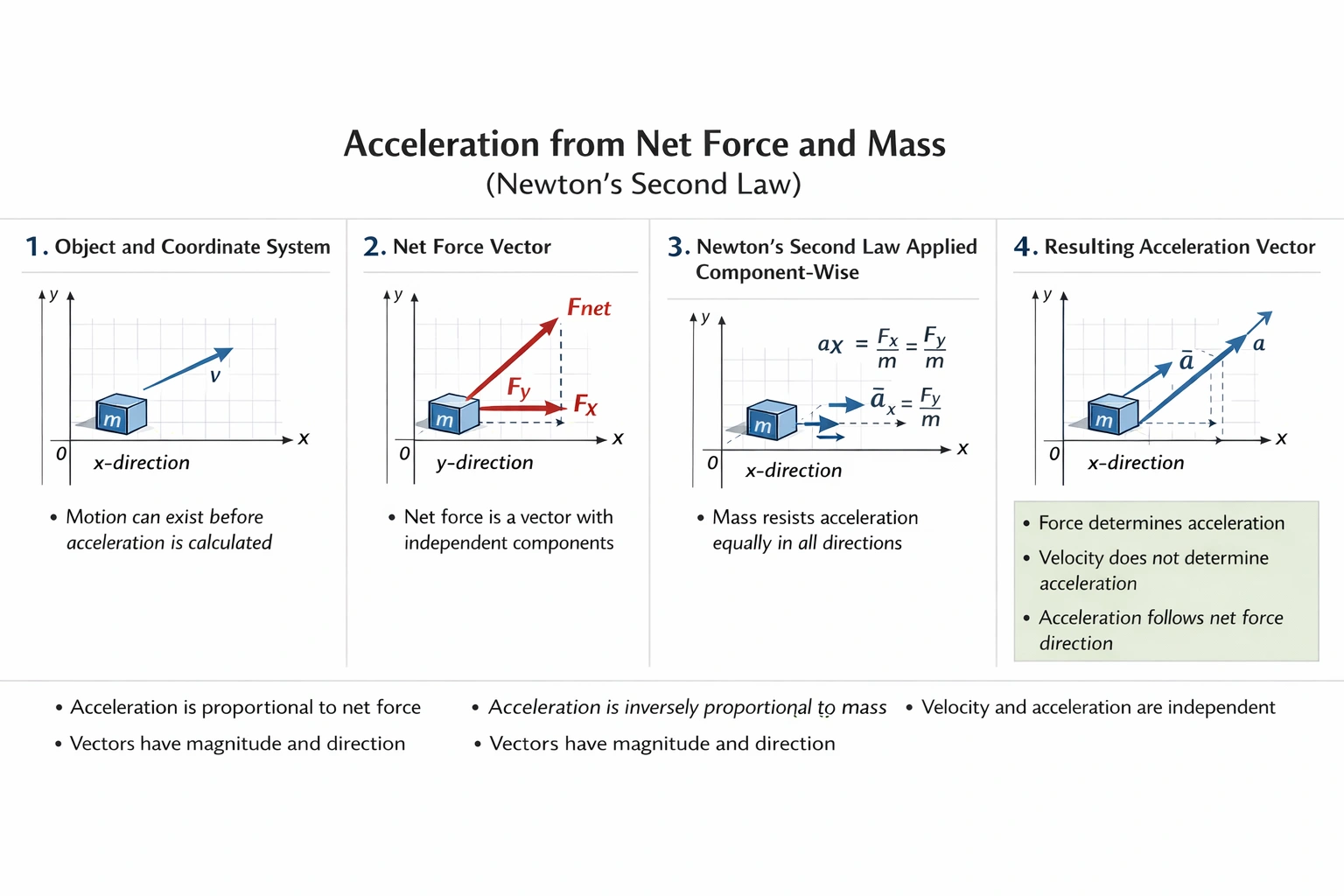
What is the acceleration of a 9.7-kilogram object moving at a velocity (2.3, 8.9) meters per second and subject to a net force of (3.2, -1.8) newtons?
A.
(?0.093, 1.1) m/s?
B. (0.24, 0.92) m/s?
C. (0.33, ?0.19) m/s?
D. (0.56, 0.73) m/s?
Rationale
The acceleration vector is (0.33, -0.19) m/s².
Newton's second law of motion states that the net force acting on an object is equal to the product of its mass and acceleration: F_net = m a. This is a vector equation, meaning it applies independently to each component of force and acceleration. The object's current velocity does not influence the instantaneous acceleration produced by the net force; acceleration is determined solely by the present net force and mass.
A) (?0.093, 1.1) m/s²
This vector does not result from dividing the given force components by the mass. It appears to be derived from an incorrect operation, possibly involving the velocity components or a miscalculation of the force-to-mass ratio. The x-component is negative, while the x-component of force is positive, indicating a fundamental error in sign or arithmetic.
B) (0.24, 0.92) m/s²
These values are not the quotients of the force components divided by the mass. They may come from an averaging error, a misapplication of the Pythagorean theorem, or using the velocity in the calculation. The correct x-component is 3.2 N / 9.7 kg ? 0.33 m/s², not 0.24 m/s².
C) (0.33, ?0.19) m/s²
Applying Newton's second law component-wise yields the correct acceleration. For the x-direction: a_x = F_x / m = 3.2 N / 9.7 kg ? 0.3299 m/s², which rounds to 0.33 m/s². For the y-direction: a_y = F_y / m = -1.8 N / 9.7 kg ? -0.1856 m/s², which rounds to -0.19 m/s². The velocity vector (2.3, 8.9) m/s is irrelevant to this calculation; it describes the object's state of motion, not the cause of its acceleration.
D) (0.56, 0.73) m/s²
This vector is significantly larger than the correct values and does not correspond to the division of the given force by the mass. It might result from using an incorrect mass, inverting the components, or incorporating the velocity vector into the calculation erroneously.
Conclusion
Acceleration is the vector result of the net force divided by mass. By computing each component independently—a_x = 3.2 / 9.7 and a_y = -1.8 / 9.7—the acceleration is determined to be approximately (0.33, -0.19) m/s². The object's pre-existing velocity does not affect this instantaneous relationship.
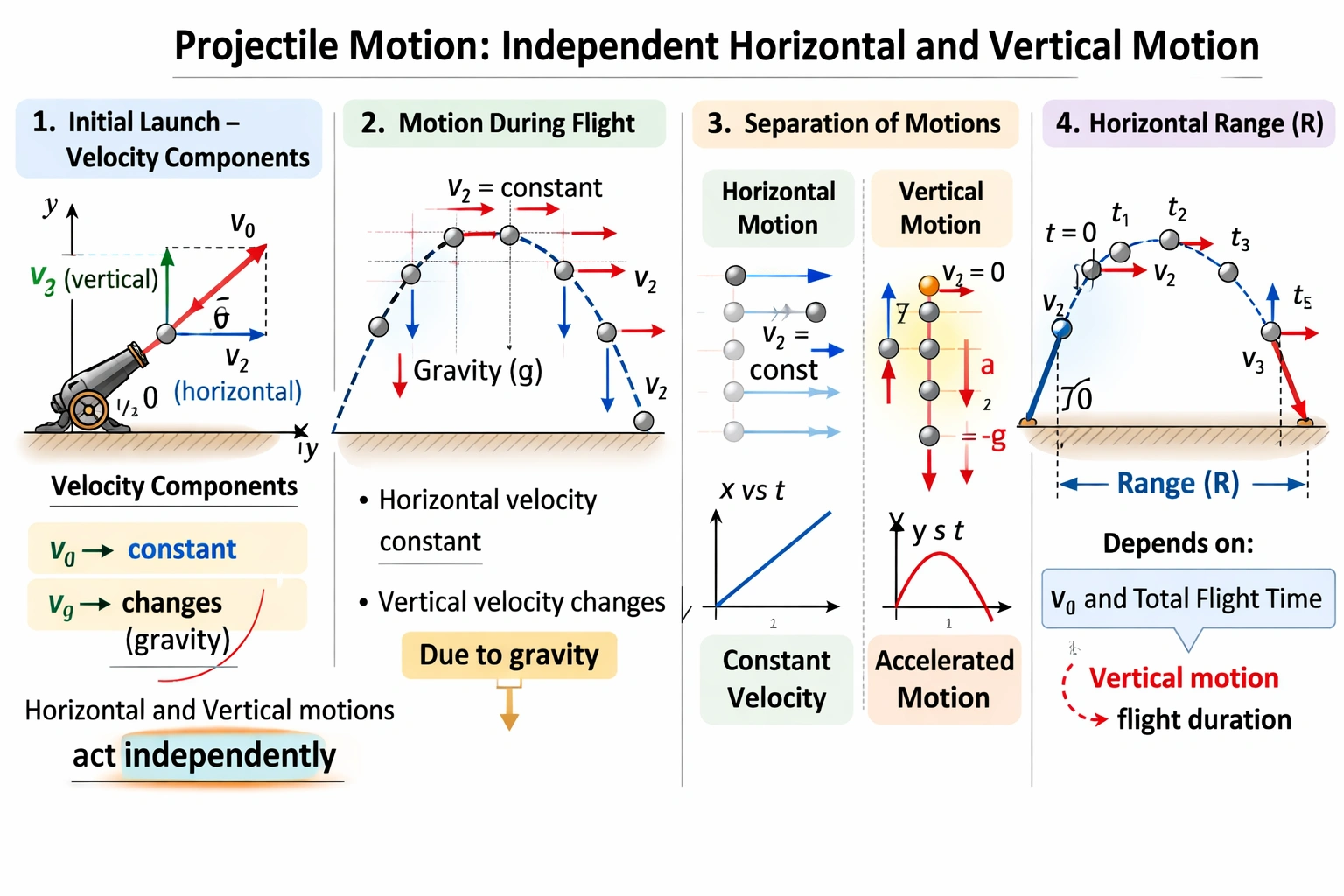
A cannonball is fired with an initial vertical velocity of 130 meters per second and an initial horizontal velocity of 450 meters per second. If it hits the ground 12 seconds after it is fired, how far did it travel?
A.
1,600 meters
B. 3,800 meters
C. 5,400 meters
D. 7,000 meters
Rationale
The cannonball travels 5,400 meters horizontally.
In projectile motion, horizontal and vertical motions are independent. The horizontal distance traveled, known as the range, is determined solely by the initial horizontal velocity and the total time of flight. Horizontal motion occurs at constant velocity (ignoring air resistance). The vertical velocity and gravitational acceleration influence the time of flight and the trajectory's shape but do not directly affect the horizontal displacement calculation once the flight time is known.
A) 1,600 meters
This distance is obtained by incorrectly using the vertical velocity to calculate range: 130 m/s × 12 s = 1,560 m ? 1,600 m. This is a fundamental error, as vertical velocity governs height and time, not horizontal distance. The horizontal component must be used for horizontal displacement.
B) 3,800 meters
This value may arise from averaging the two velocities or applying an incorrect formula that combines both components. For example, (450 + 130)/2 × 12 = 3,480 m, which is close but not exact. The horizontal range requires using only the horizontal velocity.
C) 5,400 meters
The horizontal range is calculated as: range = horizontal velocity × time = 450 m/s × 12 s = 5,400 m. The given vertical velocity of 130 m/s is extraneous for this calculation once the total flight time is provided. This is the correct application of constant-velocity horizontal motion.
D) 7,000 meters
This result is too large and could come from adding the effects of both velocities multiplicatively, e.g., (450 + 130) × 12 = 6,960 m ? 7,000 m, or from another arithmetic error. It does not reflect the independent nature of horizontal motion.
Conclusion
The horizontal distance covered by a projectile is the product of its constant horizontal velocity and the total time it is airborne. With v_x = 450 m/s and t = 12 s, the range is 450 × 12 = 5,400 meters. The vertical velocity is relevant only for determining the flight time if it were not given.
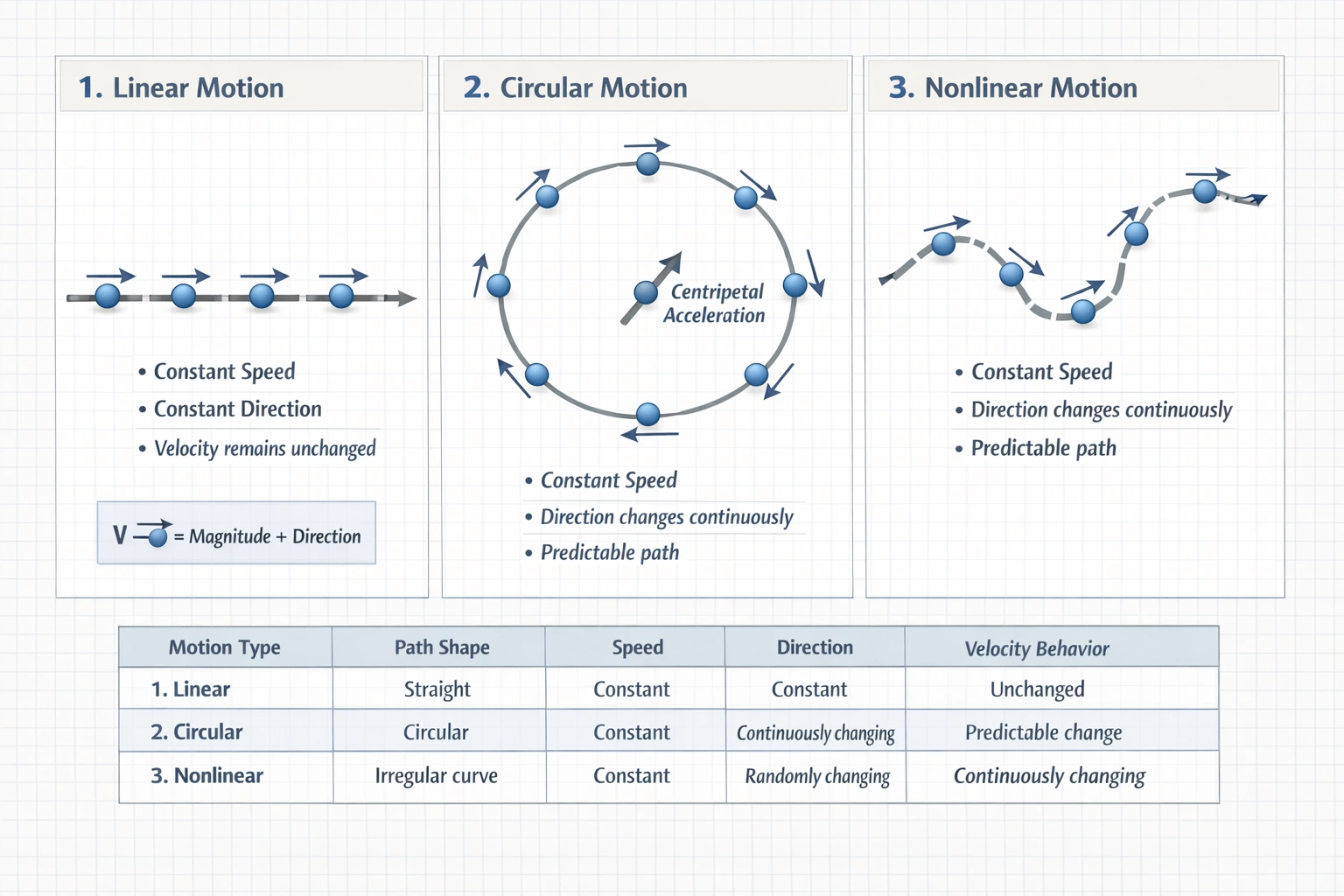
An object has a constant nonzero speed but a randomly varying velocity. Which term best describes its motion?
A.
Linear
B. Nonlinear
C. Rotational
D. Stationary
Rationale
The motion is best described as nonlinear.
Velocity is a vector quantity comprising speed (magnitude) and direction. A constant speed but changing velocity indicates that the direction of motion is changing. The term "randomly varying" specifies that these directional changes are not following a predictable pattern, such as a circle or parabola, but are irregular.
A) Linear
Linear motion implies movement along a straight-line path. In linear motion, if the speed is constant, the velocity is constant because the direction does not change. A changing velocity, even with constant speed, definitively rules out linear motion.
B) Nonlinear
Nonlinear motion encompasses any motion where the path is not a straight line. Since the velocity vector is changing (due to directional changes), the object's trajectory is curved or erratic. The "randomly varying" nature aligns with unpredictable, nonlinear paths, which may include zigzags, loops, or irregular curves.
C) Rotational
Rotational or circular motion is a specific type of nonlinear motion characterized by constant speed and a velocity vector that changes direction continuously but in a predictable, systematic way, such as around a fixed center. The "randomly varying" condition excludes this orderly, predictable pattern of directional change.
D) Stationary
Stationary means at rest, with zero speed and zero velocity. A "constant nonzero speed" explicitly contradicts this state. The object is clearly in motion.
Conclusion
Motion with constant speed but randomly changing direction results in a path that is not straight. This is the definition of nonlinear motion. Rotational motion is a subset of nonlinear motion but implies a specific, predictable pattern not present here. Therefore, the most accurate and inclusive term is nonlinear.
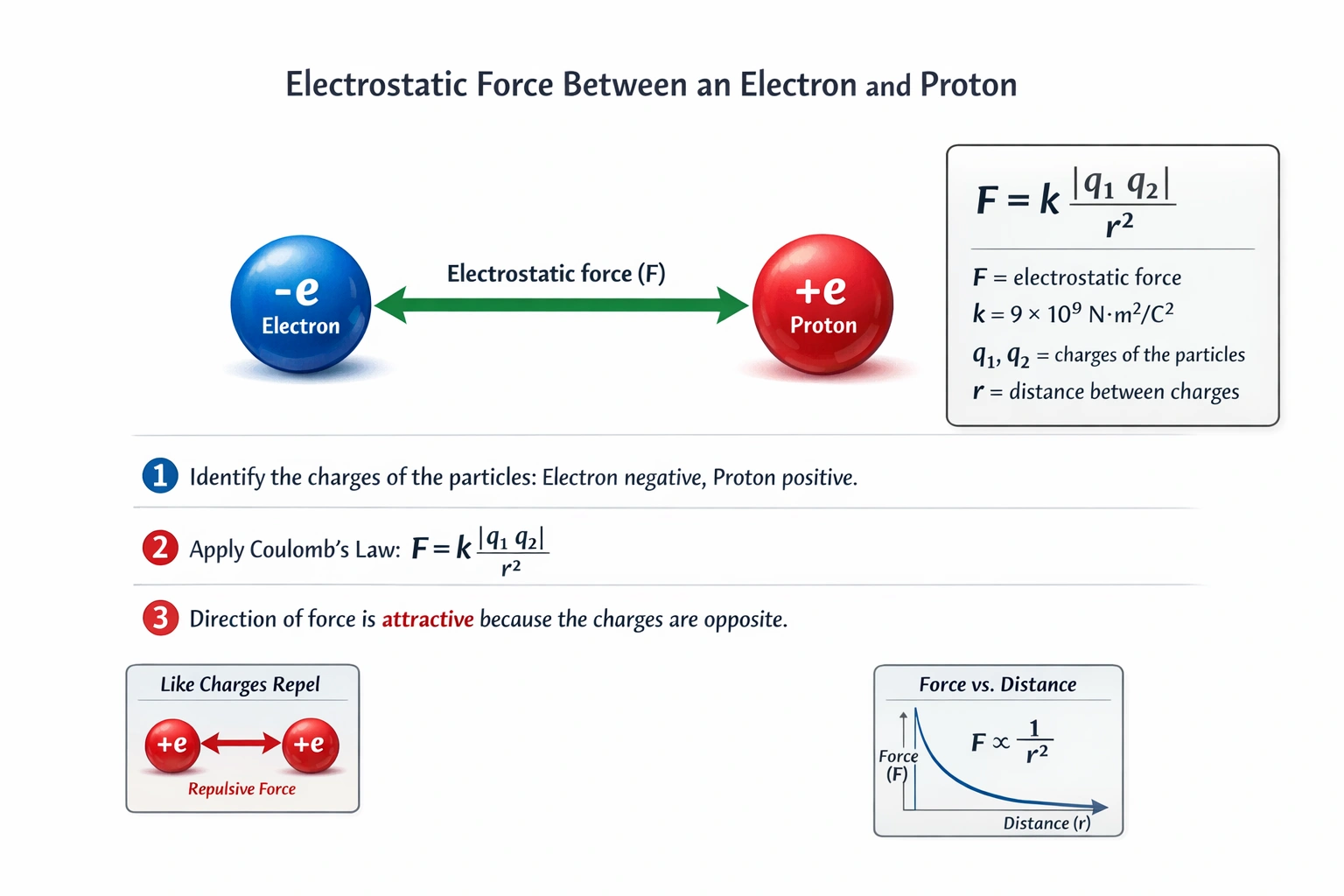
What kind of force exists between an electron and a proton?
A.
No net force
B. A repulsive force
C. A rotational force
D. An attractive force
Rationale
An attractive force exists between an electron and a proton.
Electrostatic forces between charged particles are governed by Coulomb's law. The electron carries a fundamental negative charge (-e), and the proton carries a fundamental positive charge (+e). Opposite electric charges exert an attractive force on each other, while like charges repel.
A) No net force
A net force of zero would occur only if the charges were neutral or if they were identical charges perfectly shielded or at infinite separation. An isolated electron and proton have opposite, non-zero charges, so a significant electrostatic force always exists between them, binding them in atoms.
B) A repulsive force
Repulsion occurs between charges of the same sign (positive-positive or negative-negative). Since an electron and a proton have opposite signs, they attract each other, not repel. This is a foundational principle of electromagnetism.
C) A rotational force
"Rotational force" or torque arises when a force is applied at a distance from a pivot, causing rotation. The electrostatic force between an electron and proton is a central force acting along the line connecting them. It can lead to orbital motion (as in the Bohr model), but the force itself is linear and attractive, not inherently "rotational."
D) An attractive force
Coulomb's law states that the force between two point charges is proportional to the product of their charges and inversely proportional to the square of the distance. The product of the electron's charge (-e) and the proton's charge (+e) is negative, indicating an attractive force. This attraction is what binds electrons to the nucleus in atoms.
Conclusion
According to Coulomb's law, opposite electric charges attract. An electron (negative) and a proton (positive) are the quintessential opposite charges, so the force between them is attractive. This fundamental attraction is responsible for the structure of atoms.
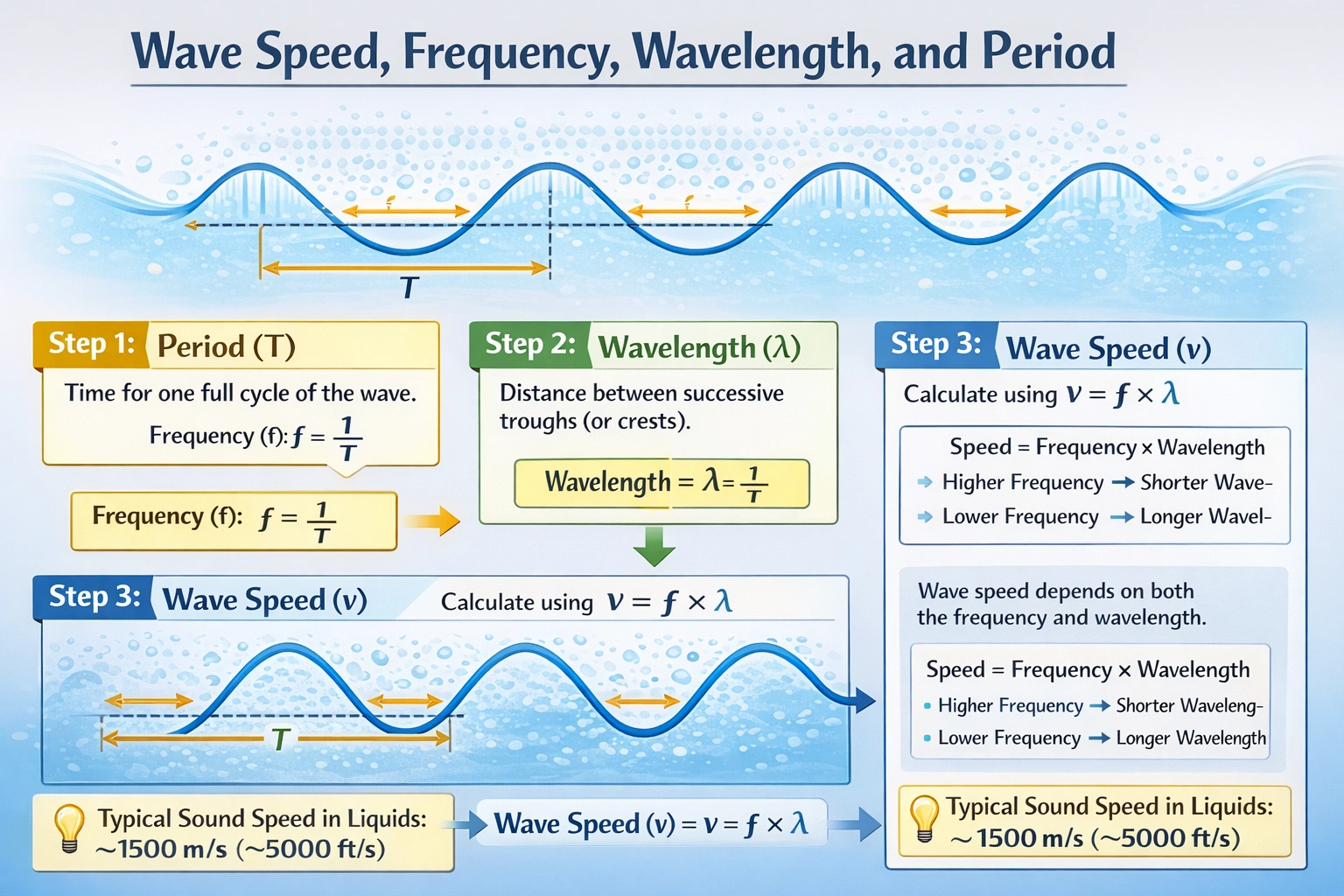
Successive troughs of a sound wave arrive through a certain liquid every 0.040 seconds. If they are 100 feet apart, how fast are they traveling?
A.
0.00040 feet per second
B. 4.0 feet per second
C. 25 feet per second
D. 2,500 feet per second
Rationale
The wave speed is 2,500 feet per second.
The speed of a wave (v) is related to its frequency (f) and wavelength (?) by the fundamental wave equation v = f ?. The period (T), the time between successive troughs, is given. Frequency is the reciprocal of the period: f = 1/T. Wavelength is the distance between successive troughs.
A) 0.00040 feet per second
This minuscule speed might result from dividing the wavelength by a very large number or misplacing decimals, e.g., ? / (1/T) confusion. It is implausible for sound in any liquid.
B) 4.0 feet per second
This is far too slow for sound, which travels at about 1,500 m/s (~5,000 ft/s) in water. It could come from incorrectly dividing the period by the wavelength (0.040/100 = 0.0004) and then multiplying by 10,000, or from other arithmetic errors.
C) 25 feet per second
This speed is still orders of magnitude too slow. It might be obtained by mistakenly using the period as a speed (0.040 s misinterpreted) or by calculating 1/T = 25 Hz and then treating that as speed in ft/s without multiplying by wavelength.
D) 2,500 feet per second
The period T = 0.040 s, so frequency f = 1/0.040 = 25 Hz. Wavelength ? = 100 ft. Wave speed v = f ? = 25 Hz × 100 ft = 2,500 ft/s. This is a reasonable speed for sound in a dense liquid (sound speed in water is about 4,800 ft/s; the given value is plausible for a different liquid or conditions).
Conclusion
Using the wave equation v = f ? with f = 1/T yields the speed. With T = 0.040 s and ? = 100 ft, v = (1/0.040) × 100 = 25 × 100 = 2,500 ft/s. This is the only calculation consistent with the given data.
What two factors determine an object's kinetic energy?
A.
Mass and velocity
B. Mass and acceleration
C. Velocity and acceleration
D. Distance and acceleration
Rationale
An object's kinetic energy is determined by its mass and its velocity.
Kinetic energy (KE) is the energy of motion. The classical formula for translational kinetic energy is KE = ½ m v², where m is mass and v is speed (the magnitude of velocity). This shows that kinetic energy is directly proportional to mass and proportional to the square of velocity.
A) Mass and velocity
The formula KE = ½ m v² explicitly identifies mass and velocity as the two variables on which kinetic energy depends. Velocity is squared, so kinetic energy increases with the square of speed.
B) Mass and acceleration
Acceleration is the rate of change of velocity. While force (F = m a) involves mass and acceleration, kinetic energy does not depend directly on acceleration. An object can have high acceleration but low velocity (and thus low kinetic energy) if it just started moving, or zero acceleration but high constant velocity (and high kinetic energy).
C) Velocity and acceleration
Acceleration is not a variable in the kinetic energy equation. Two objects with the same velocity have the same kinetic energy per unit mass, regardless of their accelerations. Acceleration affects the rate of change of kinetic energy, not its instantaneous value.
D) Distance and acceleration
Distance traveled and acceleration are related to work done (W = F d = m a d) and the change in kinetic energy via the work-energy theorem. However, they are not the factors that define the instantaneous value of kinetic energy. The object's current state of motion (mass and velocity) defines its kinetic energy.
Conclusion
The kinetic energy of an object is a function of its mass and the square of its velocity. This is encapsulated in the formula KE = ½ m v². Acceleration, distance, and other factors influence how kinetic energy changes but do not determine its value at a given instant.
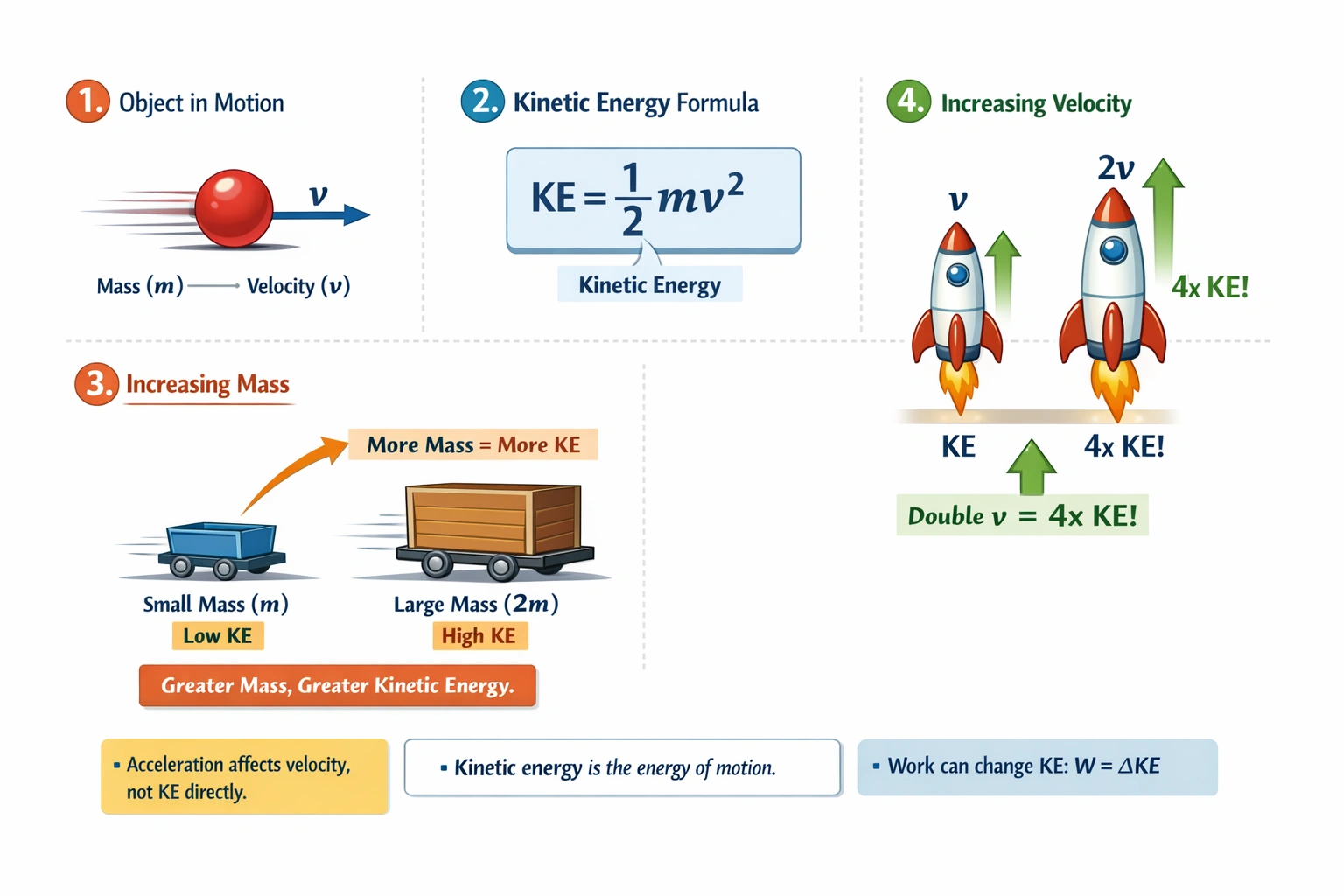
At what separation distance do the 2,031,000 kg space shuttle and the 11,110 kg Hubble Space Telescope experience a 10.0 N force of gravitational attraction?
A.
0.156 m
B. 0.388 m
C. 1.56?10?? m
D. 3.88?10?? m
Rationale
The separation distance is approximately 0.388 meters.
Newton's law of universal gravitation states: F = G (m? m?) / r², where F is the gravitational force, G is the gravitational constant (6.67×10?¹¹ N?m²/kg²), m? and m? are the masses, and r is the distance between their centers. Solving for r gives r = ?(G m? m? / F).
A) 0.156 m
This is about half the correct distance. It may result from taking a square root incorrectly or from a calculation error like using G = 6.67×10?¹?.
B) 0.388 m
Compute stepwise:
m? m? = 2.031×10? kg × 1.111×10? kg = 2.256×10¹? kg².
G m? m? = (6.67×10?¹¹) × (2.256×10¹?) ? 1.505.
Then G m? m? / F = 1.505 / 10.0 = 0.1505.
Finally, r = ?(0.1505) ? 0.388 m.
C) 1.56×10¹? m
This enormous distance (about 1/10 of an astronomical unit) is off by a factor of roughly 10¹?. It likely results from forgetting to take the square root and using r² = G m? m? / F, then misplacing the decimal or using the wrong exponent for G.
D) 3.88×10¹? m
This is even larger, roughly the distance from the Sun to Neptune. It could be obtained by a similar error as in C but with an additional factor of 10.
Conclusion
Rearranging Newton's gravitation law to solve for distance yields r = ?(G m? m? / F). Plugging in the given values (G = 6.67×10?¹¹, m? = 2.031×10? kg, m? = 1.111×10? kg, F = 10.0 N) gives r ? 0.388 m. This surprisingly small distance is due to the relatively large masses and small force, but it is mathematically correct based on the formula.
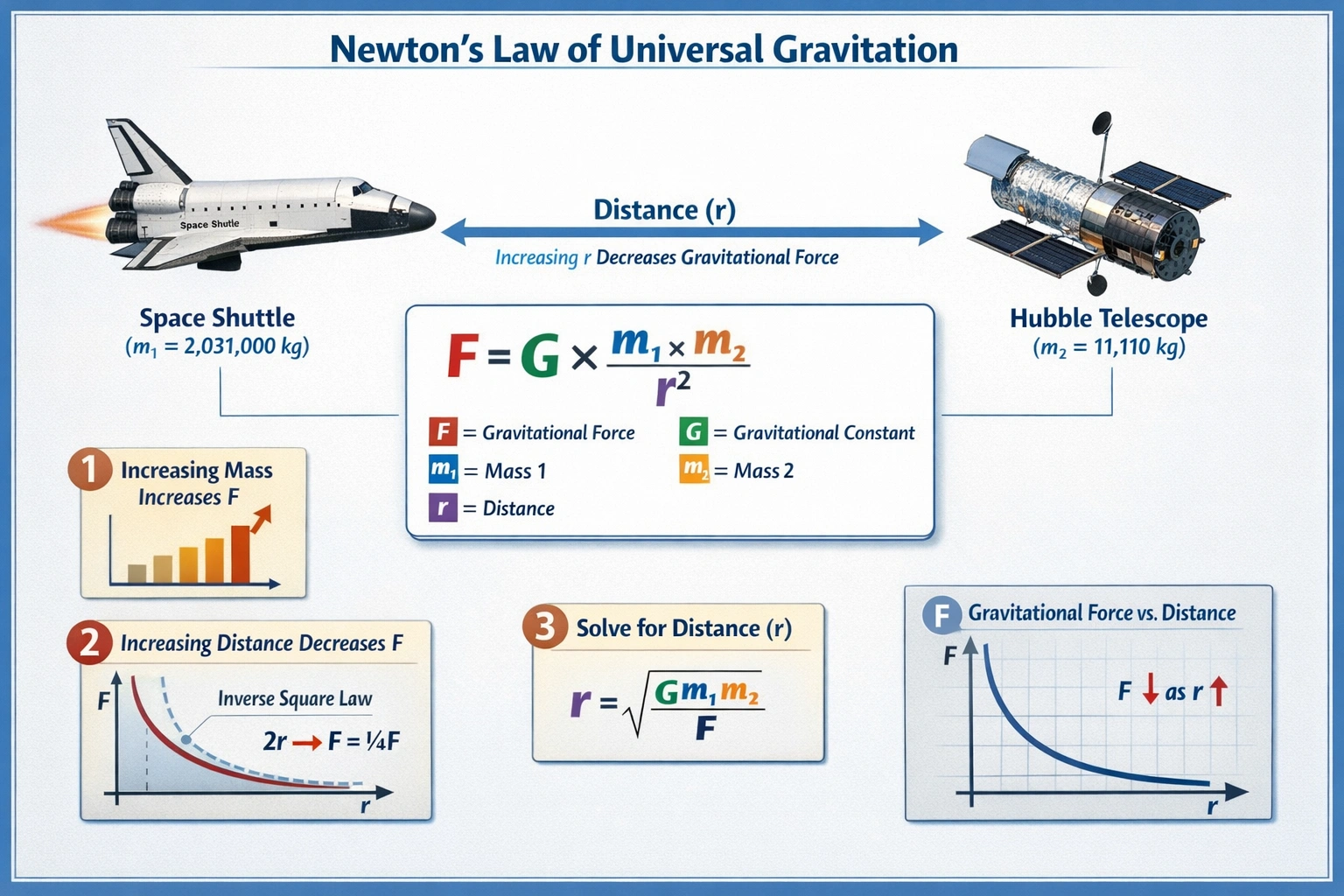
The magnetic flux near the end of a magnet is much greater than the magnetic flux farther away from the end. If the magnet moves away from a wire loop, what will happen?
A.
The loop will rotate.
B. Nothing will happen.
C. A current will flow in the loop.
D. The loop will exert an electric force on the magnet.
Rationale
A current will flow in the loop.
Faraday's law of electromagnetic induction states that a changing magnetic flux through a closed loop induces an electromotive force (emf) in the loop. If the loop is part of a complete circuit, this emf drives an electric current. Lenz's law gives the direction of the induced current: it will oppose the change in flux.
A) The loop will rotate.
Rotation might occur if there is a motor effect, where a current in a magnetic field experiences a torque. However, rotation is not the primary or guaranteed outcome. The loop could be fixed, or the forces might not cause rotation. The direct result of changing flux is an induced emf and current, not necessarily motion.
B) Nothing will happen.
This contradicts Faraday's law. Moving the magnet away changes the magnetic field through the loop, thus changing the magnetic flux. According to Faraday, this change must induce an emf. If the loop is closed, current will flow.
C) A current will flow in the loop.
As the magnet moves away, the magnetic flux through the loop decreases. This change in flux induces an emf around the loop. If the loop is conductive and forms a closed circuit, the emf causes an induced current. The current's magnetic field will oppose the decrease in flux (e.g., it will try to attract the magnet back).
D) The loop will exert an electric force on the magnet.
The loop, once current flows, creates its own magnetic field. This magnetic field interacts with the magnet's field, resulting in a magnetic force (not an electric force) between them. While this is a consequence, the primary event is the induction of current. The question asks for what will happen; the most direct and guaranteed outcome is current flow.
Conclusion
A changing magnetic flux through a conductive loop induces an emf and, if the loop is closed, a current. Moving a magnet away from the loop decreases the flux, inducing a current. This is a direct application of Faraday's law.
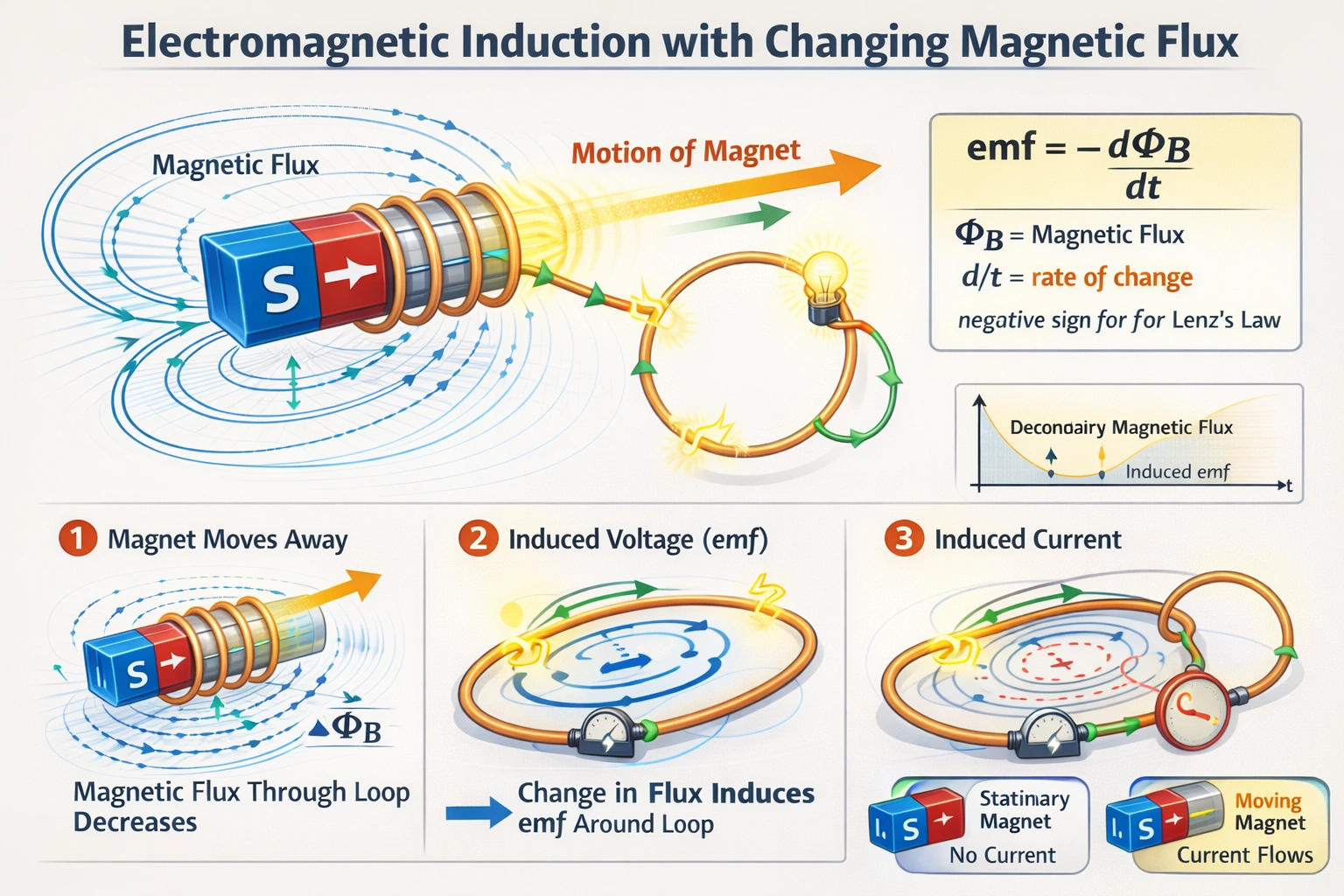
HESI A2 Exams
Biology Quizzes
3 Practice Tests
Biology Quizzes
3 Practice Tests
Chemistry Quizzes
3 Practice Tests
Chemistry Quizzes
3 Practice Tests
Anatomy Quizzes
3 Practice Tests
Anatomy Quizzes
3 Practice Tests
Reading Quizzes
4 Practice Tests
Reading Quizzes
4 Practice Tests
Grammar Quizzes
3 Practice Tests
Grammar Quizzes
3 Practice Tests
Vocabulary Quizzes
3 Practice Tests
Vocabulary Quizzes
3 Practice Tests
HESI Quizzes
3 Practice Tests
HESI Quizzes
3 Practice Tests