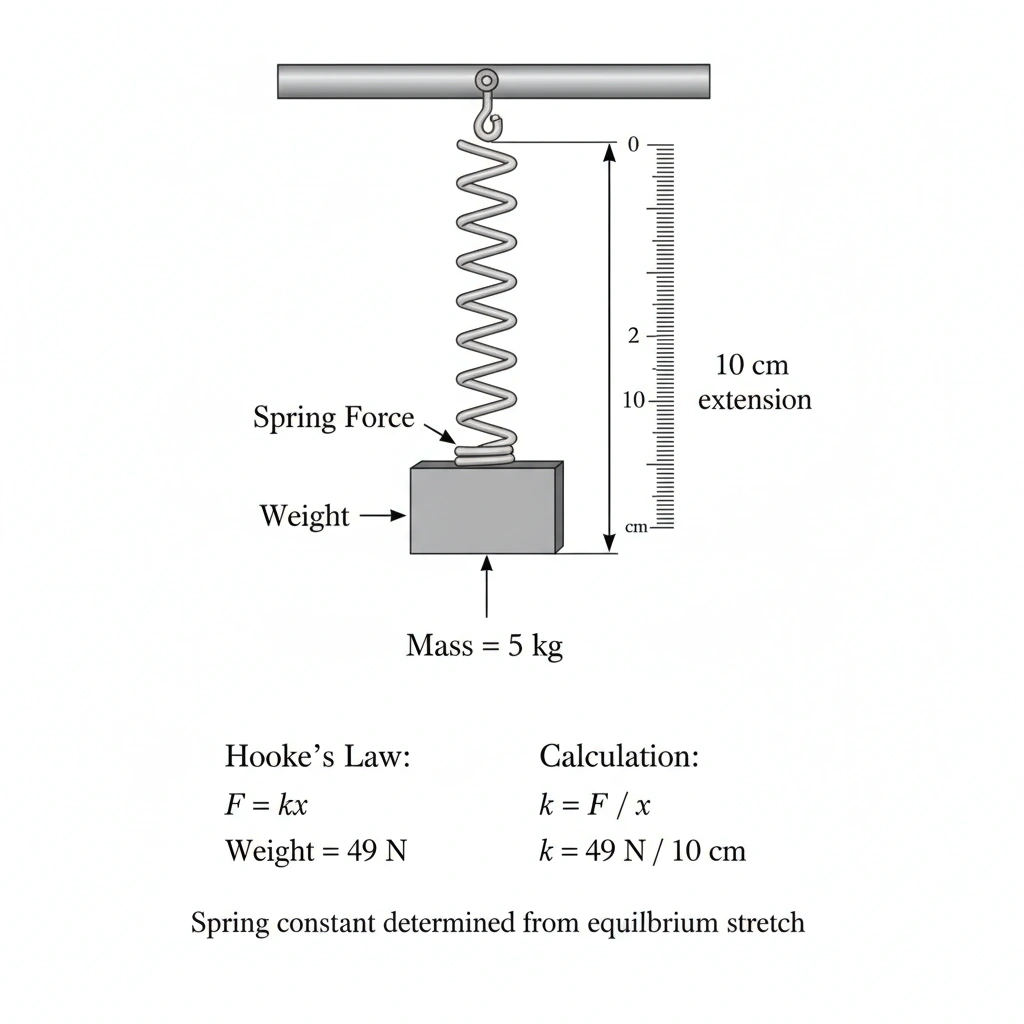
A 5-kg block is suspended from a spring, causing the spring to stretch 10 cm from equilibrium. What is the spring constant for this spring?
-
A
4.9 N/cm
-
B
9.8 N/cm
-
C
49 N/cm
-
D
50 N/cm
A 5-kg block suspended from a spring stretches it 10 cm from equilibrium, yielding a spring constant of 4.9 N/cm.
According to Hooke’s law, the force exerted by the spring equals the weight of the block (49 N), and dividing this by the displacement (10 cm) gives the stiffness constant.
A) 4.9 N/cm
This follows directly from k = F / x = 49 N / 10 cm = 4.9 N/cm. The calculation correctly uses the weight as the restoring force and the given stretch in centimeters.
B) 9.8 N/cm
This equals twice the correct value and may result from using mass instead of weight or misapplying gravitational acceleration. It does not satisfy Hooke’s law with the given displacement.
C) 49 N/cm
This would require the spring to stretch only 1 cm under the same load, contradicting the observed 10 cm extension. It misrepresents the relationship between force and displacement.
D) 50 N/cm
This approximates using g = 10 m/s² but still assumes a 1 cm stretch. It ignores the actual 10 cm displacement and overestimates stiffness by a factor of 10.
Conclusion
The spring constant is 4.9 N/cm, derived from the ratio of weight to stretch. The correct answer is A) 4.9 N/cm.

Topic Flashcards
Click to FlipState Hooke's Law for an ideal spring in equation form, and define each variable.
F = -k * x, where F is the restoring force, k is the spring constant (stiffness), and x is the displacement from equilibrium. (The negative sign indicates the force opposes the displacement.)
In a static equilibrium setup with a hanging mass, what force balances the spring's restoring force?
The weight of the hanging mass (mg).
For the 5-kg block, calculate the weight force that stretches the spring. (Use g = 9.8 m/s²)
F = m * g = 5 kg * 9.8 m/s² = 49 Newtons (N).
How do you calculate the spring constant (k) from a known force (F) and the resulting stretch (x)?
k = F / x
If the same 5-kg block stretched a different spring by 20 cm, would its spring constant be higher or lower than in the original problem?
Lower. A larger stretch for the same force means a less stiff (smaller k) spring. (k = 49 N / 0.2 m = 245 N/m or 2.45 N/cm).