100%
4
Rated
Attempts
127
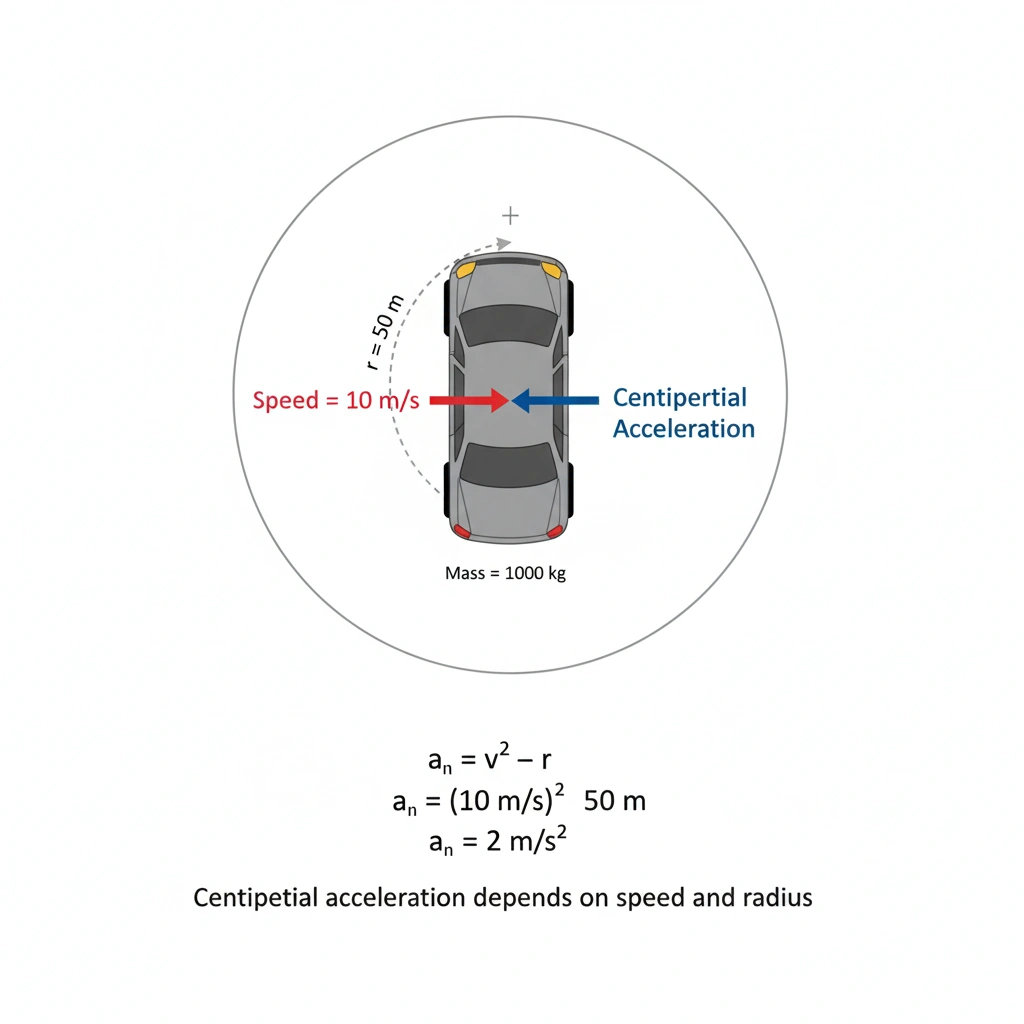
A 1,000-kg car drives at 10 m/s around a circle with a radius of 50 m. What is the centripetal acceleration of the car?
-
A
2 m/s²
-
B
4 m/s²
-
C
5 m/s²
-
D
10 m/s²
A
2 m/s²
B
4 m/s²
C
5 m/s²
D
10 m/s²
Topic Flashcards
Click to FlipMini Quiz
1 / 3
Is centripetal acceleration a vector quantity pointing toward the center of the circle?
Related Questions
Top Picks
A 3-volt flashlight uses a bulb with 60-ohm resistance. What current flows through the flashlight?
A balloon with a charge of 5 μC is placed 25 cm from another balloon with the same charge. What is the magnitude of the resulting repulsive force?
A go-kart is set into motion with an initial speed of 5 m/sec. It moves for 20 seconds. At the end of that time, its speed is 25 m/sec. What is the magnitude of the go-kart’s acceleration?
In one minute, 15 waves break onto the shore. What is the frequency of the waves?
A box is moved by a 15 N force over a distance of 3 m. What is the amount of work that has been done?
Available FREE Test
Sets
Available Test
Sets