HESI PHYSICAL ASSESSMENT
This HESI Physical Assessment quiz focuses on testing your ability to apply fundamental physics principles in practical, exam-style scenarios. It helps improve accuracy and comprehension under simulated test conditions.
Topics Covered
Motion and Forces
Energy Concepts
Mechanics Fundamentals
Temperature and Heat
Basic Electrical Principles
00:00
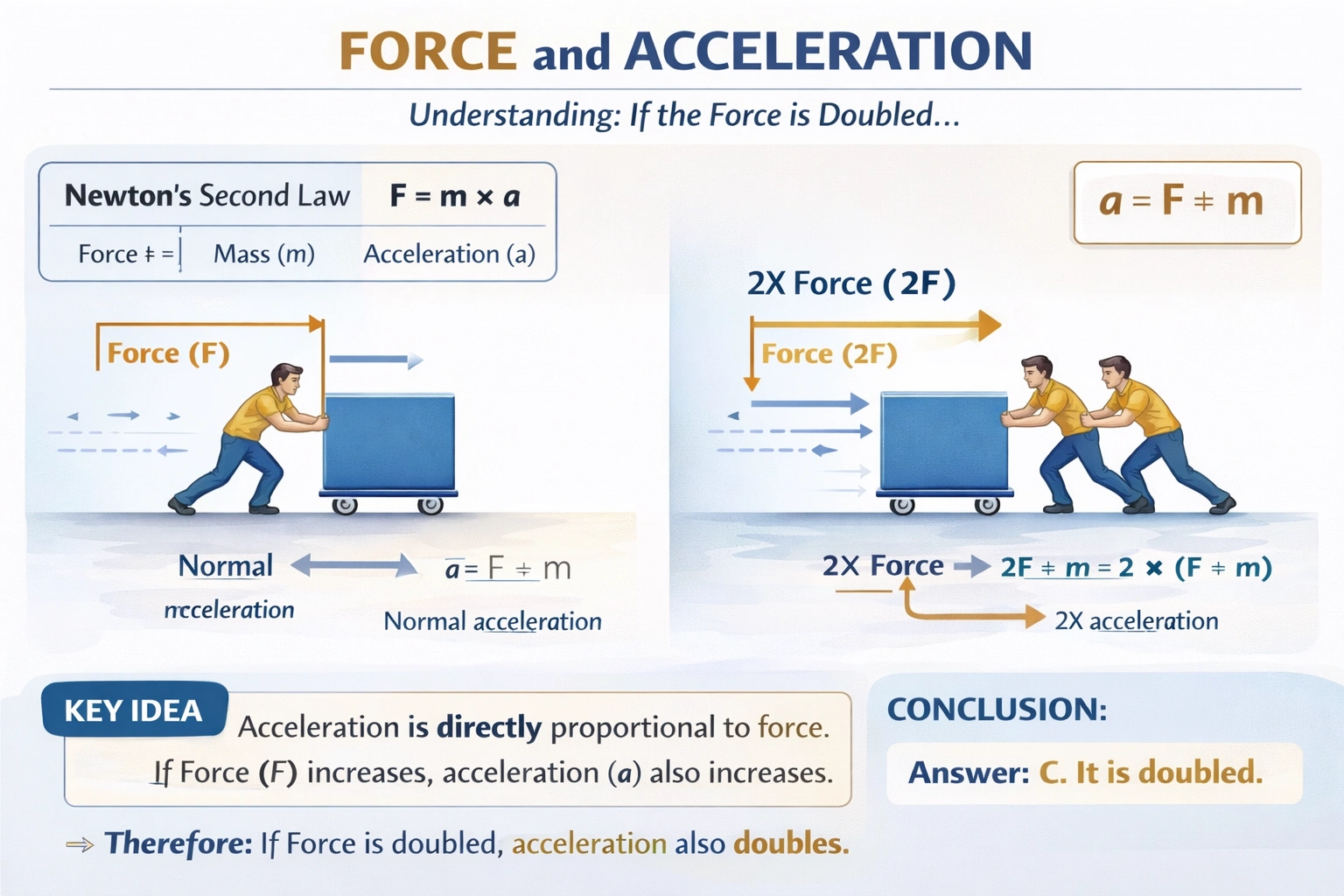
If the force on an object is doubled, how does its acceleration change?
A.
It remains the same.
B. It is halved.
C. It is doubled.
D. It is eliminated.
Rationale
Doubling the net force applied to an object directly doubles its acceleration, assuming mass remains constant, as dictated by Newton's second law of motion.
A) It remains the same. This option contradicts Newton's second law, which establishes a direct proportionality between net force and acceleration. If force doubled while acceleration stayed constant, the relationship F = ma would require mass to double simultaneously€”an unsupported assumption. Without changes to mass or other forces, acceleration cannot remain unchanged when force increases.
B) It is halved. Suggesting acceleration halves when force doubles implies an inverse relationship, which misapplies Newton's second law. An inverse proportionality between force and acceleration would violate the fundamental equation F = ma and contradict countless experimental observations of motion under varying forces.
C) It is doubled. Newton's second law states that acceleration equals net force divided by mass (a = F/m). When mass remains constant, acceleration scales linearly with force: doubling F yields doubling a. This direct proportionality forms the cornerstone of classical mechanics, enabling predictions of motion from applied forces in contexts ranging from vehicle dynamics to planetary orbits.
D) It is eliminated. Claiming acceleration vanishes when force doubles misinterprets the force-acceleration relationship. Elimination of acceleration would require net force to reach zero, not increase. This option confuses the effects of balanced versus unbalanced forces and fails to recognize that greater unbalanced force produces greater acceleration, not its absence.
Conclusion Newton's second law (F = ma) establishes that acceleration responds linearly to changes in net force when mass is constant. Doubling force doubles acceleration€”a principle essential for engineering safe vehicles, designing mechanical systems, and understanding motion in everyday life. This direct proportionality underscores why controlling applied forces allows precise manipulation of an object's acceleration in technological and scientific applications.
Which property of a substance does not change with a change in temperature?
A.
Mass
B. Volume
C. Phase
D. Solubility
Rationale
Mass remains invariant with temperature changes, as it measures the quantity of matter present regardless of thermal conditions or physical state alterations.
A) Mass Mass quantifies the amount of matter in an object and remains constant regardless of temperature fluctuations, location, or physical state. Whether a substance is heated, cooled, melted, or frozen, its mass€”the total number of atoms or molecules€”does not change unless matter is added or removed. This conservation principle underpins chemical reactions, phase transitions, and thermodynamic analyses.
B) Volume Volume typically expands with increasing temperature and contracts with decreasing temperature due to thermal expansion. As particles gain kinetic energy, they vibrate more vigorously and occupy greater average separation, increasing the substance's volume. This temperature dependence makes volume an unreliable constant property across thermal variations.
C) Phase Phase€”solid, liquid, or gas€”depends critically on temperature and pressure. Water freezes at 0°C and boils at 100°C under standard pressure, demonstrating how temperature changes directly trigger phase transitions. Since phase varies with thermal conditions, it cannot represent a temperature-invariant property.
D) Solubility Solubility, the maximum amount of solute that dissolves in a solvent, generally changes with temperature. For most solids in liquids, solubility increases with rising temperature; for gases in liquids, solubility typically decreases. This temperature sensitivity makes solubility unsuitable as a constant property across thermal changes.
Conclusion Mass represents a fundamental, conserved quantity in classical physics, independent of temperature, pressure, or physical state. While volume, phase, and solubility respond dynamically to thermal variations, mass remains fixed unless matter itself is added or removed. This invariance enables accurate measurements in chemistry, engineering, and everyday applications€”from cooking to spacecraft design€”where tracking matter quantity is essential despite environmental changes.

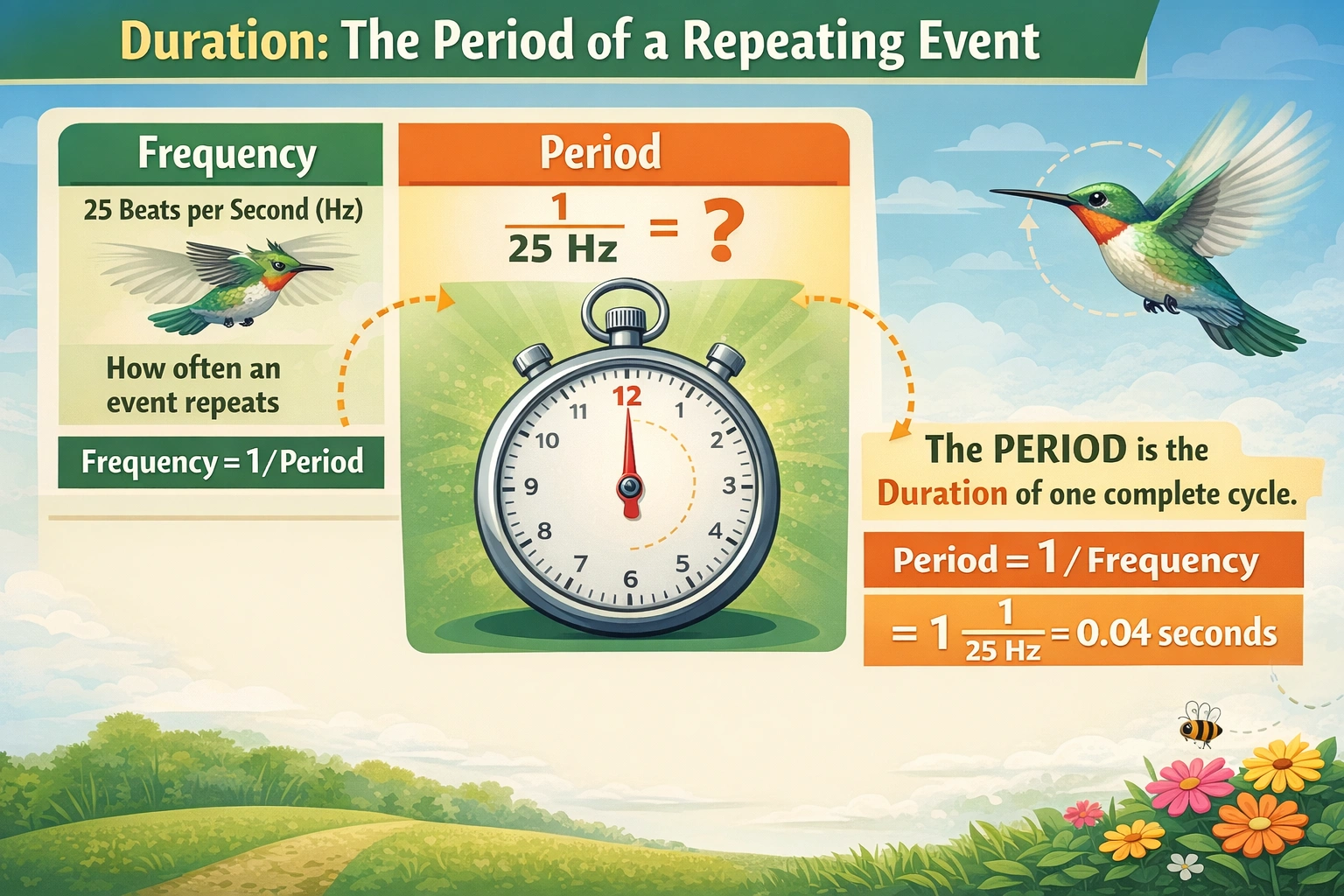
A hummingbird's wings beat at 25 beats per second. What is the period of the wing beating in seconds?
A.
0.04 s
B. 0.25 s
C. 0.4 s
D. 4 s
Rationale
The period of the wing beating is 0.04 seconds, representing the time for one complete beat cycle and calculated as the reciprocal of frequency.
A) 0.04 s Period (T) and frequency (f) are reciprocally related: T = 1/f. Given f = 25 Hz (beats per second), T = 1/25 s = 0.04 s. This calculation correctly converts frequency to period, quantifying the duration of one wingbeat cycle.
B) 0.25 s This value misplaces the decimal or incorrectly computes 1/4 instead of 1/25. While 0.25 s corresponds to a frequency of 4 Hz, it does not match the given 25 Hz wingbeat rate, making this option inconsistent with the reciprocal relationship.
C) 0.4 s A period of 0.4 s implies a frequency of 2.5 Hz (1/0.4), far slower than the hummingbird's actual 25 Hz wingbeat. This option misapplies the frequency-period conversion by a factor of ten, yielding an unrealistically slow oscillation for hummingbird flight.
D) 4 s A 4-second period corresponds to a mere 0.25 Hz frequency€”one beat every four seconds€”which contradicts the hummingbird's rapid wing motion. This extreme miscalculation highlights the importance of correctly applying reciprocal relationships in oscillatory motion analysis.
Conclusion Frequency and period describe complementary aspects of periodic motion: frequency counts cycles per second, while period measures seconds per cycle. Their reciprocal relationship (T = 1/f) enables conversion between these perspectives, crucial for analyzing waves, vibrations, and oscillatory systems€”from hummingbird flight to alternating current circuits and musical instruments.
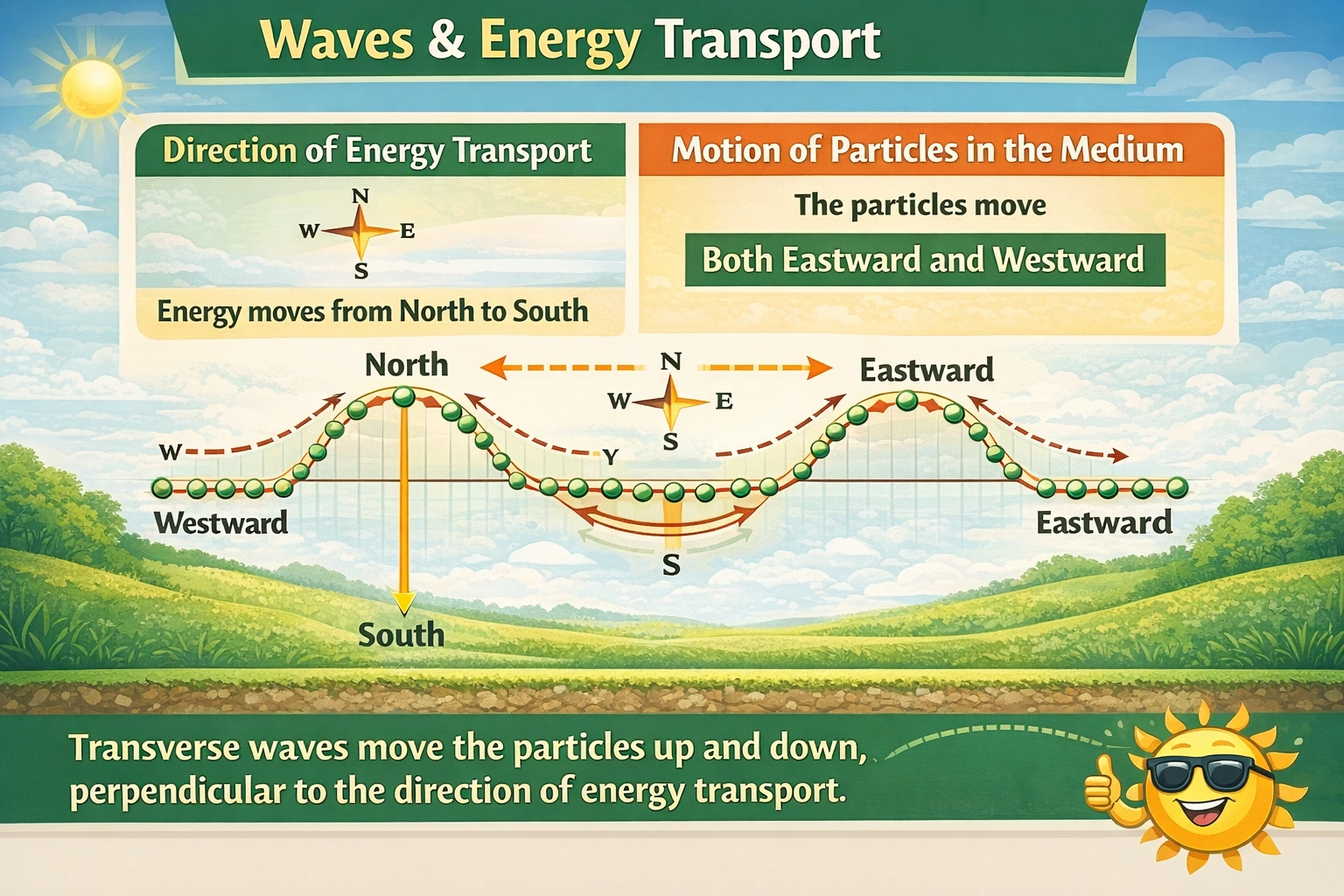
A transverse wave transports energy from north to south. In what direction do the particles in the medium move?
A.
Only north to south
B. Both northward and southward
C. Only east to west
D. Both eastward and westward
Rationale
Particles in the medium move both eastward and westward, oscillating perpendicular to the wave's north-south energy transport direction, which defines transverse wave motion.
A) Only north to south This option describes longitudinal wave motion, where particles oscillate parallel to energy propagation. Transverse waves, by definition, feature particle motion perpendicular to the direction of energy transfer, making parallel oscillation inconsistent with the wave type specified.
B) Both northward and southward Oscillation along the north-south axis again implies longitudinal motion. While particles in any wave move bidirectionally about an equilibrium position, transverse waves require this motion to be perpendicular€”not parallel€”to the energy flow direction.
C) Only east to west Restricting particle motion to a single perpendicular direction (east to west) ignores the oscillatory nature of wave motion. Particles in transverse waves move back-and-forth across the equilibrium position, requiring bidirectional motion (both eastward and westward) to complete each cycle.
D) Both eastward and westward Transverse waves feature particle oscillations perpendicular to the direction of energy propagation. With energy moving north to south, particles oscillate along an east-west axis, moving both eastward and westward about their equilibrium positions. This bidirectional perpendicular motion transfers energy without net particle displacement, characteristic of transverse wave behavior in strings, electromagnetic fields, and surface water waves.
Conclusion Transverse waves transport energy via particle oscillations perpendicular to the propagation direction, distinguishing them from longitudinal waves where oscillations align with energy flow. This perpendicular relationship enables phenomena like polarization in light and wave propagation along strings. Understanding particle motion direction relative to energy transport is fundamental for analyzing wave behavior in optics, seismology, and communication technologies.
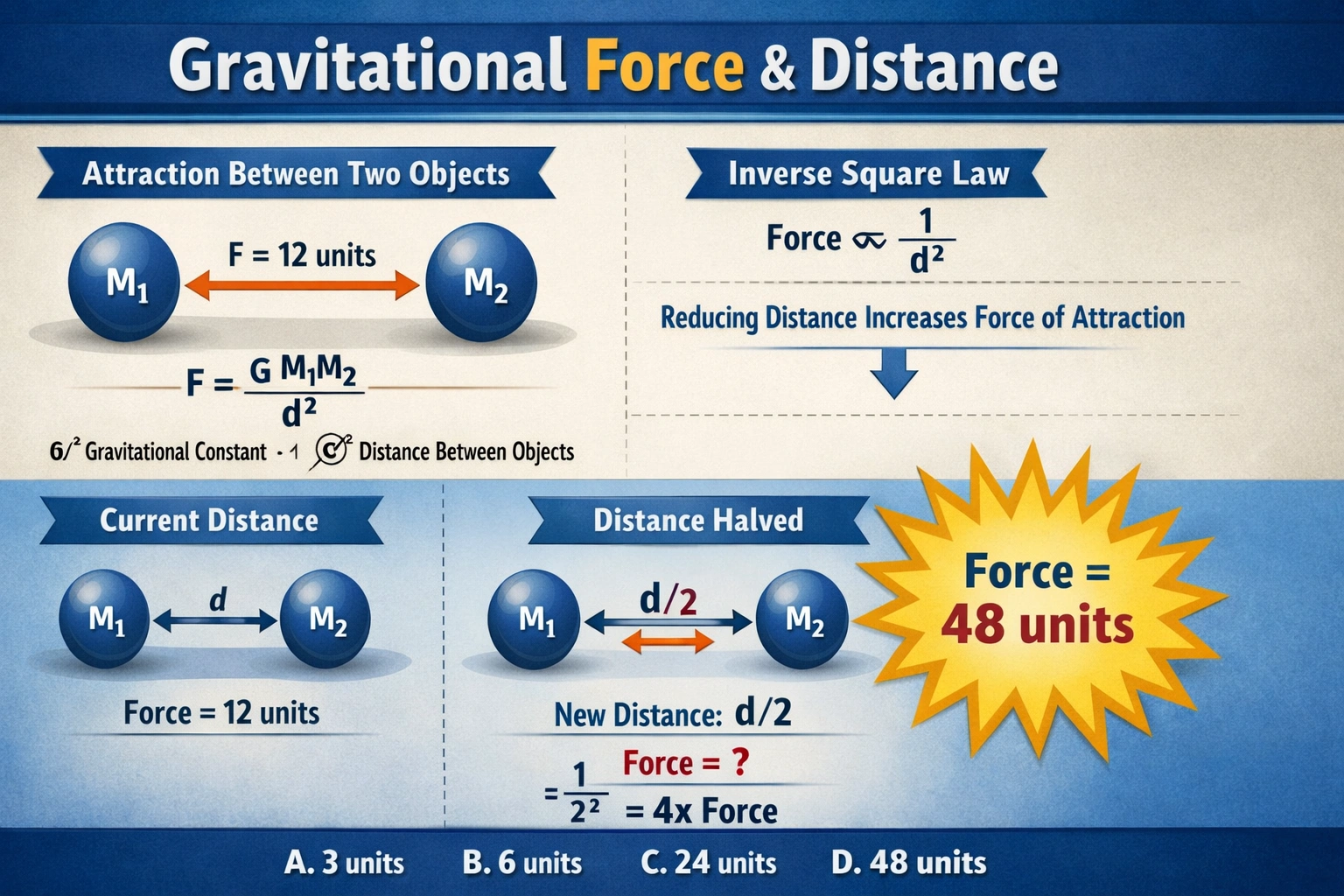
Two objects attract each other with a gravitational force of 12 units. If the distance between them is halved, what is the new force of attraction between the two objects?
A.
3 units
B. 6 units
C. 24 units
D. 48 units
Rationale
Halving the distance between the objects increases the gravitational force to 48 units, as gravitational force varies inversely with the square of the separation distance.
A) 3 units This value incorrectly assumes force scales linearly with distance or applies an inverse (not inverse-square) relationship. Reducing distance should increase gravitational attraction, not decrease it, making this option directionally and mathematically flawed.
B) 6 units Halving the force when halving distance implies a direct proportionality between force and distance, contradicting Newton's law of universal gravitation. Gravitational force strengthens as objects approach, so this option misrepresents both the direction and magnitude of change.
C) 24 units This choice correctly recognizes that force increases when distance decreases but applies only an inverse (not inverse-square) relationship: halving distance doubles force (12 x 2 = 24). However, gravity follows an inverse-square law, requiring force to quadruple when distance halves.
D) 48 units Newton's law of universal gravitation states F ˆ 1/r². Halving the separation distance (r †’ r/2) increases force by a factor of 1/(½)² = 4. Thus, the new force equals 12 units x 4 = 48 units. This calculation correctly applies the inverse-square dependence fundamental to gravitational, electrostatic, and electromagnetic field interactions.
Conclusion The inverse-square law governs gravitational force: doubling distance quarters the force, while halving distance quadruples it. This relationship explains planetary orbits, satellite trajectories, and tidal forces. Understanding how force scales with distance enables predictions in astrophysics, aerospace engineering, and fundamental physics, highlighting the profound connection between geometry and natural law.
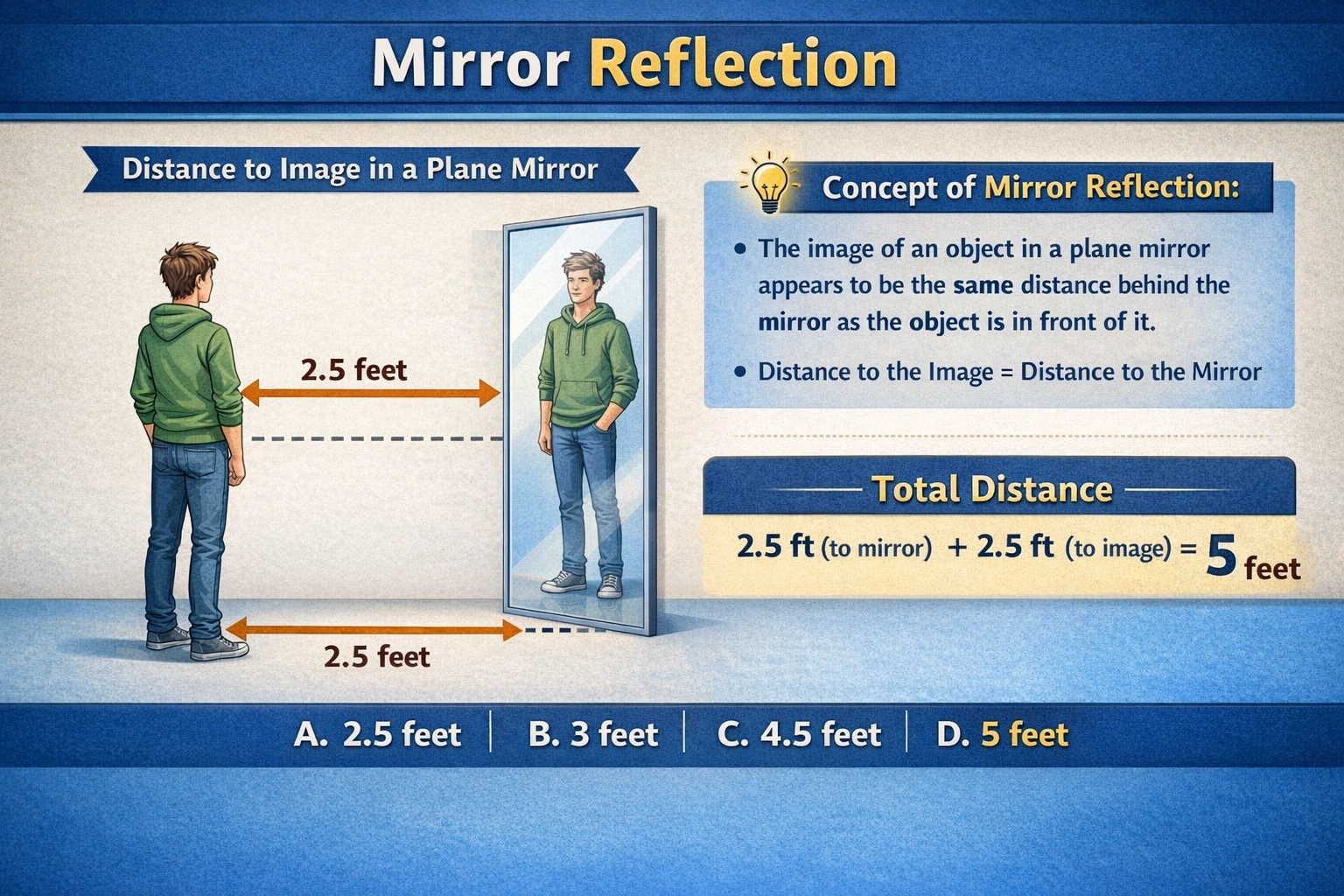
Jack stands in front of a plane mirror. If he is 2.5 feet away from the mirror, how far away from Jack is his image?
A.
2.5 feet
B. 3 feet
C. 4.5 feet
D. 5 feet
Rationale
Jack's image appears 5 feet away from him, as plane mirrors produce virtual images located as far behind the mirror as the object stands in front, doubling the object-mirror distance for total object-image separation.
A) 2.5 feet This value equals Jack's distance to the mirror but ignores that his image forms an equal distance behind the mirror. The total separation between Jack and his image spans both the front and back distances, requiring addition of the two 2.5-foot segments.
B) 3 feet This arbitrary value lacks basis in plane mirror optics. Image location in plane mirrors depends strictly on object distance, with no intermediate or rounded values€”image distance behind mirror exactly equals object distance in front.
C) 4.5 feet While closer to the correct value, this option misapplies the mirror equation or introduces unwarranted approximation. Plane mirror image formation follows exact geometric symmetry: object and image distances from the mirror are precisely equal, yielding a total separation of exactly twice the object-mirror distance.
D) 5 feet Plane mirrors create virtual images with object distance (d‚’) equal to image distance (dáµ¢) behind the mirror: dáµ¢ = d‚’ = 2.5 feet. The total distance between object and image equals d‚’ + dáµ¢ = 2.5 ft + 2.5 ft = 5 feet. This geometric relationship holds for all plane mirror configurations, independent of observer position or mirror size.
Conclusion Plane mirror optics obey simple geometric symmetry: images form as far behind the mirror as objects stand in front, creating virtual, upright, same-size images. This principle enables applications from personal grooming to periscopes and optical instruments. Understanding image location rules facilitates analysis of more complex mirror and lens systems in photography, telescopes, and vision correction.
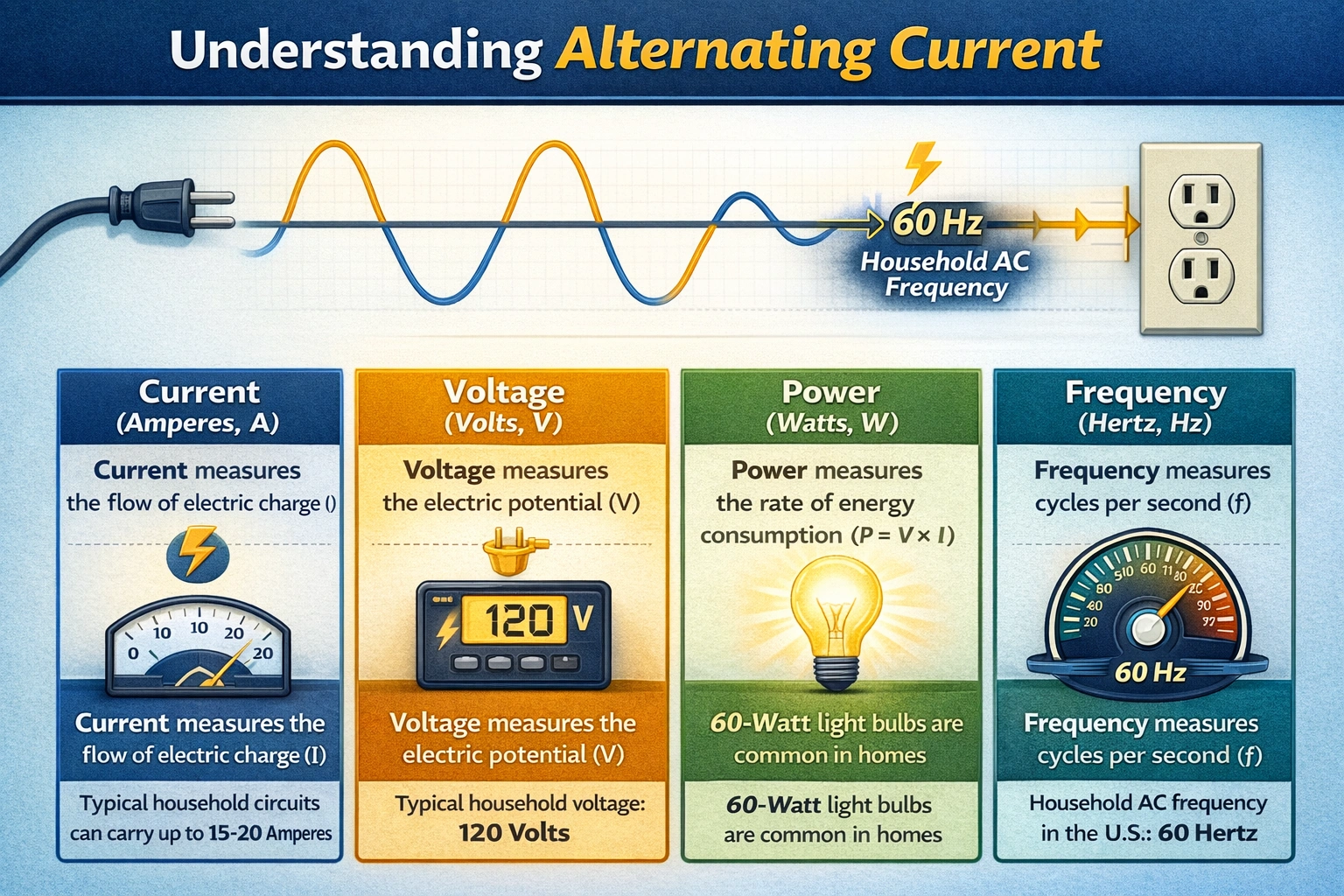
Household alternating current typically has a frequency of 60 Hz. Which statement is true?
A.
The circuit is appropriate for lighting 60-watt bulbs.
B. Circuits in the home may carry a current of 60 amperes.
C. The expected voltage drop is 60 volts per meter.
D. Electrons complete a cycle 60 times per second.
Rationale
Electrons complete a cycle 60 times per second in 60 Hz alternating current, reflecting the definition of frequency as oscillations per unit time in AC systems.
A) The circuit is appropriate for lighting 60-watt bulbs. Bulb wattage rating indicates power consumption, not compatibility with supply frequency. While 60-watt bulbs operate on standard household voltage, their suitability depends on voltage rating, not the 60 Hz frequency. This option conflates power rating with frequency specification.
B) Circuits in the home may carry a current of 60 amperes. Household circuits typically carry 15€“20 amperes per branch; 60 amperes would require heavy-gauge wiring and special protection. While main service panels may handle 60+ amperes total, individual circuits do not, and this statement misrepresents typical residential electrical design unrelated to frequency.
C) The expected voltage drop is 60 volts per meter. Voltage drop depends on wire resistance, current, and length€”not supply frequency. Household voltage is ~120 V (US) or ~230 V (EU) RMS, with drops of a few volts over typical circuit lengths. This option invents a nonexistent relationship between frequency and voltage gradient.
D) Electrons complete a cycle 60 times per second. Frequency measures oscillations per second: 60 Hz means the current direction reverses 120 times per second (60 complete cycles), with electrons oscillating back-and-forth 60 times yearly. This statement correctly interprets frequency as the rate of cyclic change in alternating current, fundamental to AC power distribution and electronic device operation.
Conclusion Alternating current frequency (60 Hz in North America, 50 Hz elsewhere) defines how rapidly voltage and current oscillate, influencing transformer design, motor operation, and electronic device compatibility. Understanding frequency as cycles per second enables proper selection of equipment, analysis of AC circuits, and appreciation of power grid synchronization€”critical for electrical engineering and safe household electricity use.
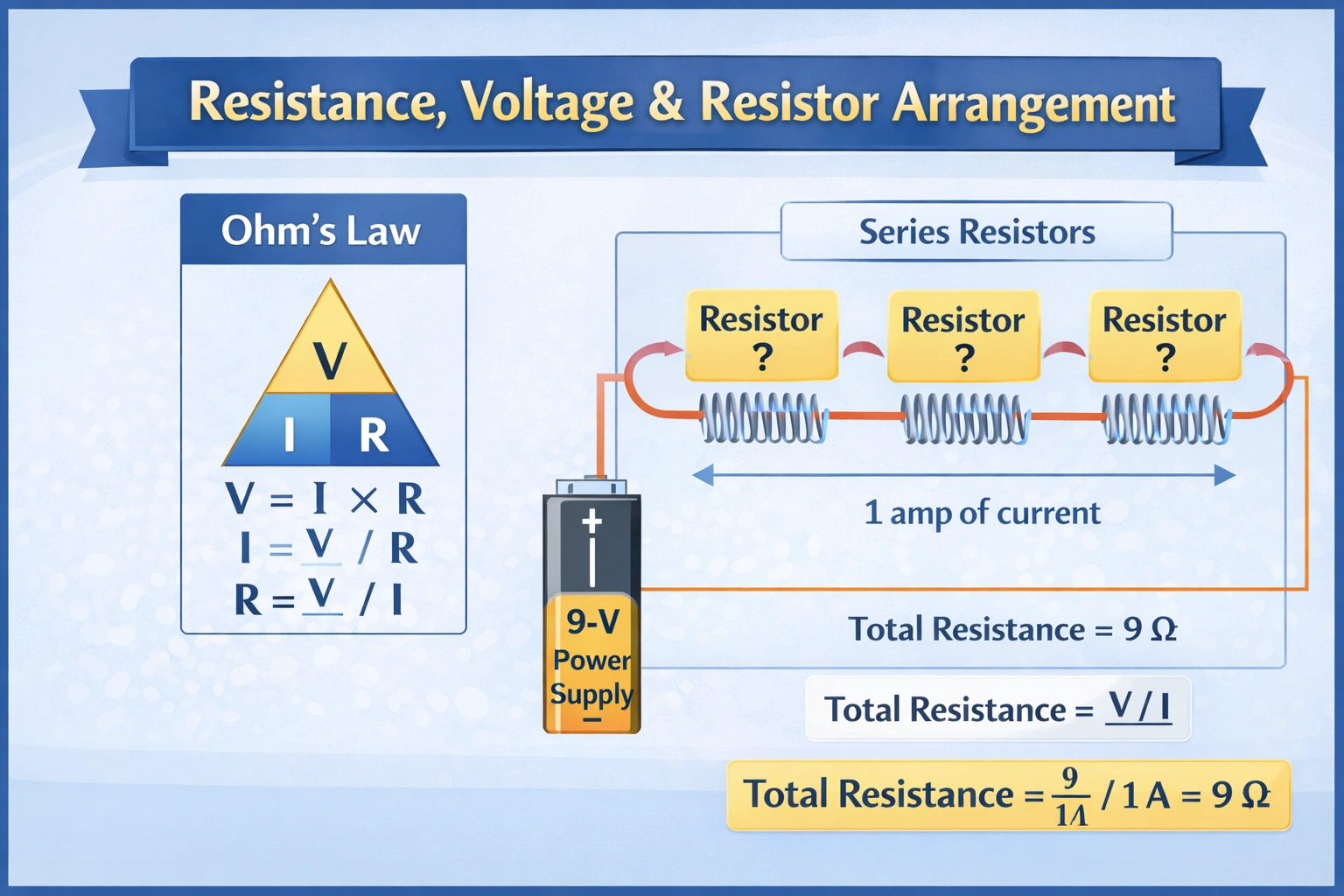
A circuit consists of three same-size resistors, wired in series to a 9-V power supply and producing 1 amp of current. What is the resistance of each resistor?
A.
9 ohms
B. 6 ohms
C. 3 ohms
D. 1 ohm
Rationale
Each resistor has a resistance of 3 ohms, determined by applying Ohm's law to the series circuit and dividing total resistance equally among the three identical components.
A) 9 ohms This value equals the supply voltage but ignores current and series resistance addition. Total circuit resistance is V/I = 9 V / 1 A = 9 Ω; dividing this equally among three identical series resistors yields 3 Ω each, not 9 Ω per resistor.
B) 6 ohms Assigning 6 Ω per resistor would yield 18 Ω total resistance (3 x 6 Ω), requiring only 0.5 A current at 9 V (I = V/R = 9/18 = 0.5 A), contradicting the given 1 A. This option miscalculates the series resistance distribution.
C) 3 ohms Ohm's law gives total resistance: R_total = V/I = 9 V / 1 A = 9 Ω. For three identical resistors in series, R_total = R‚ + R‚‚ + R‚ƒ = 3R. Solving: 3R = 9 Ω †’ R = 3 Ω per resistor. This calculation correctly applies series resistance rules and Ohm's law.
D) 1 ohm One ohm per resistor would yield 3 Ω total resistance, producing 3 A current at 9 V (I = 9 V / 3 Ω = 3 A), tripling the given current. This option underestimates individual resistance, violating the observed circuit behavior.
Conclusion Series circuits sum individual resistances to determine total opposition to current, while Ohm's law (V = IR) links voltage, current, and resistance. Combining these principles enables calculation of unknown component values from measurable circuit parameters. This analytical approach underpins circuit design, troubleshooting, and component selection in electronics from simple devices to complex systems.
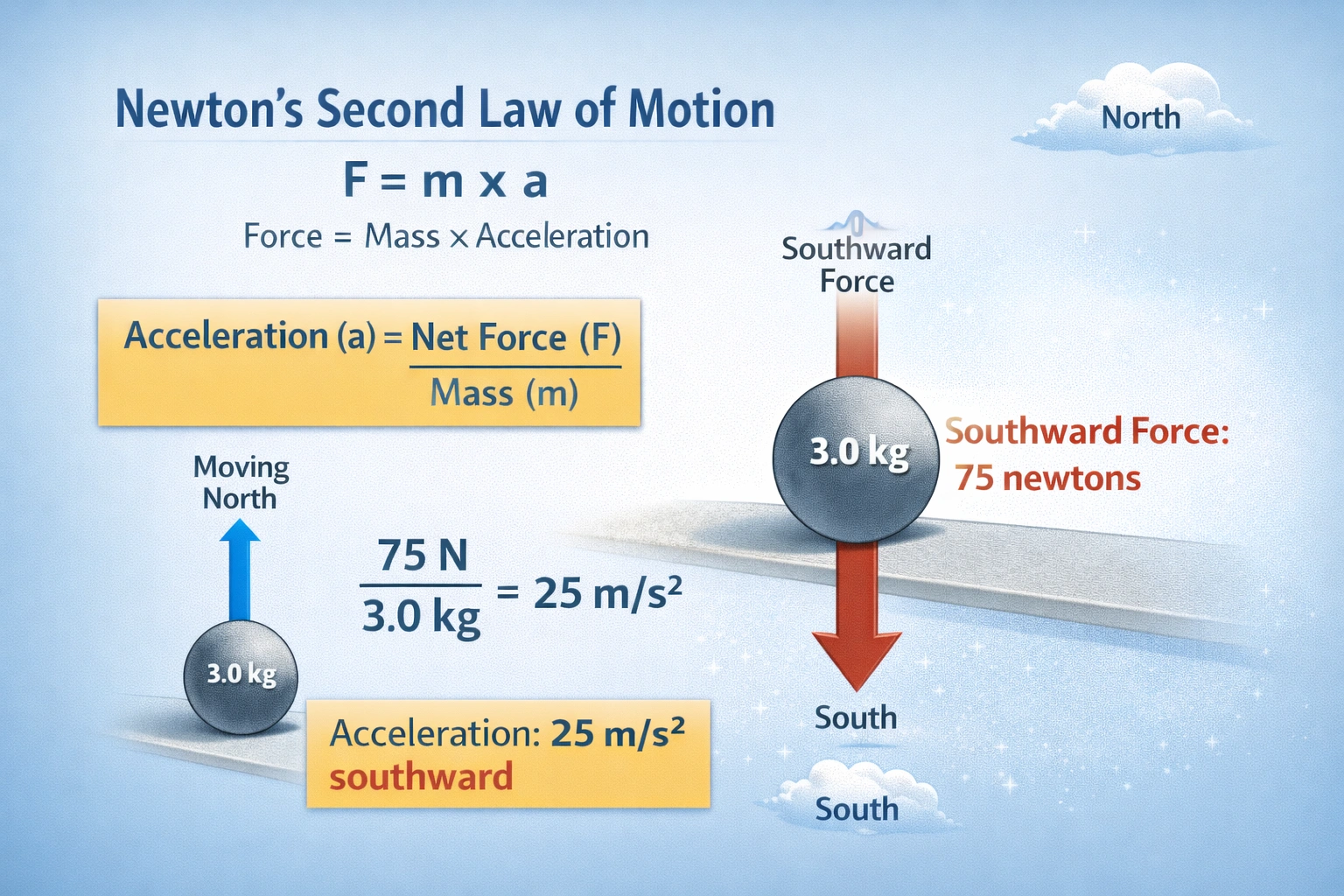
A 3.0-kilogram object moving northward experiences a southward force of 75 newtons. What is its acceleration?
A.
25 m/s? northward
B. 25 m/s? southward
C. 225 m/s? northward
D. 225 m/s? southward
Rationale
The object's acceleration is 25 m/s² southward.
Newton's Second Law is a vector equation: F_net = ma. This means the acceleration vector points in the same direction as the net force vector. The object's initial northward velocity is irrelevant for determining the direction of the acceleration produced by the applied force. The acceleration describes the change in velocity, not the velocity itself. A force opposing the direction of motion will produce an acceleration that reduces the object's speed in that direction and may eventually reverse it.
A) 25 m/s² northward
This option assigns the correct magnitude but the wrong direction. A southward force cannot produce a northward acceleration. If a northward-moving object experienced a northward acceleration, its northward speed would increase. A southward force acts to decrease the northward speed, meaning the acceleration (change in velocity) must be southward. This option violates the fundamental vector nature of Newton's Second Law.
B) 25 m/s² southward
The magnitude is calculated correctly: a = F/m = 75 N/3.0 kg = 25 m/s². Critically, because the net force is directed southward, the resulting acceleration vector must also be directed southward. This southward acceleration will act against the initial northward velocity. If the force continues to act, the object will slow down, come to a momentary stop, and then begin moving southward.
C) 225 m/s² northward
This option is incorrect in both magnitude and direction. The magnitude 225 results from multiplying force and mass (75 x 3.0 = 225) instead of dividing. This is a misapplication of the formula. Furthermore, assigning a northward direction compounds the error, as it suggests the force causes an acceleration in the opposite direction, which is physically impossible according to Newton's Second Law.
D) 225 m/s² southward
While this option correctly identifies the direction of acceleration (southward, matching the force), the magnitude is wrong due to the same multiplication error as in option C. The formula for acceleration requires division (a = F/m), not multiplication. Using the product gives a number with incorrect units (N·kg) and a value that is nine times larger than the true acceleration.
Conclusion
The solution requires a two-part analysis: calculating the magnitude of acceleration via a = F/m, and determining its direction from the direction of the net force. The initial motion of the object does not affect the direction of the acceleration caused by a new force. A southward force of 75 N on a 3.0 kg mass produces a southward acceleration of 25 m/s². This acceleration will change the object's velocity vector, ultimately opposing its initial northward motion.
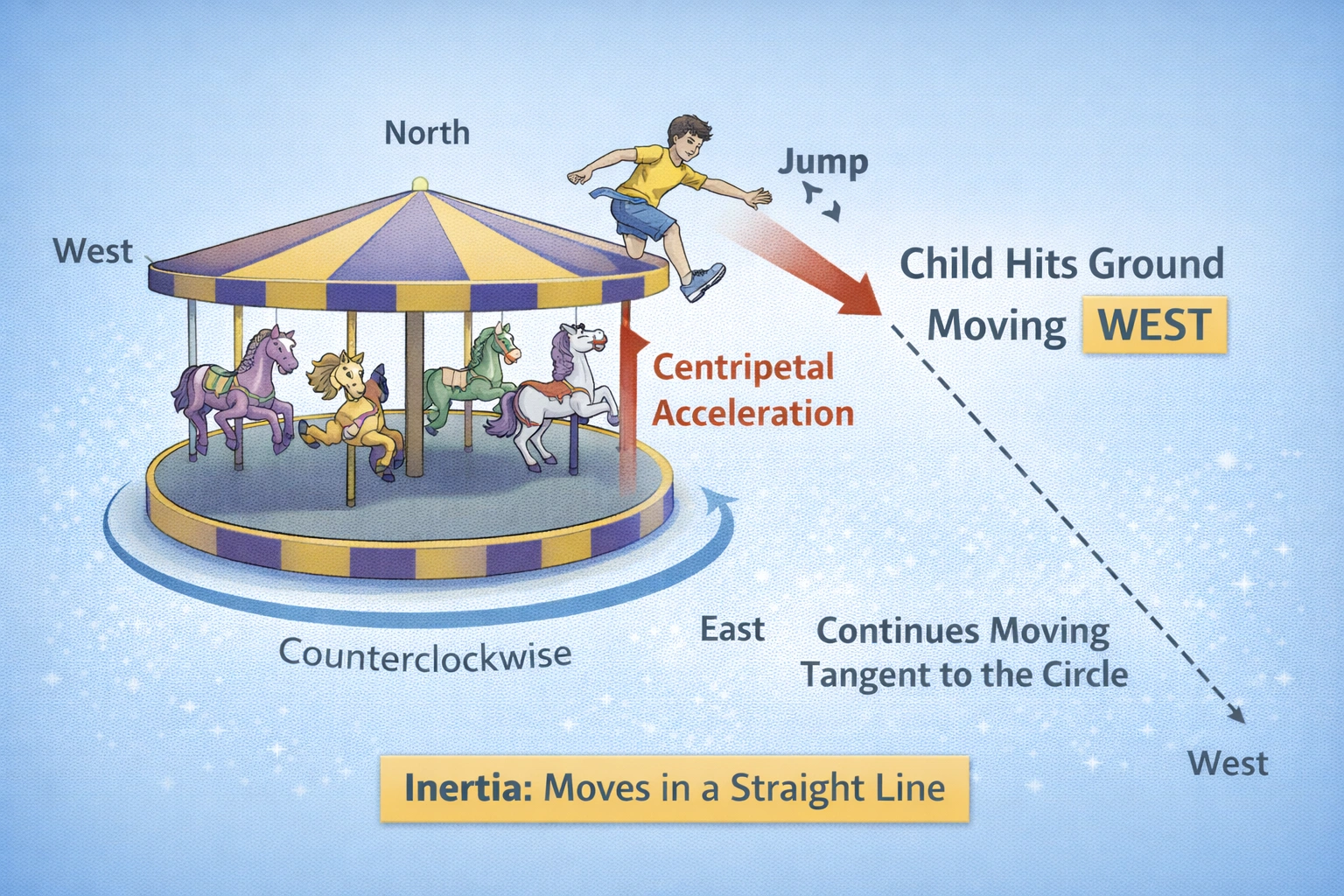
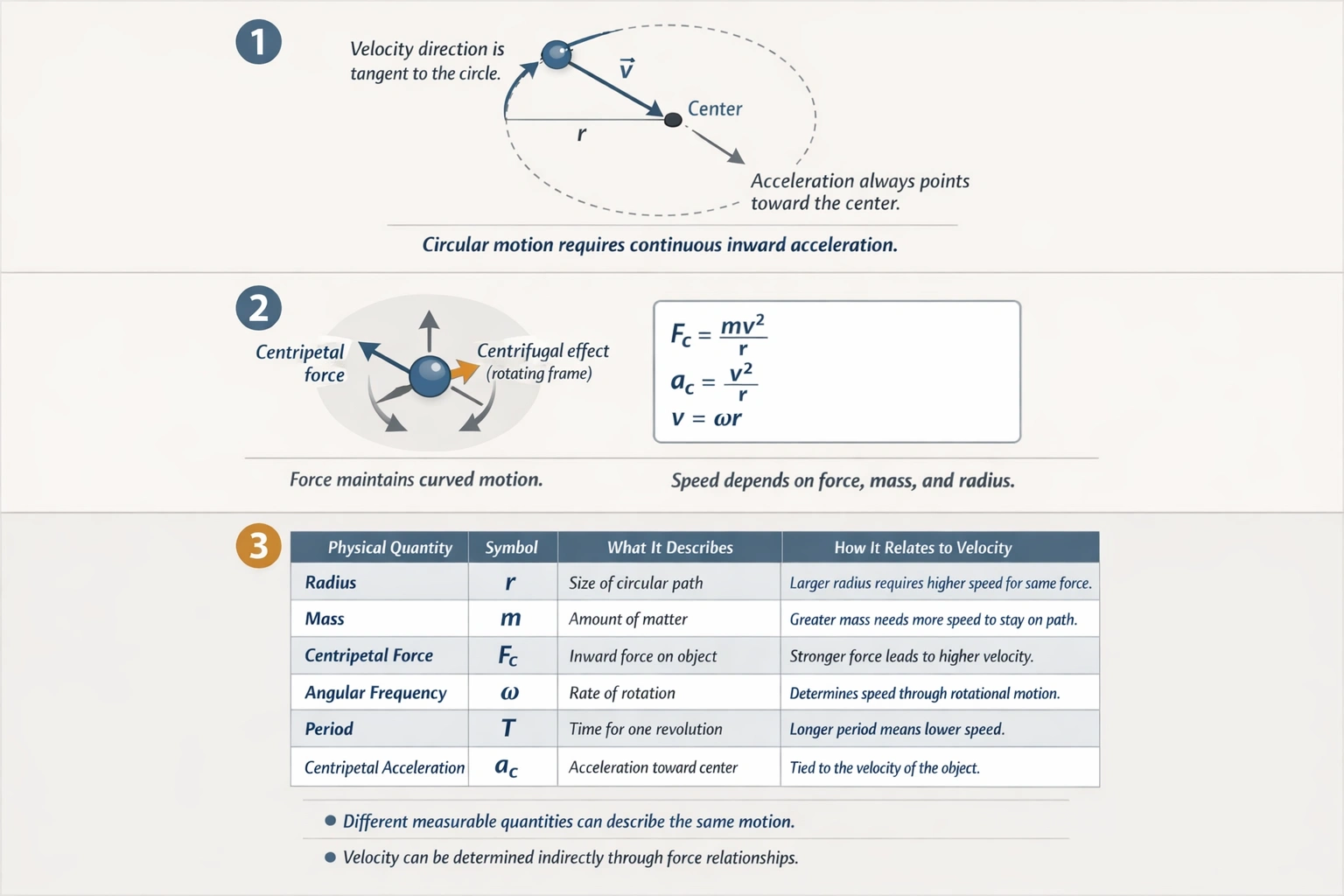
A merry-go-round is spinning counterclockwise. If a child riding the merry-go-round jumps off when he is experiencing centripetal acceleration directed southward in what direction will he be moving when he hits the ground?
A.
East
B. North
C. South
D. West
Rationale
The child will be moving westward when he hits the ground.
In uniform circular motion, the centripetal acceleration is always directed radially inward, toward the center of the circle. The instantaneous velocity of the object is always tangential to the circle, perpendicular to the radius at that point. When the child jumps off, he is released from the centripetal force that was constraining him to circular motion. According to Newton's First Law (the law of inertia), he will then continue moving in a straight line with the instantaneous velocity he had at the exact moment of release.
A) East
An eastward tangential velocity would correspond to a point on the western side of a counterclockwise circle. At a point on the west side, the radius points east, so the centripetal acceleration (inward) would be eastward. This contradicts the given condition that the acceleration is southward at the jump point.
B) North
A northward tangential velocity occurs at the bottom (southernmost) point of a counterclockwise circle. At that point, the radius points north toward the center, so the centripetal acceleration is northward. This is the opposite of the stated southward acceleration.
C) South
The child's motion is tangential, not radial. The centripetal acceleration is southward, meaning it points toward the center from the child's position. If the acceleration is southward, the center lies to the south of the child. Therefore, the child must be at the northernmost point of the circle. At the northern point of a counterclockwise circle, the tangential velocity is directed west (or east, depending on rotation direction). It is never directed south, as that would be either toward or directly away from the center, not tangent to the path.
D) West
For an object moving counterclockwise, if the centripetal acceleration is directed southward, the center of the circle is directly south of the child's position. This places the child at the top (northernmost) point of the circular path. At the top of a counterclockwise circle, the instantaneous tangential velocity is directed horizontally to the west. The moment the child jumps, he is projected off on this westward tangent. He will travel in a straight line westward (ignoring gravity's initial effect) until he hits the ground a short distance away.
Conclusion
The key is to link the direction of the centripetal acceleration to the child's position on the circle, and then recall the direction of tangential velocity for counterclockwise rotation at that position. A southward acceleration places the child at the top. At the top, the velocity is perpendicular to the north-south radius line, which for counterclockwise motion is west. Therefore, upon release, inertia carries the child westward.
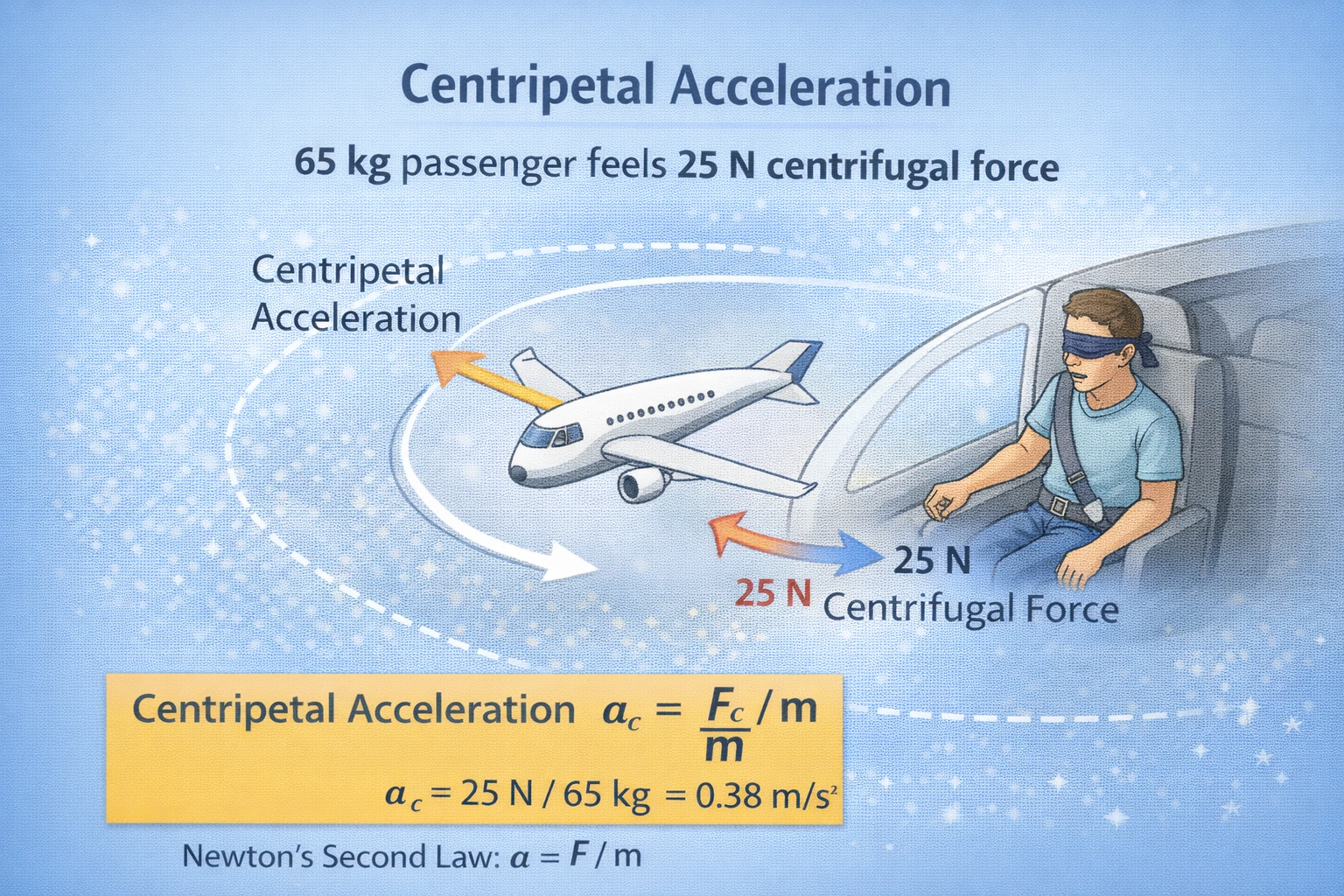
A plane is flying at a constant speed on a circular path as the pilots wait for permission to land. If a 65-kilogram passenger feels a centrifugal force of 25 newtons, what is the plane's centripetal acceleration?
A.
0.38 m/s?
B. 0.76 m/s?
C. 2.6 m/s?
D. 1,600 m/s?
Rationale
The plane's centripetal acceleration is 0.38 m/s².
The centrifugal force is a fictitious force that appears to act in a rotating (non-inertial) reference frame, such as the frame of the turning airplane. It is directed radially outward from the center of rotation. Its magnitude is equal to the mass times the centripetal acceleration, but it points in the opposite direction. In other words, from the passenger's perspective seated in the plane, they feel pushed outward against the seat with a force of 25 N. This "outward" force they feel is their inertia resisting the inward centripetal acceleration that is actually acting on them. Therefore, the magnitude of the real centripetal force causing the turn is also 25 N.
A) 0.38 m/s²
The perceived centrifugal force on the passenger is F_c = 25N. In the rotating frame, this force balances the passenger's inertia. The real centripetal force F_c acting on the passenger (and the plane) has the same magnitude: F_c = 25N. Using Newton's second law for circular motion, F_c = ma_c, where a_c is the centripetal acceleration. Solving for acceleration: a_c = F_c/m = 25 N/65 kg ‰ˆ 0.3846 m/s², which rounds to 0.38 m/s².
B) 0.76 m/s²
This value is approximately double the correct answer. It could result from mistakenly using the formula a = 2F/m or from a calculation error like 50N/65kg. There is no physical basis for doubling the force in this context.
C) 2.6 m/s²
This value is close to 25N/9.8kg. It appears to come from incorrectly dividing the force by the acceleration due to gravity (g) instead of by the passenger's mass. This reflects a confusion between weight, mass, and acceleration.
D) 1,600 m/s²
This extremely large acceleration (over 160 times Earth's gravity) would be lethal. It results from a severe dimensional error, specifically multiplying force and mass: 25N x 65kg = 1625N·kg, which is not a valid unit for acceleration. This mistake confuses the formula F = ma with a = F·m.
Conclusion
The centrifugal force felt in a rotating frame is numerically equal to the centripetal force required for the circular motion. To find the shared centripetal acceleration of the plane and passenger, one takes this force value and divides by the passenger's mass. The result, 0.38 m/s², is a gentle turn, consistent with a plane holding in a waiting pattern.
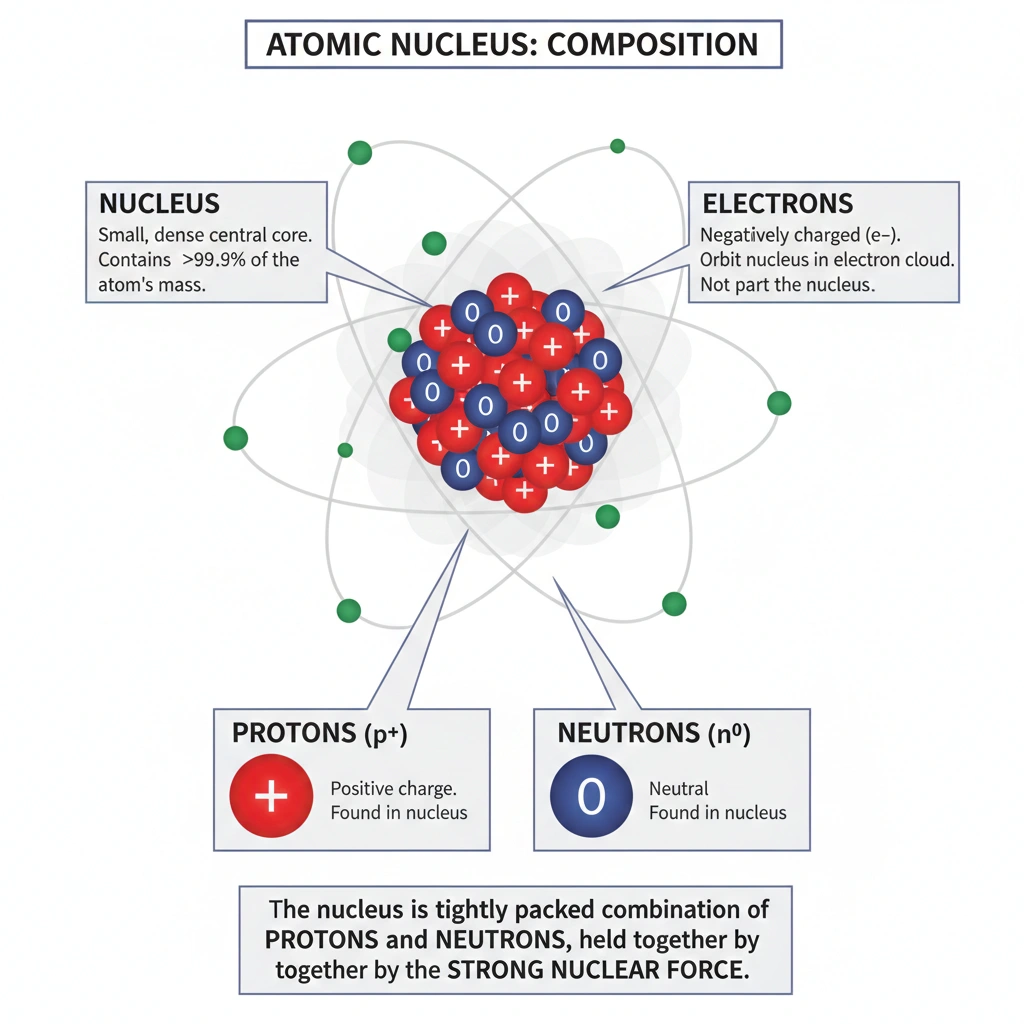
Which of the following best describes an atom's nucleus?
A.
A tightly packed combination of neutrons and protons
B. A tightly packed combination of electrons and protons
C. A tightly packed combination of electrons and neutrons
D. A tightly packed combination of electrons, neutrons, and protons
Rationale
An atom's nucleus is a tightly packed combination of neutrons and protons.
The nucleus is the small, dense, central core of an atom. It contains over 99.9% of the atom's mass but occupies a tiny fraction of its volume. The particles within the nucleus are called nucleons, which include positively charged protons and neutral neutrons. These nucleons are held together by the strong nuclear force, which overcomes the electrostatic repulsion between the positively charged protons. Electrons, which are much lighter and negatively charged, reside in a cloud around the nucleus at distances thousands of times larger than the nucleus itself.
A) A tightly packed combination of neutrons and protons
This is the accurate description. The nucleus is composed exclusively of nucleons€”protons and neutrons€”bound tightly by the strong force. The density of nuclear matter is extremely high, on the order of 10¹· kg/m³.
B) A tightly packed combination of electrons and protons
This is incorrect. Electrons are not found in the nucleus. They are fundamental particles belonging to a different class (leptons) and are not subject to the strong nuclear force that binds the nucleus. Their presence in the nucleus would violate quantum mechanical principles and the observed stability of atoms.
C) A tightly packed combination of electrons and neutrons
This is also incorrect. While neutrons are present in the nucleus (except in the most common isotope of hydrogen, which has just a proton), electrons are not. There is no known bound state consisting solely of electrons and neutrons at the atomic scale.
D) A tightly packed combination of electrons, neutrons, and protons
This option includes all three particles but is misleading because it incorrectly places electrons within the nucleus. In an atom, electrons exist in orbitals outside the nucleus. Their inclusion in the description of the nucleus's composition is a fundamental error in atomic structure.
Conclusion
The modern model of the atom, established by Rutherford's experiments and developed through quantum mechanics, clearly distinguishes between the nucleus and the electron cloud. The nucleus's identity is defined by its composition of protons and neutrons. Electrons, while crucial to the atom's chemical behavior and overall neutrality, are not part of the nuclear core.
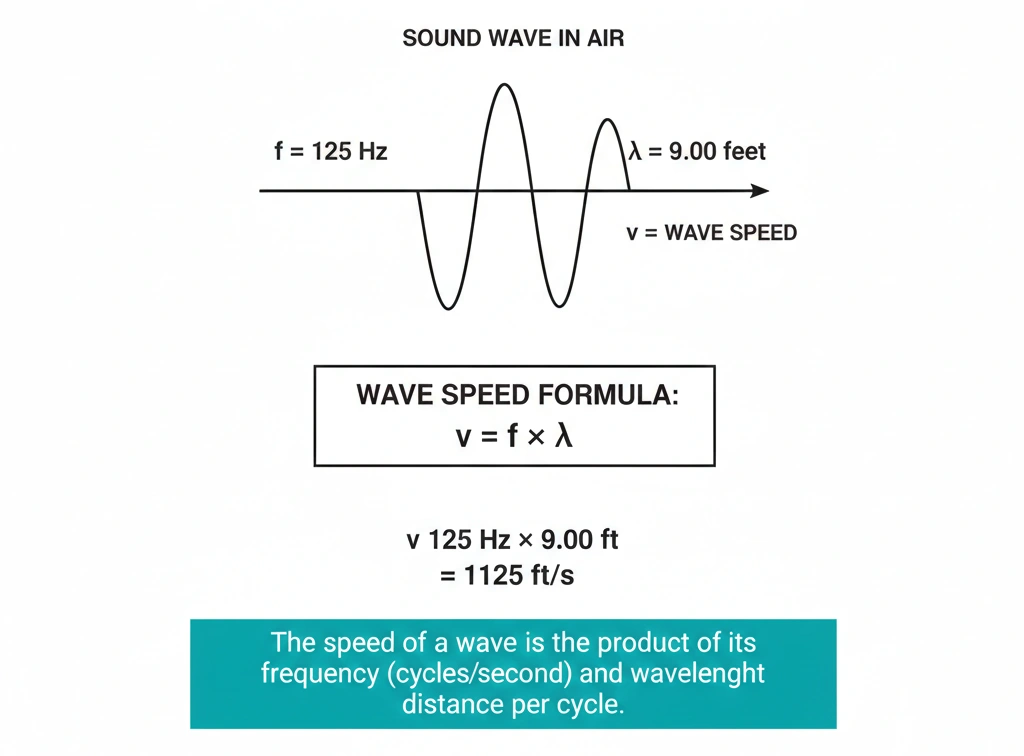
If a sound wave in air at a certain temperature and humidity has a frequency of 125 Hz and a wavelength of 9.00 feet, what is its wave speed?
A.
0.0720 feet per second
B. 13.9 feet per second
C. 134 feet per second
D. 1,125 feet per second
Rationale
The wave speed is 1,125 feet per second.
For any wave, the speed (v), frequency (f), and wavelength (λ) are related by the fundamental wave equation: v = fλ. Frequency is the number of cycles per second, and wavelength is the distance per cycle. Multiplying them gives the distance traveled per second, which is the speed. The units must be consistent; here, frequency is in Hz (cycles per second) and wavelength is in feet (distance per cycle), so the product yields feet per second.
A) 0.0720 feet per second
This value is obtained by dividing the wavelength by the frequency: 9.00 ft/125Hz = 0.0720 ft/Hz, which is not a standard speed unit. This calculation actually yields the period of the wave (seconds per cycle) if units are correctly interpreted, not the speed.
B) 13.9 feet per second
This is approximately 125/9.00 ‰ˆ 13.9. This is the inverse of the previous error€”dividing frequency by wavelength. This gives units of Hz/ft, or cycles per second per foot, which is not speed. It represents the wave number (spatial frequency), not the propagation speed.
C) 134 feet per second
This is an intermediate, incorrect value that may come from a miscalculation such as 125 x 9.00/8.33 or another arithmetic mistake. It does not match the precise product of the given numbers.
D) 1,125 feet per second
The correct calculation is: v = fλ = 125Hz x 9.00ft = 1125 ft/s. This is a straightforward multiplication: 125 cycles/second times 9.00 feet/cycle = 1125 feet/second. This is a plausible speed for sound in air (the speed of sound in dry air at 20°C is about 1125 ft/s, or 343 m/s).
Conclusion
The wave equation v = fλ is universal. Applying it directly with the given values yields a speed of 1,125 ft/s. The other options result from incorrectly inverting the relationship or making arithmetic errors.
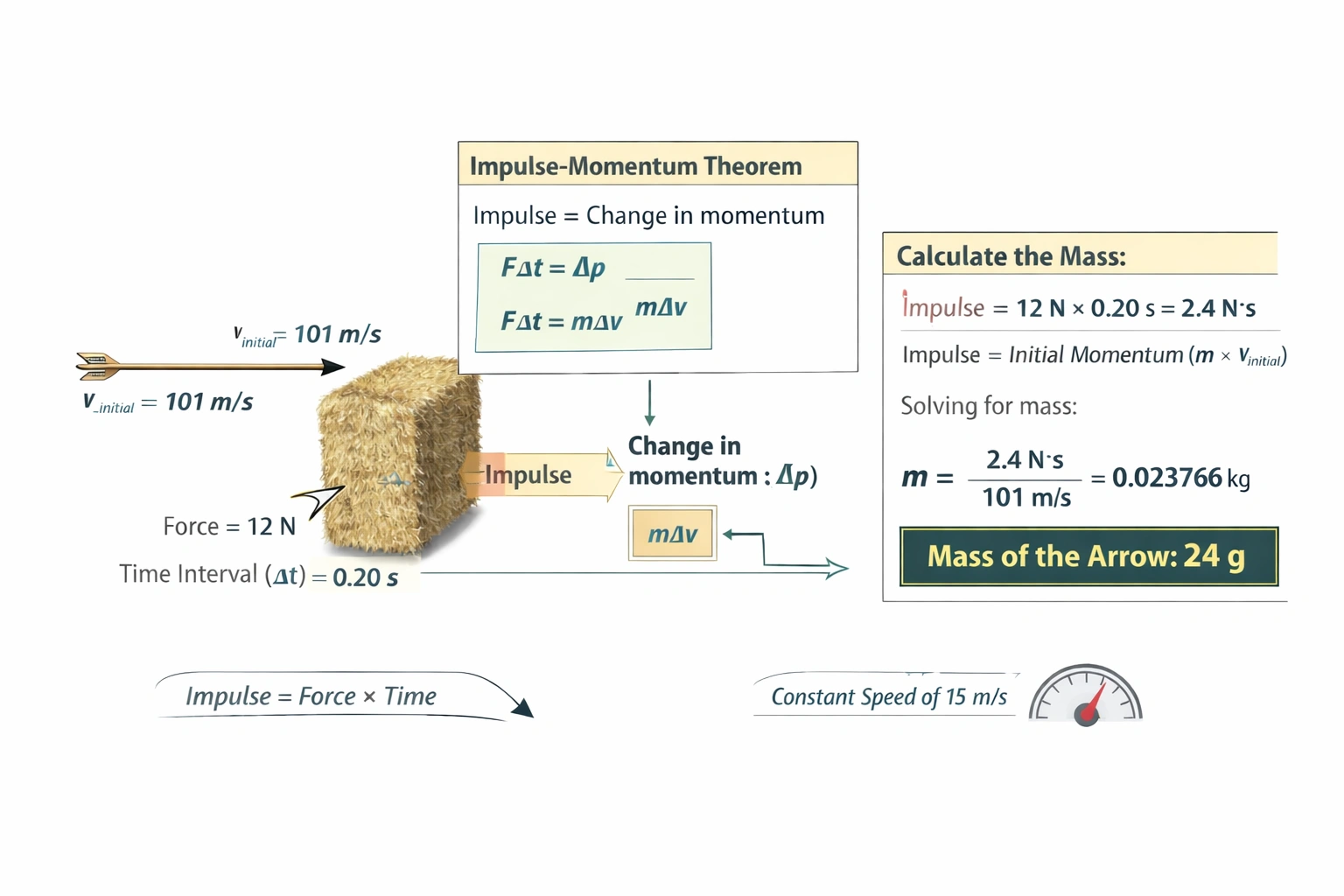
What is the mass in grams of an arrow shot at 101 m/s if a bale of hay imparts 12 N of force during the 0.20 s it takes to halt the arrow?
A.
12
B. 24
C. 36
D. 48
Rationale
The mass of the arrow is 24 grams.
This problem applies the impulse-momentum theorem. The impulse applied to an object (J = FΔt) equals its change in momentum (Δp = mΔv). Here, the arrow's final velocity is 0 m/s, so its change in momentum is mv_initial. The force from the hay acts opposite the arrow's motion to stop it. Therefore, FΔt = mv_initial. Solve for mass: m = FΔt/v_initial. Careful unit conversion from kilograms to grams is needed at the end.
A) 12 g
This is half the correct answer. It might result from an arithmetic error such as m = (12 x 0.20)/(2 x 101) or from incorrectly rounding an intermediate step.
B) 24 g
First, compute the impulse: J = FΔt = 12N x 0.20s = 2.4N·s (or kg·m/s).
This impulse equals the arrow's initial momentum: m x 101m/s = 2.4 kg·m/s.
Solve for mass in kg: m = 2.4/101 ‰ˆ 0.02376kg.
Convert kg to grams: 0.02376kg x 1000g/kg = 23.76g ‰ˆ 24g.
C) 36 g
This could come from an incorrect calculation like m = (12 x 0.30)/101 (using 0.30 s instead of 0.20 s), or from adding the force and time in some way. There's no valid physical basis for this mass.
D) 48 g
This is approximately double the correct answer. It might result from forgetting to divide by the velocity after calculating impulse (m = 2.4kg), then converting that to grams (2400 g) and misplacing the decimal, or from using v = 50.5m/s (half of 101) in the denominator.
Conclusion
Using the impulse-momentum theorem links the stopping force and time to the arrow's initial motion. The calculated mass of about 0.0238 kg, or 24 grams, is a reasonable mass for an arrow. The other options stem from miscalculations of impulse, incorrect algebraic manipulation, or unit conversion errors.
Which of the following represents an electric current?
A.
Electric flux in a vacuum
B. Electrons moving in a wire
C. A disconnected voltage source
D. An electromagnetic wave in a material
Rationale
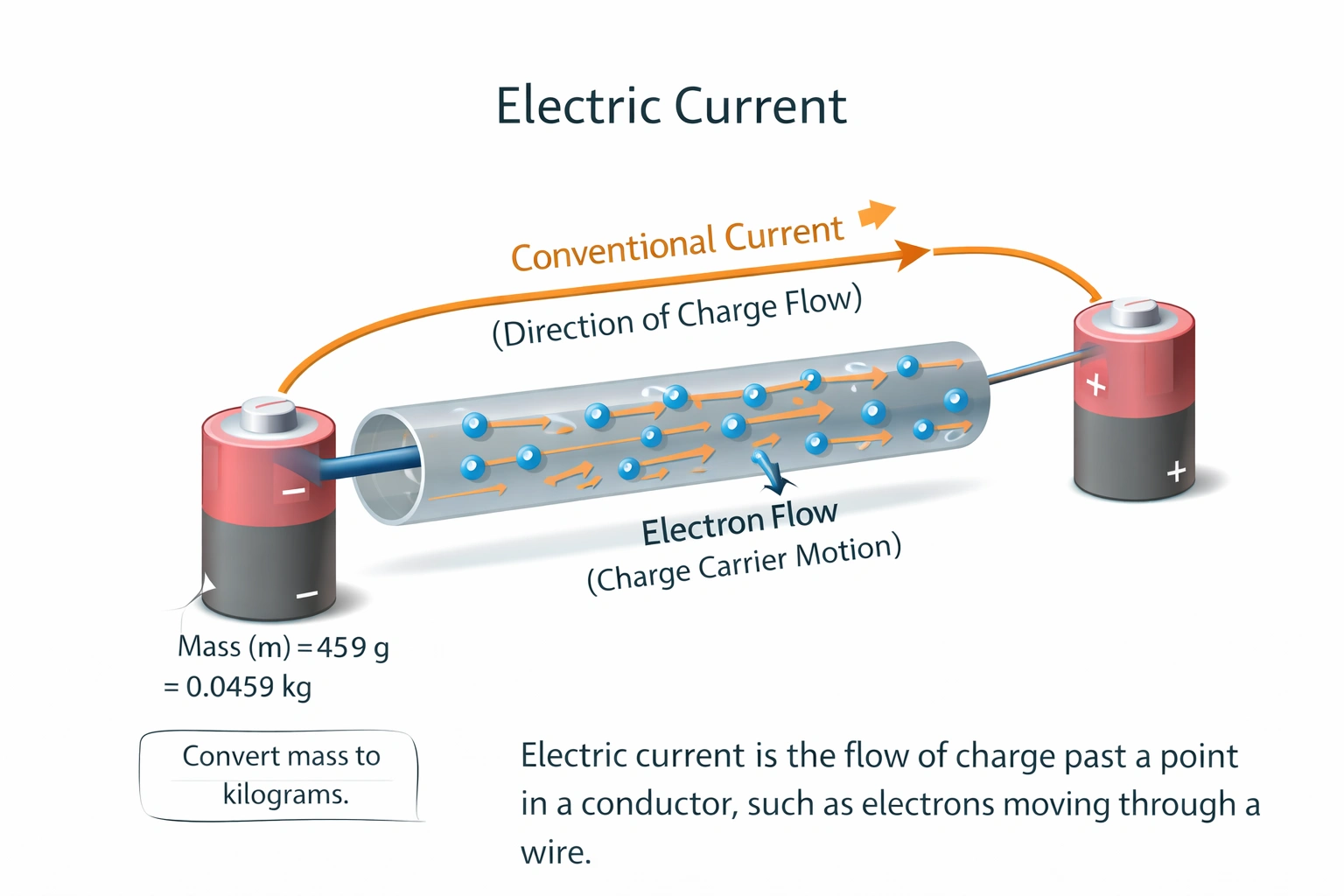
Electrons moving in a wire represents an electric current.
Electric current is defined as the net rate of flow of electric charge through a cross-sectional area. In a conductor like a metal wire, the mobile charge carriers are electrons. Their net drift motion constitutes a flow of charge. By convention, current direction is defined as the direction positive charge would flow, which is opposite the electron flow in metals.
A) Electric flux in a vacuum
Electric flux (Φ_E) is a measure of the number of electric field lines passing through a given area. It is a scalar quantity used in Gauss's law. Flux describes the strength and distribution of an electric field, not the movement of charge. There is no flow of charge in electric flux; it is a static property of a field configuration.
B) Electrons moving in a wire
This is the microscopic description of electric current in a metallic conductor. Although individual electrons move slowly with a drift velocity, their collective net motion results in a flow of charge. When a voltage is applied across a wire, an electric field is established, causing electrons to drift in a net direction. This net flow of charge per second is the electric current.
C) A disconnected voltage source
A voltage source, such as a battery, provides an electromotive force (emf) that creates a potential difference between its terminals. When disconnected, it is an open circuit. While the source has the potential to cause current, no closed path exists for charge to flow continuously. Therefore, there is no sustained electric current.
D) An electromagnetic wave in a material
An electromagnetic (EM) wave consists of oscillating electric and magnetic fields that propagate through space or a medium. While these time-varying fields can induce very small, oscillating currents in conductive materials they encounter, the EM wave itself is not a current. It is a propagation of energy. In insulating materials, the wave may cause bound charges to oscillate slightly, but there is no net flow of charge over time.
Conclusion
The essence of electric current is the net movement of charge. Only the directed, net motion of charged particles, such as electrons drifting in a wire, fulfills this definition. Electric flux is a field property, a voltage source is a potential, and an EM wave is an energy propagation; none are synonymous with a sustained flow of charge.
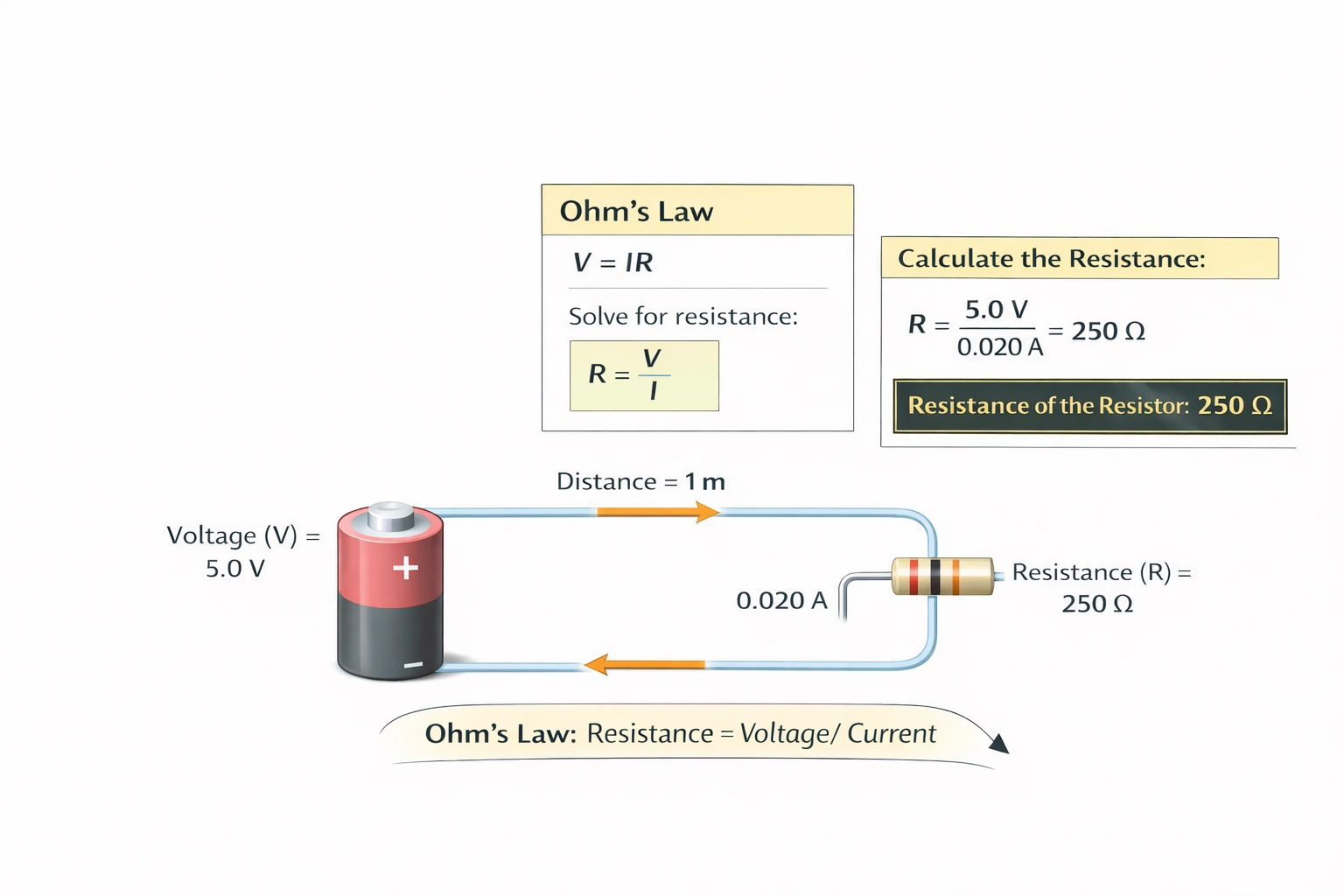
A 5.0-volt battery delivers 0.020 amps to a resistor. What is the resistance of the resistor?
A.
4.0x10??? ohms
B. 0.10 ohms
C. 10 ohms
D. 250 ohms
Rationale
The resistance of the resistor is 250 ohms.
This is a direct application of Ohm's Law, which states that the voltage (V) across a resistor is proportional to the current (I) flowing through it: V = IR. The constant of proportionality is the resistance (R). To find resistance, rearrange the formula: R = V/I. The units are consistent: volts divided by amps gives ohms (Ω).
A) 4.0x10»³ ohms (0.004 Ω)
This would result from inverting Ohm's Law: R = I/V = 0.020/5.0 = 0.004Ω. This is an extremely low resistance, characteristic of a short circuit or a superconductor. With 5.0 V, a 0.004 Ω resistor would draw 1250 A, not 0.020 A.
B) 0.10 ohms
This comes from V/(10I) = 5.0/0.20 = 0.10Ω, using a current ten times larger than given. This is also a very low resistance that would correspond to a high current.
C) 10 ohms
This would be correct for a current of 0.50 A (5.0/0.50 = 10) or a voltage of 0.20 V (0.20/0.020 = 10). It does not match the given numbers.
D) 250 ohms
Correct calculation: R = V/I = 5.0V/0.020A = 250Ω. This is a standard resistance value. A 250 Ω resistor connected across a 5.0 V battery would indeed draw a current of 0.020 A (20 mA).
Conclusion
Ohm's Law provides a simple, linear relationship between voltage, current, and resistance. Plugging in the given values yields a resistance of 250 Ω. The incorrect options arise from either reversing the division (I/V) or from arithmetic errors involving the decimal places.
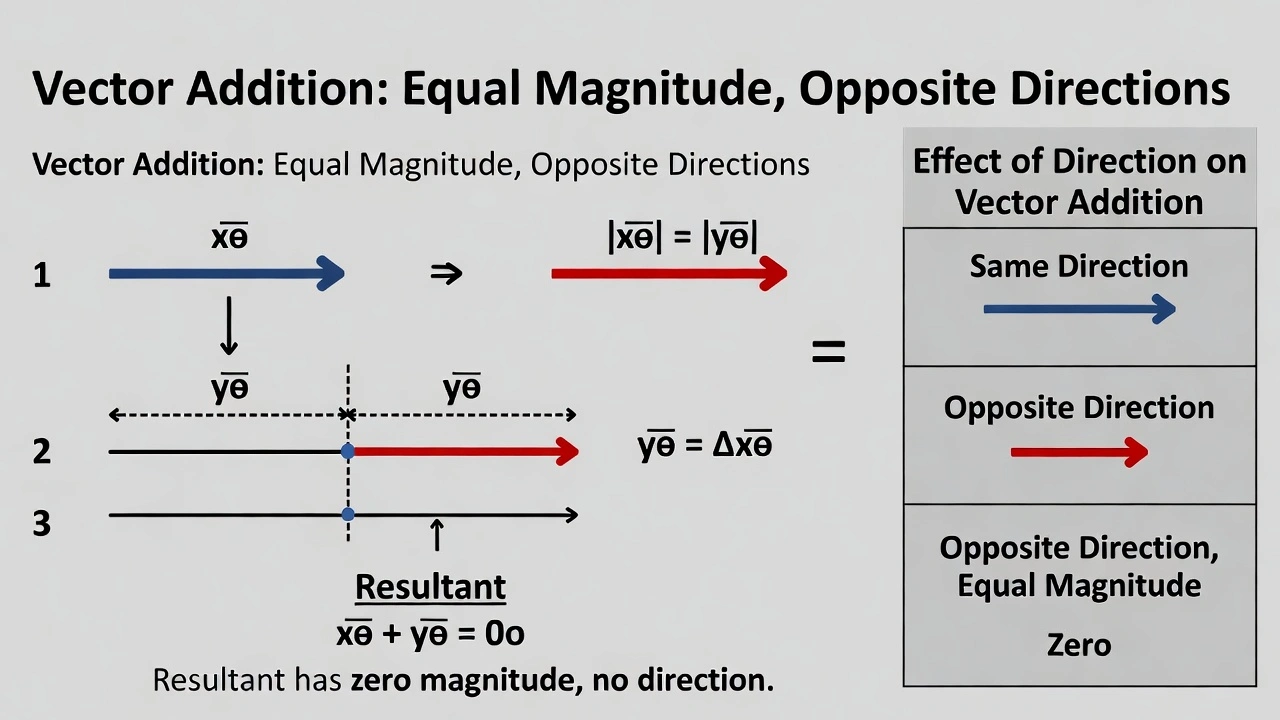
Vector x has the same length as vector y but the exact opposite direction. What is the resultant x + y?
A.
x
B. 0
C. 1/2x
D. 2x
Rationale
The resultant of adding the two vectors is the zero vector.
Vector addition combines both magnitude and direction. When two vectors are equal in magnitude but diametrically opposed in direction, one vector is the exact negative of the other. Mathematically, if vector y = -vector x, then their sum is defined as vector x + (-vector x). This operation is analogous to adding a number and its additive inverse in scalar arithmetic, yielding a result of zero. In vector terms, this zero is represented by the zero vector, which has a magnitude of zero and an undefined direction, symbolizing complete cancellation.
A) -vector x
The expression -vector x represents a vector with the same magnitude as vector x but pointing in the opposite direction. This is precisely the description of vector y itself, not the result of adding vector x and vector y. The sum of a vector and its negative is a distinct entity—the zero vector—not merely the negative of the first vector. Confusing the addend with the resultant reflects a misunderstanding of the vector addition operation.
B) 0
The zero vector is the identity element for vector addition. For two vectors to sum to zero, they must be equal in magnitude and opposite in direction. This condition is perfectly met by the given description. Graphically, placing the tail of vector y at the head of vector x would bring the tip of vector y back to the starting point of vector x, resulting in no net displacement. This represents a state of equilibrium in physical systems, such as when two equal and opposite forces act on a point.
C) 1/2 vector x
A resultant of half the original vector's magnitude would arise from different conditions, such as adding two vectors where one is half the magnitude of the other and they are oriented in the same direction. It could also result from averaging the vectors. This outcome implies only a partial cancellation, which contradicts the total cancellation inherent in the scenario of equal magnitude and exact opposition.
D) 2 vector x
A resultant vector with twice the magnitude of vector x occurs only when the two vectors being added are identical—that is, they share the same magnitude and the same direction. This represents the maximum constructive interference, where the displacements or forces amplify each other. The given condition of opposite directions leads to destructive interference, making this result impossible.
Conclusion
The principle of vector addition dictates that the sum of two vectors is determined by both their lengths and their directional relationship. Equal magnitude paired with opposite direction is the specific condition for total cancellation. This yields the zero vector, indicating no net effect. The other options correspond to different vector relationships: partial alignment, identical alignment, or misidentifying an input for the output. Only the condition of exact opposition with equal magnitude produces a resultant of zero.
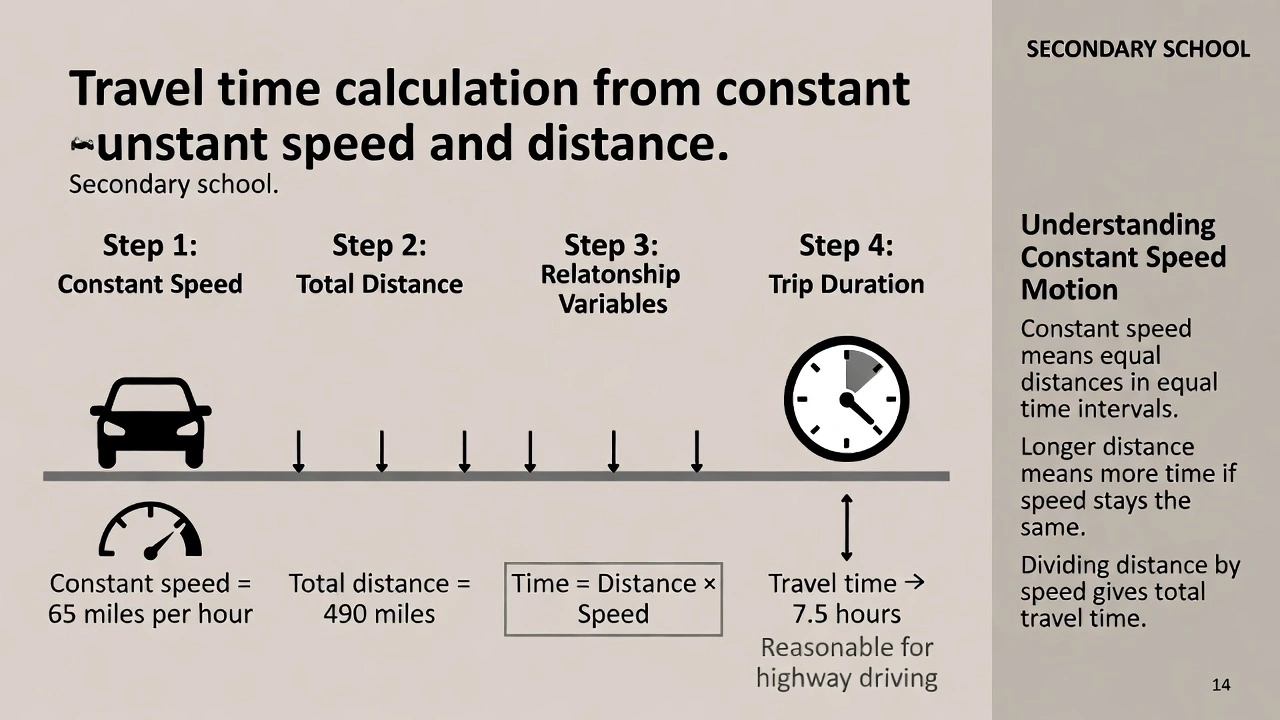
If a car goes a constant speed of 65 miles per hour over 490 miles, how long is the trip?
A.
0.13 hours
B. 7.5 hours
C. 430 hours
D. 32,000 hours
Rationale
The trip takes approximately 7.5 hours.
The relationship between distance, constant speed, and time is one of the most direct formulas in kinematics: time = distance / speed. The units are consistent—distance in miles and speed in miles per hour—so the result of the division will be in hours. This calculation requires performing the division 490 ÷ 65.
A) 0.13 hours
This value is approximately the result of dividing the speed by the distance: 65 mph / 490 miles ? 0.133 hours per mile. This inverts the correct formula. The quantity 0.13 hours represents the time it would take to travel one mile at 65 mph, not the time for 490 miles. This answer is off by a factor of over 50 and contradicts the intuitive understanding that a journey of nearly five hundred miles at highway speed requires several hours.
B) 7.5 hours
Performing the correct calculation: time = 490 miles / 65 mph = 7.53846... hours. Rounded to two significant figures, this is 7.5 hours. A trip lasting between seven and eight hours is reasonable and expected for a distance of 490 miles at a steady speed of 65 mph, aligning with common experience of long-distance travel.
C) 430 hours
This number is roughly the product of 490 and 0.88, or it could be a misplaced decimal from a potential result of 43 hours. Four hundred and thirty hours equates to nearly 18 days of continuous driving. Such a duration would imply an average speed of about 1.14 mph, which is a walking pace, utterly unrealistic for a car trip. This result likely stems from a major arithmetic error or from multiplying distance and speed incorrectly.
D) 32,000 hours
This extreme value (about 3.65 years) results from a gross miscalculation, most plausibly multiplying the distance by the speed: 490 miles * 65 mph = 31,850. This product yields a value with units of mile²/hour, which is meaningless for time. It represents a complete misunderstanding of the formula or a severe error in handling numerical values.
Conclusion
The formula connecting distance, speed, and time for constant velocity is linear and straightforward. The time required is directly proportional to the distance and inversely proportional to the speed. Dividing 490 by 65 gives a rational result of about 7.5 hours. The other answers arise from inverting the relationship, making multiplicative errors, or committing catastrophic arithmetic mistakes, all of which lead to physically implausible travel times.
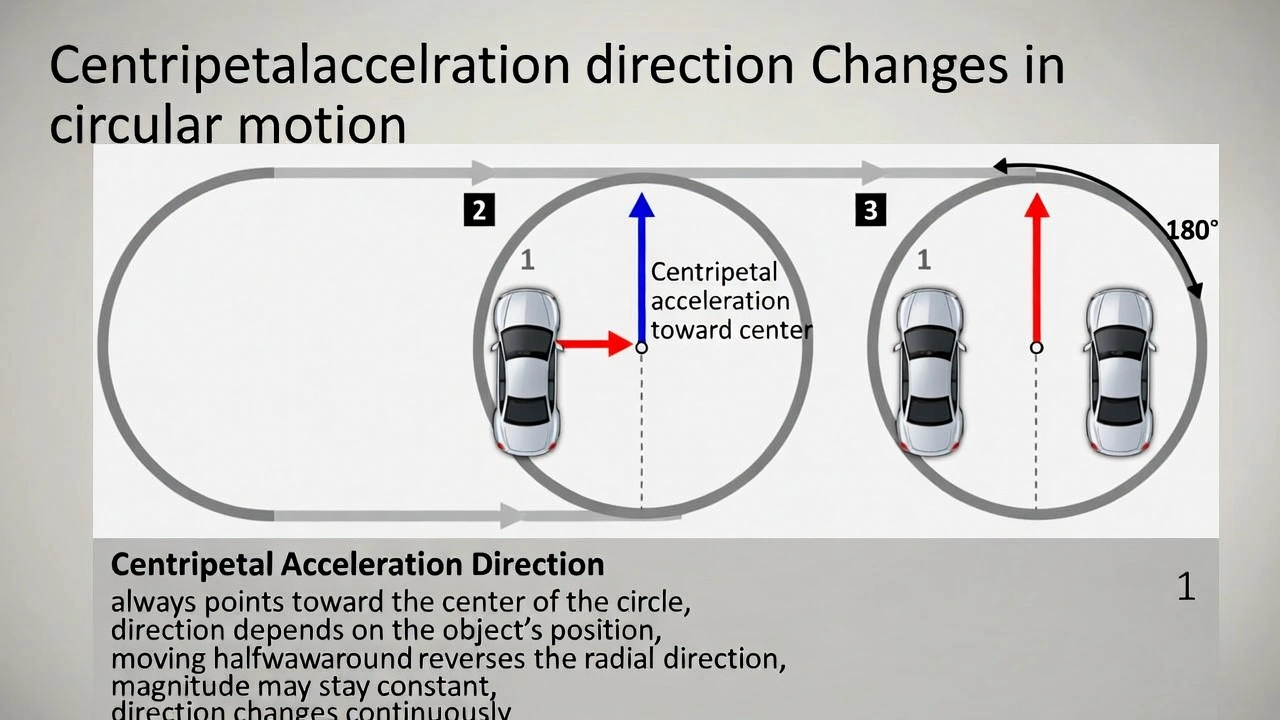
A car at a certain point on a circular racetrack experiences centripetal acceleration to the west. What is the direction of the centripetal acceleration when the car goes halfway around the circle from that point?
A.
East
B. North
C. South
D. West
Rationale
At the halfway point, the centripetal acceleration is directed east.
Centripetal acceleration is the instantaneous acceleration that causes an object to follow a curved path. It is always directed radially inward, toward the center of the circle. Its direction is not fixed in space; it rotates so it always points from the object's instantaneous position directly to the circle's center. Therefore, as the object moves around the circle, the direction of its centripetal acceleration changes accordingly.
A) East
If the centripetal acceleration is initially west at the starting point, the center of the circular track must lie directly west of that starting position. The radial line from the car points west to the center. After traveling halfway around the circle (a 180-degree displacement), the car is located at the point diametrically opposite its starting point. The center of the circle, which remains fixed, is now located directly east of this new position. Consequently, the radial line from the car to the center points east, and so does the centripetal acceleration.
B) North
A direction of north would imply that the car has moved one-quarter of the way around the circle from the starting point. At that 90-degree position, the radial line to the center would be perpendicular to the original west direction. If the original radial line pointed west, a 90-degree rotation could point either north or south, depending on the direction of travel. Halfway around, however, corresponds to a 180-degree rotation, which reverses the direction, not rotates it 90 degrees.
C) South
Similar to north, a direction of south would correspond to a quarter-turn in the opposite direction (or a three-quarter turn). It represents a 90-degree or 270-degree change from the original west direction. A 180-degree change from west results in east, not south.
D) West
The centripetal acceleration would still be west only if the car returned to its original starting point or to another point where the radial line to the center also points west. After a half-revolution, the car is on the opposite side of the circle, so the direction to the center is the exact opposite of the original direction.
Conclusion
Centripetal acceleration is defined by its radial inward direction toward the circle's fixed center. The car's position relative to that center determines the acceleration's direction. Moving halfway around the circle flips the car's position relative to the center, thereby reversing the radial direction. An initial westward acceleration therefore becomes an eastward acceleration at the halfway point.
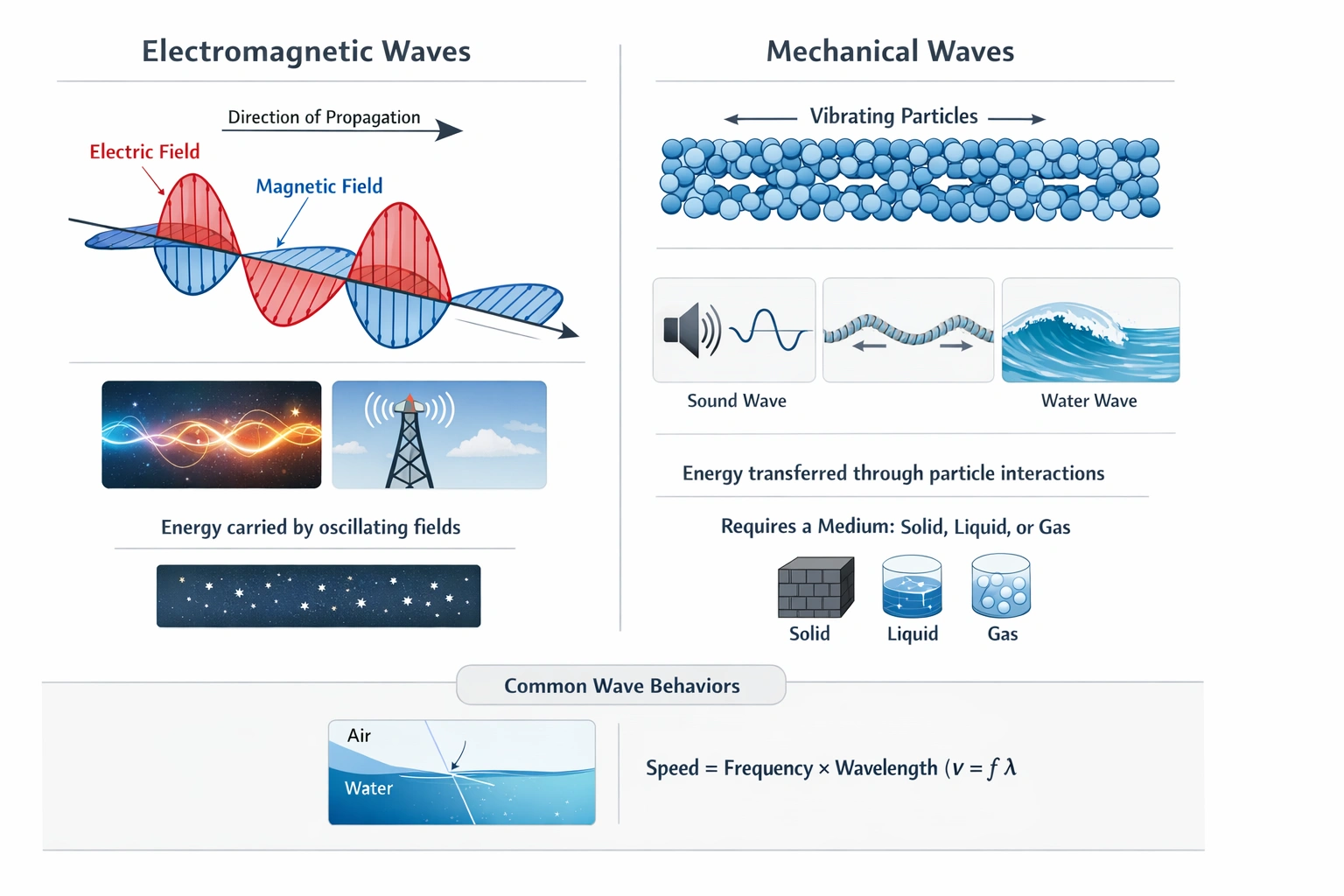
What differentiates an electromagnetic wave from a mechanical wave?
A.
Only electromagnetic waves can exist in a vacuum.
B. Only electromagnetic waves can exhibit refraction.
C. Only electromagnetic waves can travel through a material.
D. Only electromagnetic waves obey the wave-speed equation *v*=λf
Rationale
The fundamental distinction is that electromagnetic waves can propagate through a vacuum, while mechanical waves cannot.
Waves are classified by what is oscillating and what medium is required for propagation. Electromagnetic waves consist of oscillating electric and magnetic fields that can sustain each other. They are disturbances in the electromagnetic field itself, which permeates all of space, including a vacuum. Mechanical waves are disturbances that propagate through a material medium (solid, liquid, or gas) by transferring energy from particle to particle through interactions like collisions or elastic deformations.
A) Only electromagnetic waves can exist in a vacuum.
This statement is uniquely true for electromagnetic waves. Light from the sun travels through the near-perfect vacuum of space to reach Earth. Radio waves, X-rays, and all other EM waves share this property. Mechanical waves, such as sound waves, water waves, or seismic waves, require atoms or molecules to transfer energy. In a vacuum, there is no medium to support these vibrations, so mechanical waves cannot exist.
B) Only electromagnetic waves can exhibit refraction.
Refraction is the bending of a wave's path when it passes from one medium into another at an angle, due to a change in its speed. This phenomenon is not exclusive to any wave type; it is a general wave behavior. Light (an EM wave) refracts when passing from air to water, making a straw look bent. Sound (a mechanical wave) also refracts when moving through layers of air with different temperatures or densities. Both types of waves obey Snell's Law in their respective contexts.
C) Only electromagnetic waves can travel through a material.
Both electromagnetic and mechanical waves can travel through materials. Electromagnetic waves travel through glass, water, and air. Mechanical waves, by definition, require a material medium to travel. Sound waves travel through solids, liquids, and gases. Seismic waves travel through the Earth. The statement is false because mechanical waves not only can but must travel through materials.
D) Only electromagnetic waves obey the wave-speed equation v = lambda f.
The equation v = f lambda, which relates wave speed (v), frequency (f), and wavelength (lambda), is a universal wave equation. It applies to all periodic waves, regardless of their nature. It holds true for sound waves, water waves, waves on a string, and light waves. The relationship is derived from the definition of speed as distance per time, where the wave travels one wavelength (distance) in one period (time). This is not a differentiating feature.
Conclusion
The core difference lies in the requirement of a physical medium. Mechanical waves are defined by their dependence on medium particles to propagate energy. Electromagnetic waves are self-propagating oscillations of fields that do not require a material medium. While both wave types can refract and obey v = f lambda, and both can travel through materials, the ability to travel through a perfect vacuum is an exclusive property of electromagnetic waves.
One isotope of a particular element is neutral, and a different isotope of that element is an ion. Which conclusion is correct?
A.
One isotope has more protons than the other.
B. One isotope has more electrons than the other.
C. Both isotopes have the same number of neutrons.
D. Both isotopes have the same number of nucleons.
Rationale
The neutral isotope and the ionic isotope have different numbers of electrons.
Isotopes are variants of a single chemical element that share the same number of protons but differ in their number of neutrons. The charge state of an atom (neutral vs. ion) is determined by the balance between the number of protons (positive charges) in the nucleus and the number of electrons (negative charges) surrounding it. A neutral atom has equal numbers of protons and electrons. An ion has an imbalance, resulting from the loss or gain of electrons.
A) One isotope has more protons than the other.
If the number of protons differed, the atoms would belong to different elements. The definition of an isotope is predicated on atoms having the same atomic number (same proton count). Therefore, this statement cannot be true for isotopes of the same element.
B) One isotope has more electrons than the other.
This is necessarily true given the conditions. Both isotopes have the same number of protons (defining the element). For one atom to be neutral, its electron count must equal its proton count. For the other atom to be an ion, its electron count must be different from its proton count. Since the proton counts are equal, the electron counts between the two atoms must differ. For example, a neutral ²³Na atom has 11 protons and 11 electrons. The ion ²²Na⺠also has 11 protons but only 10 electrons.
C) Both isotopes have the same number of neutrons.
Isotopes, by definition, have different numbers of neutrons. If they had the same number of neutrons and the same number of protons, they would be identical atoms, not different isotopes. The "different isotope" phrasing explicitly indicates a variation in neutron number.
D) Both isotopes have the same number of nucleons.
The number of nucleons (protons + neutrons) is the mass number. Different isotopes have different mass numbers because they have different numbers of neutrons. Therefore, they cannot have the same number of nucleons. The neutral atom and the ion could have the same or different mass numbers, but the condition that they are "different isotopes" means their mass numbers are different.
Conclusion
Isotopic identity is based on proton count (same) and neutron count (different). Charge state is based on electron count relative to proton count. Two isotopes of the same element must have identical proton numbers but can independently differ in neutron number and electron number. The given scenario forces a difference in electron count to explain the difference in charge, while a difference in neutron count is inherent to them being different isotopes.

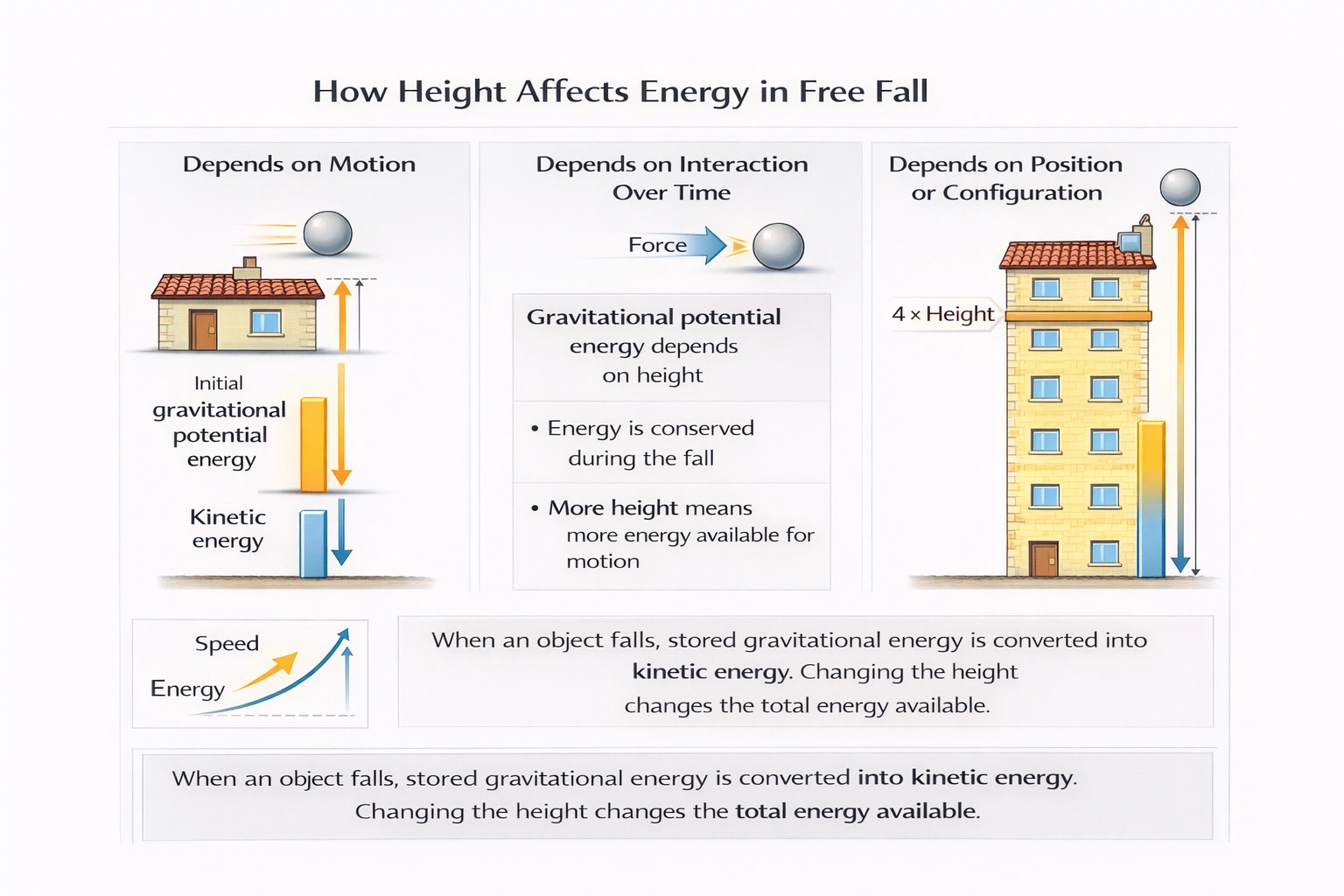
A carpenter's tool falls off a rooftop and strikes the ground with a certain kinetic energy. If it fell from a roof that was four times higher, how would this new kinetic energy (just before impact) compare to the original?
A.
The kinetic energy would be 2 times greater.
B. The kinetic energy would be 4 times greater.
C. The kinetic energy would be 8 times greater.
D. The kinetic energy would be 16 times greater.
Rationale
Falling from four times the height results in four times the kinetic energy upon impact.
Assuming negligible air resistance, mechanical energy is conserved. The tool initially possesses gravitational potential energy (PE) relative to the ground, given by PE = mgh, where m is mass, g is gravitational acceleration, and h is height. As it falls, this potential energy is converted into kinetic energy (KE). Just before impact, all the initial potential energy has become kinetic energy (assuming it started from rest). Therefore, the kinetic energy at impact is directly proportional to the initial height: KE_final = mgh.
A) The kinetic energy would be 2 times greater.
This factor would apply to the impact speed, not the energy. For an object dropped from rest, the final speed is given by v = ?(2gh). If height increases by a factor of 4, speed increases by a factor of ?4 = 2. However, kinetic energy depends on the square of the speed (KE = ½ mv²). Doubling the speed quadruples the kinetic energy, because 2² = 4.
B) The kinetic energy would be 4 times greater.
This is correct. The initial potential energy, and thus the final kinetic energy, is directly proportional to height: KE ? h. If the new height h' is 4 times the original height (h' = 4h), then the new kinetic energy KE' is 4 times the original kinetic energy (KE' = 4 KE). The relationship is linear.
C) The kinetic energy would be 8 times greater.
There is no standard physical relationship that yields a factor of 8 when height is quadrupled. This might come from incorrectly combining the factor for speed (2) and the factor for something else, like 2 * 4 = 8, which has no basis in the energy equations.
D) The kinetic energy would be 16 times greater.
This factor would result if kinetic energy were proportional to the square of the height (KE ? h²). However, from energy conservation, KE = mgh, which is directly proportional to h, not h². Squaring the height increase factor (4² = 16) is a misapplication of the relationship between speed and height.
Conclusion
Under energy conservation in a uniform gravitational field, the kinetic energy at impact is equal to the initial gravitational potential energy. Potential energy is linear with height. Therefore, quadrupling the height quadruples the potential energy available for conversion, resulting in four times the kinetic energy.
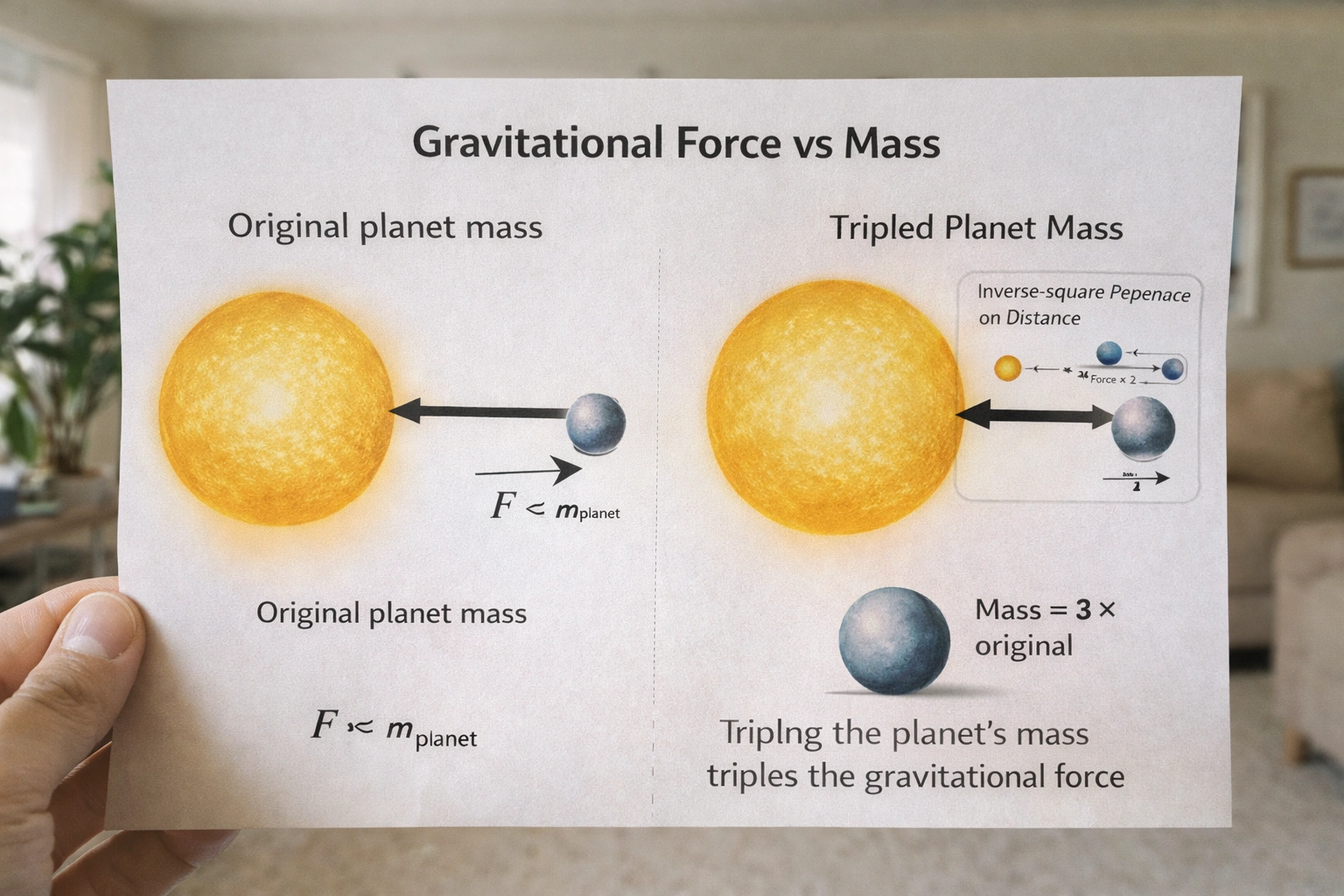
According to Newton's equation for universal gravitation, if the mass of a planet near the sun were tripled,
A.
the force of attraction would be tripled.
B. the force of attraction would be doubled.
C. the force of attraction would be quartered.
D. the force of attraction would be quadrupled.
Rationale
Tripling the planet's mass triples the gravitational force.
Newton's Law of Universal Gravitation states that the force F between two masses m? and m? separated by a distance r is: F = G (m? m?) / r², where G is the gravitational constant. The force is directly proportional to the product of the two masses. If the distance r and the other mass (the Sun's mass) remain constant, then the force is directly proportional to the mass of the planet: F ? m_planet.
A) the force of attraction would be tripled.
If the original planet mass is m, the original force is F? ? m * M_sun.
The new planet mass is 3m.
The new force is F_new ? (3m) * M_sun = 3 (m * M_sun) = 3 F?.
Thus, the force triples. This is a direct consequence of the linear proportionality.
B) the force of attraction would be doubled.
Doubling would occur if the planet's mass were doubled, not tripled. This option misstates the factor of change.
C) the force of attraction would be quartered.
Quartering implies reducing the force to one-fourth. This would happen if the distance between the planet and Sun were doubled (since force ? 1/r², (1/2)² = 1/4) or if one of the masses were reduced to one-fourth. It is unrelated to tripling a mass.
D) the force of attraction would be quadrupled.
Quadrupling would occur if the planet's mass were quadrupled, or if the distance were halved ( (1/(1/2))² = 4 ). Tripling a mass increases the force by a factor of 3, not 4.
Conclusion
Newton's law shows that gravitational force is directly proportional to each mass. Holding all other variables constant, changing one mass by a factor changes the force by the same factor. Therefore, tripling the planet's mass triples the gravitational force.
The electric force on a 1-coulomb charge is 25 newtons. If that charge is removed, what is the field strength at its former location?
A.
1 newton per coulomb
B. 24 newtons per coulomb
C. 25 newtons per coulomb
D. 100 newtons per coulomb
Rationale
The electric field strength at that location is 25 newtons per coulomb.
The electric field (E) at a point in space is defined as the electric force (F) experienced by a small positive test charge (q) placed at that point, divided by the magnitude of the test charge: E = F / q. The electric field is a property of space itself, created by other source charges. It exists independently of whether a test charge is present to feel it. Measuring the force on a known charge is a method to determine the pre-existing field.
A) 1 newton per coulomb
This would be the field strength if the force on the 1-coulomb charge were 1 N. It ignores the given force value of 25 N.
B) 24 newtons per coulomb
This appears to subtract 1 from 25 without any physical basis. The field strength is not obtained by decrementing the force value. The formula is a direct ratio, not a subtraction.
C) 25 newtons per coulomb
Using the definition: E = F / q = 25 N / 1 C = 25 N/C. The fact that the charge is 1 coulomb simplifies the calculation—the force numerically equals the field strength. Removing the 1-coulomb charge does not alter the electric field produced by other, external sources. The field strength of 25 N/C remains at that point in space.
D) 100 newtons per coulomb
This could result from multiplying the force and charge (25 * 4 = 100) or from another incorrect operation. The defining formula involves division, not multiplication.
Conclusion
The electric field strength is defined as force per unit charge. A measurement of 25 N on a 1 C charge directly gives a field strength of 25 N/C. The field is a condition of space caused by other charges; removing the test charge does not erase the field it was used to measure. Therefore, the field strength remains 25 N/C.

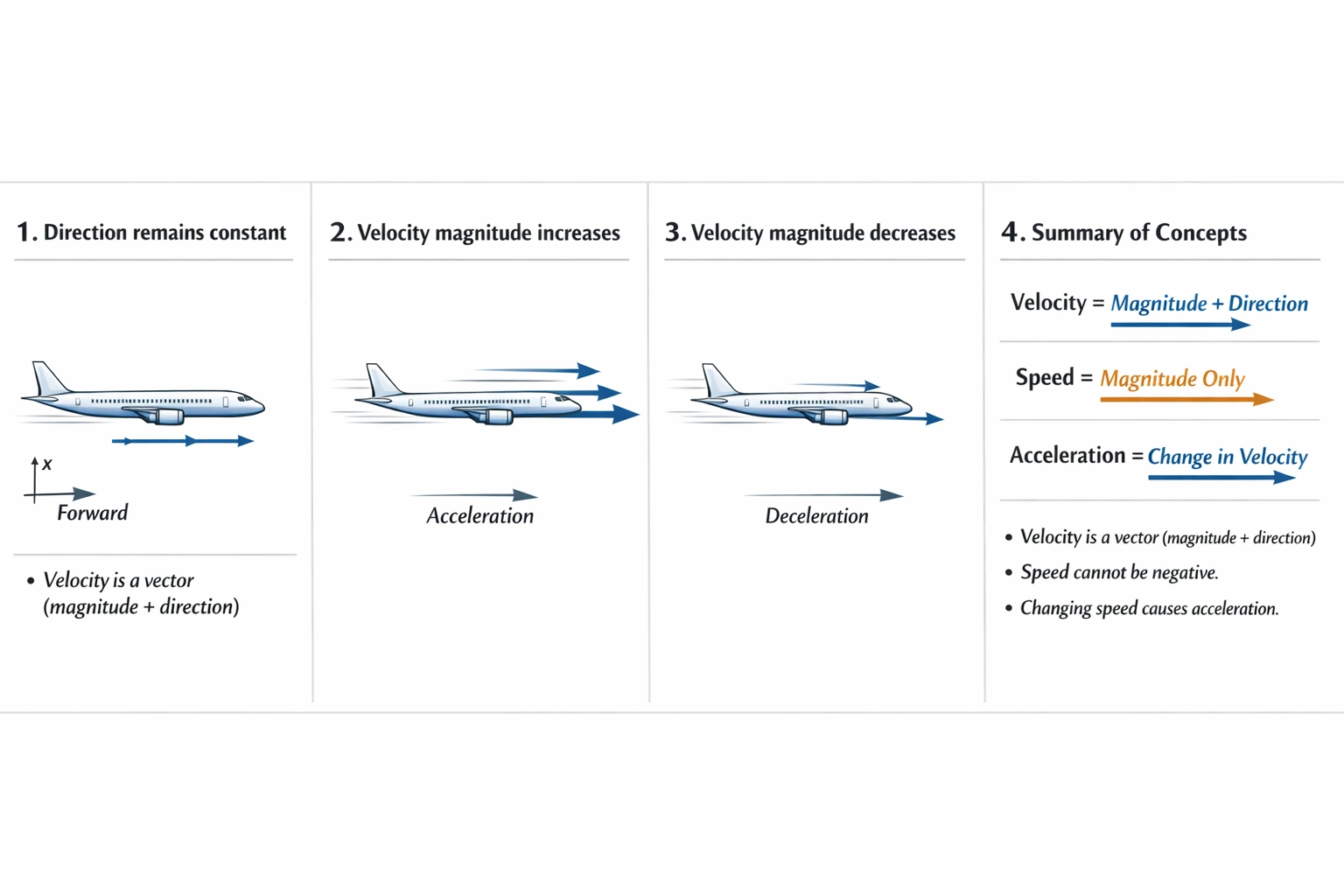
If a plane has a velocity that changes but is always in the same direction, which statement about its speed is true?
A.
The plane's speed is 0.
B. The plane's speed is varying.
C. The plane's speed is negative.
D. The plane's speed is constant.
Rationale
The plane's speed is varying.
Velocity is a vector quantity, consisting of both magnitude (speed) and direction. A change in velocity can result from a change in speed, a change in direction, or both. In this scenario, the plane's velocity is changing, but its direction remains constant. Therefore, the change in velocity must be due solely to a change in its magnitude—the speed. This means the plane is either accelerating or decelerating along a straight path, resulting in a speed that is not constant.
A) The plane's speed is 0.
A speed of zero indicates the object is at rest. The problem states the plane's velocity is changing, which implies motion. A changing velocity requires a nonzero initial velocity; otherwise, there would be no change to measure. An object with zero speed has a constant zero velocity, which contradicts the condition of a changing velocity.
B) The plane's speed is varying.
With the direction held constant, any change in the velocity vector is attributed to a change in its magnitude. This magnitude is the speed. If the velocity is changing in a fixed direction, the plane must be experiencing acceleration or deceleration along that line, meaning its speed is increasing or decreasing. This is the only logical conclusion under the given conditions.
C) The plane's speed is negative.
Speed is a scalar quantity defined as the absolute magnitude of velocity. It is always a non-negative value. While velocity can be negative in a coordinate system to indicate direction opposite to a defined positive axis, speed itself cannot be negative. The concept of a negative speed is physically meaningless in describing motion.
D) The plane's speed is constant.
Constant speed with constant direction results in constant velocity. For velocity to change while direction remains the same, the speed must change. Uniform motion along a straight line has constant velocity. Any change in velocity, even without a directional shift, necessitates a change in speed.
Conclusion
The relationship between velocity, speed, and direction is fundamental in kinematics. A change in velocity with constant direction forces a change in speed. The plane cannot be at rest, cannot have a negative speed, and cannot have a constant speed if its velocity is changing in a fixed direction. Therefore, the plane's speed must be varying.
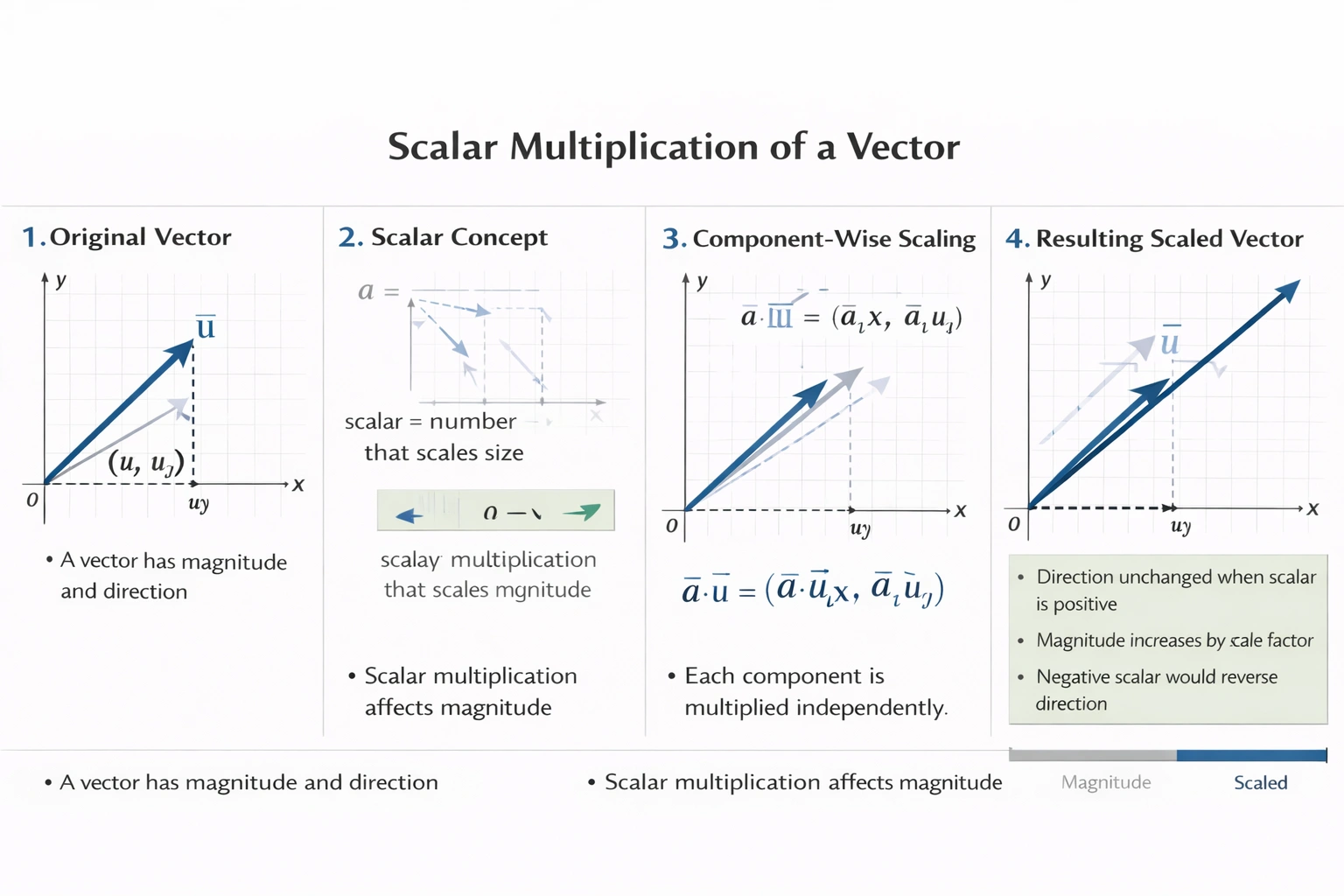
Given vector u? = (?4, 6) and scalar a = 3, what is a u??
A.
(?12, 6)
B. (?12, 18)
C. (?1, 6)
D. (?1, 9)
Rationale
The product of the scalar and the vector is (?12, 18).
Scalar multiplication in vector algebra is an operation where each component of the vector is multiplied by the scalar. This operation scales the vector's magnitude by the absolute value of the scalar and preserves the vector's direction if the scalar is positive. If the scalar is negative, the direction is reversed. The operation is performed component-wise.
A) (?12, 6)
This result shows the scalar was applied to the x-component (?4 × 3 = ?12) but not correctly to the y-component. The y-component remains 6 instead of becoming 6 × 3 = 18. This is a partial application error, possibly from forgetting to multiply both components.
B) (?12, 18)
The correct calculation is a u = (3 × (?4), 3 × 6) = (?12, 18). The new vector points in the same direction as the original (since the scalar is positive) but is three times longer. Its magnitude is scaled by a factor of 3.
C) (?1, 6)
This vector appears to be the result of an addition or subtraction operation, not scalar multiplication. It seems as though 3 was subtracted from the x-component (?4 + 3 = ?1) while the y-component was unchanged. This does not follow the rules of vector-scalar multiplication.
D) (?1, 9)
This could result from incorrectly adding the scalar to the components (?4 + 3 = ?1; 6 + 3 = 9) or from another arithmetic confusion. It does not represent the product of the scalar and the vector.
Conclusion
Scalar multiplication distributes the scalar to each component of the vector. For u? = (?4, 6) and a = 3, the correct computation is (3 × (?4), 3 × 6) = (?12, 18). Any other operation, such as addition or selective multiplication, yields an incorrect result.
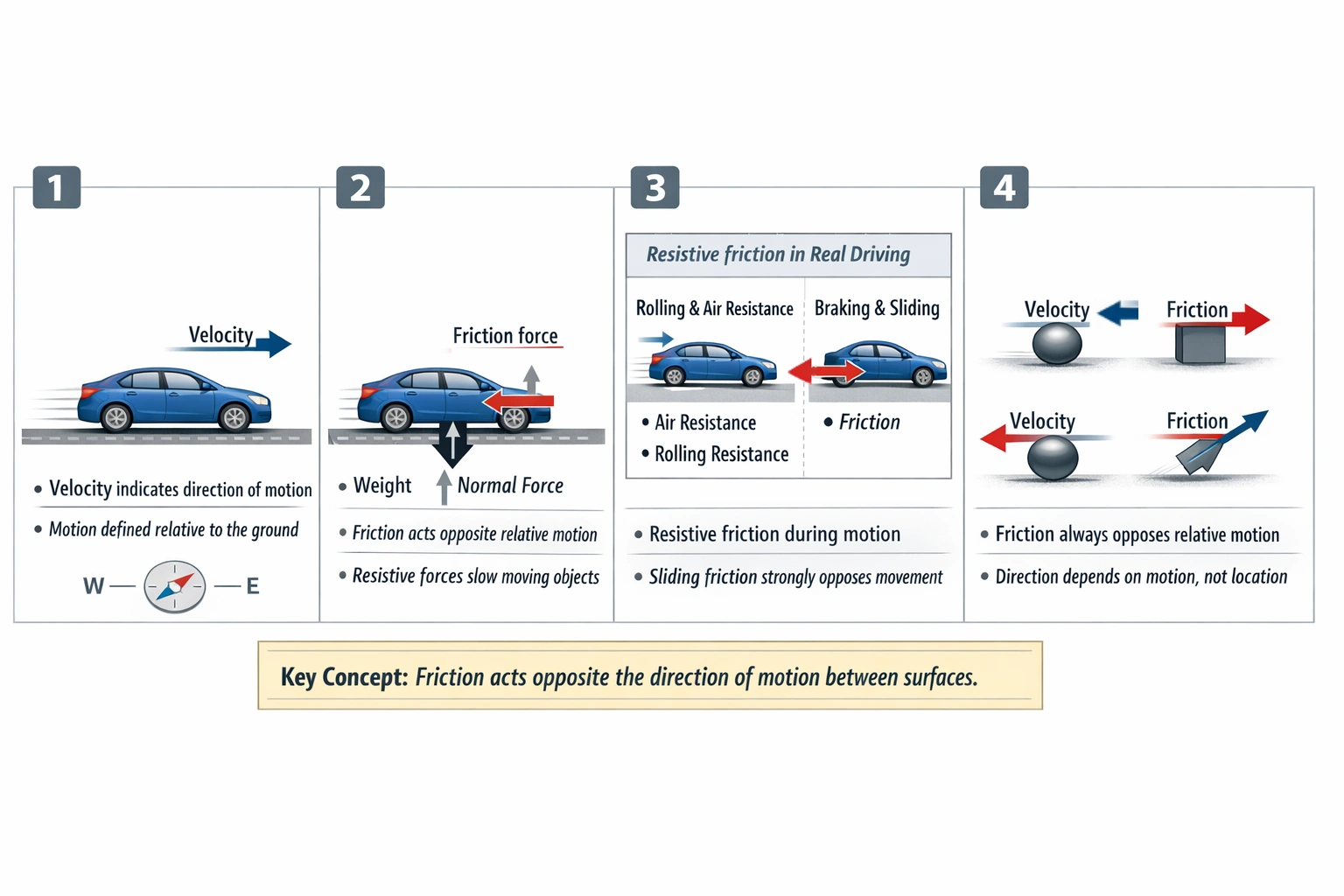
A car is moving east at 20 meters per second. In what direction is the force of friction?
A.
East
B. North
C. South
D. West
Rationale
The force of friction is directed west.
Kinetic friction opposes the relative motion between two surfaces in contact. For a car moving on a road, if considering the friction force that opposes the car's motion (such as air resistance, rolling resistance, or braking friction), it acts in the direction opposite to the car's velocity. If the car is coasting without propulsion, the net frictional force from the environment acts to slow it down.
A) East
A force in the same direction as motion would accelerate the car, increasing its eastward speed. This describes a driving force, such as the force from the engine transmitted through the tires via static friction, not an opposing frictional force.
B) North and C) South
These perpendicular directions would cause the car to turn, not simply oppose its straight-line motion. While friction is necessary for turning (providing centripetal force), the question likely addresses the direct opposition to the car's forward motion. A purely north or south frictional force would not oppose eastward motion directly but would alter its path sideways.
D) West
If the car is moving east, any frictional force that opposes this motion must act westward. This includes air resistance, which pushes against the direction of travel, and kinetic friction from the road if the wheels are locked or sliding. Even for a driven car, the kinetic friction force on a sliding tire acts opposite to the tire's motion relative to the road.
Conclusion
The force of kinetic friction always acts opposite to the direction of relative motion between surfaces. Since the car's velocity is eastward, the opposing frictional force is westward. This principle holds for resistive forces like air resistance and sliding friction.
Which set of information about an object in uniform circular motion is sufficient to determine the object's velocity?
A.
Frequency, mass, period
B. Centrifugal force, mass, radius of motion
C. Angular frequency, centripetal force, period
D. Angular frequency, centripetal acceleration, mass
Rationale
Knowing the centrifugal force, mass, and radius of motion is sufficient to determine the velocity.
In uniform circular motion, velocity is a vector with magnitude (tangential speed v) and direction (tangential to the circle). To find v, one can use relationships involving centripetal force F_c = m v² / r, radius r, angular velocity ? = v / r, period T = 2? / ?, or centripetal acceleration a_c = v² / r. The term "centrifugal force" in the context of a rotating reference frame has the same magnitude as the centripetal force but acts outward.
A) Frequency, mass, period
Frequency (f) and period (T) are reciprocals (f = 1/T), so providing both is redundant. Knowing the period (or frequency) and the radius allows calculation of speed (v = 2?r / T), but this set lacks the radius. Mass alone is not needed to determine speed from period and radius.
B) Centrifugal force, mass, radius of motion
In the rotating frame, the centrifugal force magnitude equals m v² / r. With centrifugal force F_centrifugal, mass m, and radius r, one can solve for v: v = ?(F_centrifugal × r / m). This set provides all necessary variables directly.
C) Angular frequency, centripetal force, period
Angular frequency (?) and period (T) are related (? = 2?/T), so one is redundant. Centripetal force is F_c = m ?² r. This set lacks the radius r. With F_c, ?, and m, one could solve for r first (r = F_c / (m ?²)) and then find v = ? r, but the period is an unnecessary extra piece that does not help without r.
D) Angular frequency, centripetal acceleration, mass
Centripetal acceleration a_c = ?² r. With a_c and ?, one can find r = a_c / ?². Then velocity v = ? r = ? × (a_c / ?²) = a_c / ?. Mass is not required in this calculation; it is extraneous. While this set can determine velocity, it includes unnecessary information (mass), and set B provides a more direct and complete set without redundancy.
Conclusion
To determine the tangential speed v in uniform circular motion, one can use the relationship involving centripetal (or centrifugal) force, mass, and radius. Set B provides these three quantities directly, allowing for a straightforward calculation. The other sets either lack essential information (like radius) or contain redundant data.
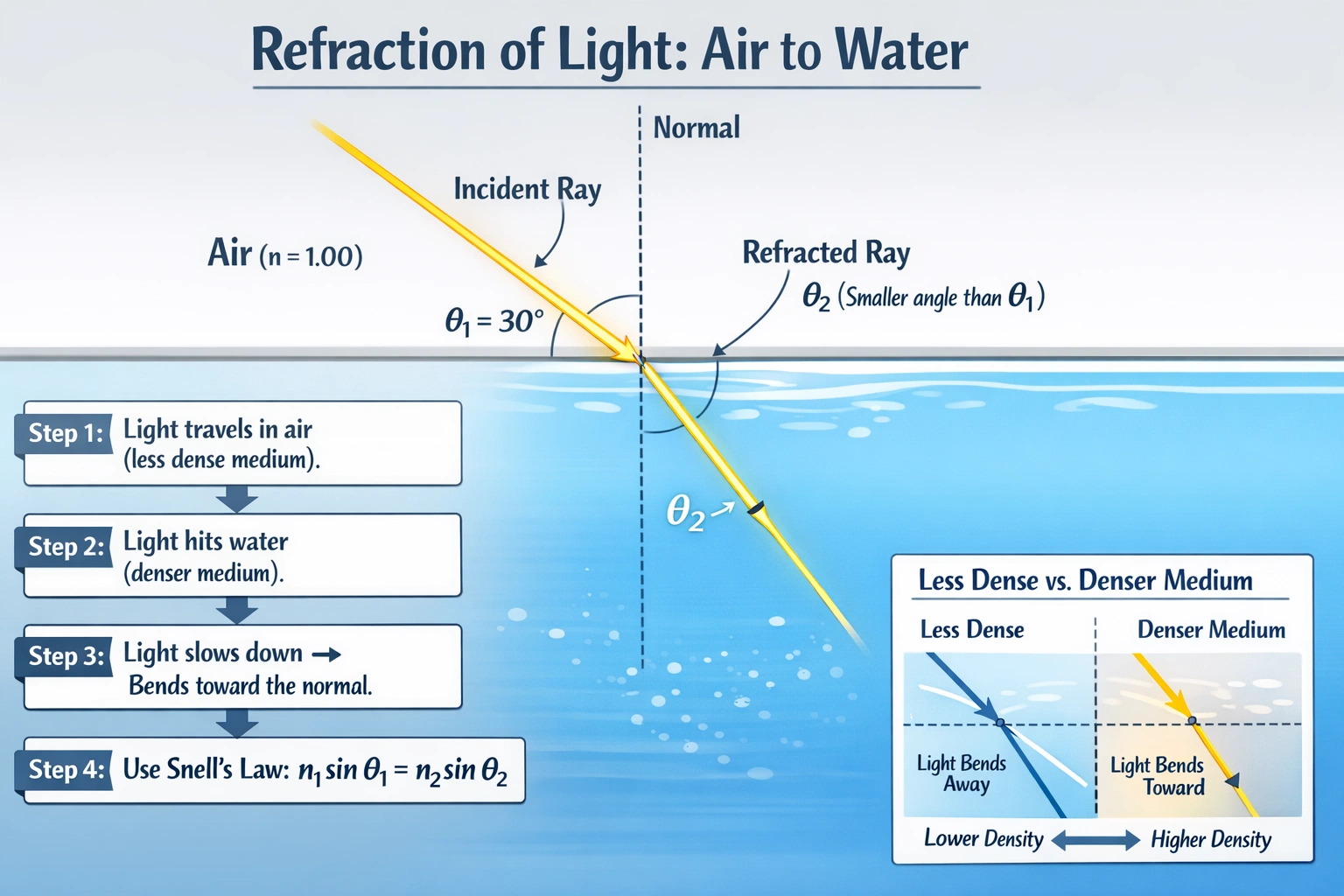
A ray traveling in air strikes water at an angle of 30.0? from the normal. What will its angle be in the water? (Assume air has a refractive index of 1.00 and water has a refractive index of 1.30.)
A.
22.6?
B. 23.1?
C. 39.0?
D. 40.5?
Rationale
The angle of refraction in the water is approximately 22.6°.
Snell's law of refraction governs the bending of light at an interface between two media: n? sin ?? = n? sin ??, where n is the refractive index and ? is the angle measured from the normal. When light travels from a less dense medium (lower n) to a denser medium (higher n), it slows down and bends toward the normal, resulting in a smaller refraction angle.
A) 22.6°
Applying Snell's law: n_air sin(30.0°) = n_water sin(??) ? 1.00 × 0.5 = 1.30 × sin(??) ? sin(??) = 0.5 / 1.30 ? 0.3846. Taking the inverse sine gives ?? ? arcsin(0.3846) ? 22.6°. This bending toward the normal is expected when entering a denser medium.
B) 23.1°
This is close but not precise. It may arise from using slightly different values for sin(30°) or the refractive indices, or from rounding intermediate steps differently. The exact calculation yields about 22.6°.
C) 39.0°
This angle is larger than the incident angle, which would occur if light were entering a less dense medium (from water to air). Since water (n=1.30) is denser than air (n=1.00), light should bend toward the normal, resulting in a smaller angle, not larger.
D) 40.5°
This is even larger and suggests bending away from the normal when entering a denser medium, which contradicts the physical principle of refraction. Such an angle would require the light to speed up upon entering water, which is not the case.
Conclusion
Snell's law accurately predicts the refraction angle. Light moving from air (n=1.00) to water (n=1.30) bends toward the normal. With an incident angle of 30.0°, the refracted angle is approximately 22.6°. Angles larger than 30° would imply bending away, which occurs only when light passes into a less dense medium.
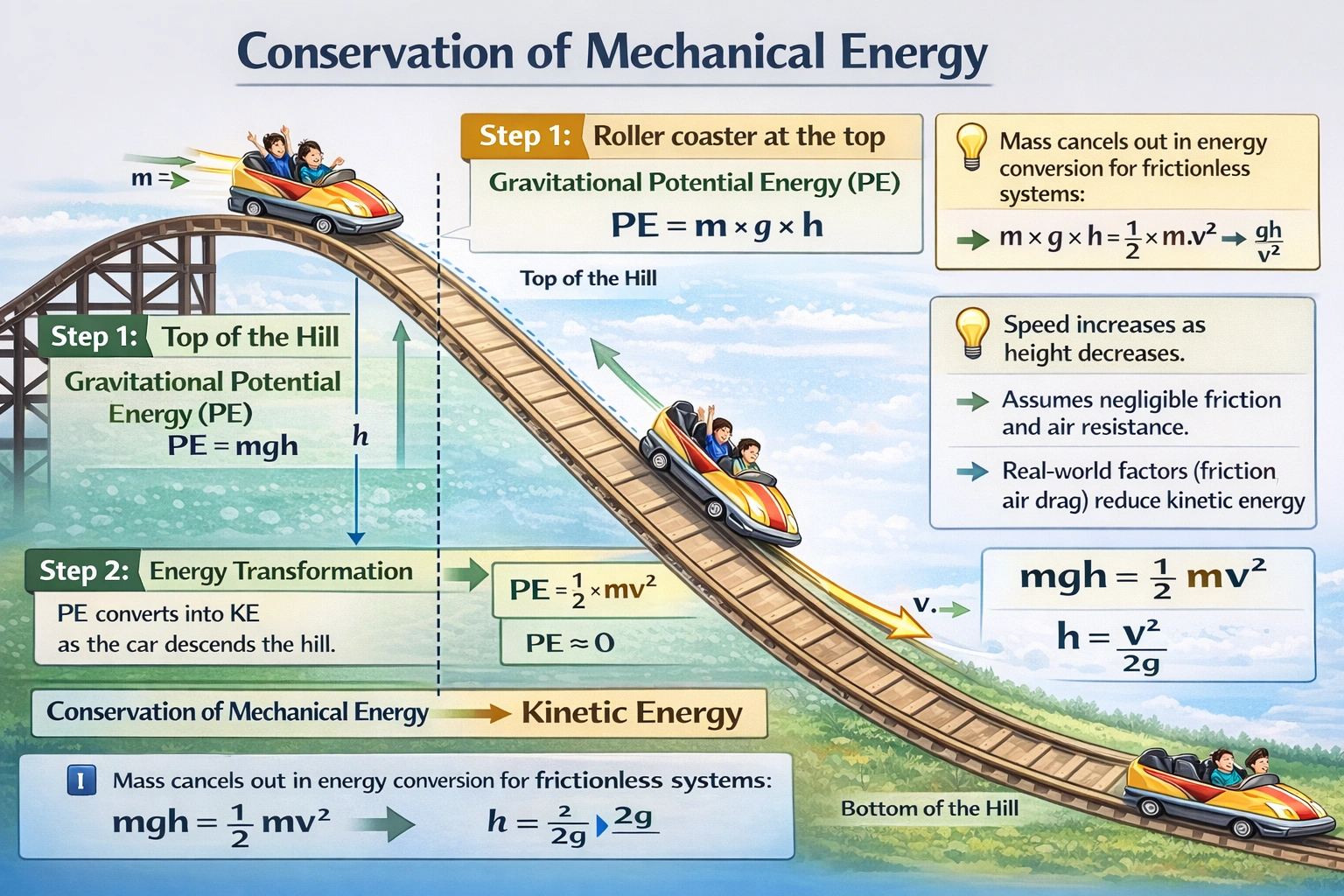
A roller coaster car loaded with riders has a mass of 1490 kg. The car reaches its top speed of 26.8 m/s at the bottom of the first hill (along ground level). What was the height of the previous hill?
A.
2.73 m
B. 19.2 m
C. 36.6 m
D. 73.4 m
Rationale
The height of the previous hill was approximately 36.6 meters.
Assuming negligible friction and air resistance, mechanical energy is conserved. At the top of the hill, the car possesses gravitational potential energy (PE = m g h). At the bottom, that potential energy is converted entirely into kinetic energy (KE = ½ m v²). Setting PE_initial = KE_final allows solving for height h.
A) 2.73 m
This height is far too low. It might result from using h = v / g (26.8 / 9.8 ? 2.73), which is not the energy conservation formula. That formula would give the height for an object dropped from rest to achieve speed v, but here the car starts from rest at the hilltop, so energy conservation is the correct approach.
B) 19.2 m
This is about half the correct value. It could come from using h = v² / g (26.8² / 9.8 ? 73.3) and then dividing by 2 incorrectly, or from an arithmetic mistake in computing v².
C) 36.6 m
Using conservation of energy: m g h = ½ m v² ? h = v² / (2g). Substituting v = 26.8 m/s and g = 9.8 m/s²: h = (26.8)² / (2 × 9.8) = 718.24 / 19.6 ? 36.65 m, which rounds to 36.6 m.
D) 73.4 m
This is exactly double the correct height. It results from omitting the factor of 1/2 in the kinetic energy formula: using h = v² / g = 718.24 / 9.8 ? 73.3 m.
Conclusion
The principle of energy conservation provides the relationship between height and speed. With h = v²/(2g) and the given values, the height is approximately 36.6 m. This assumes all potential energy converts to kinetic energy, with no energy losses.
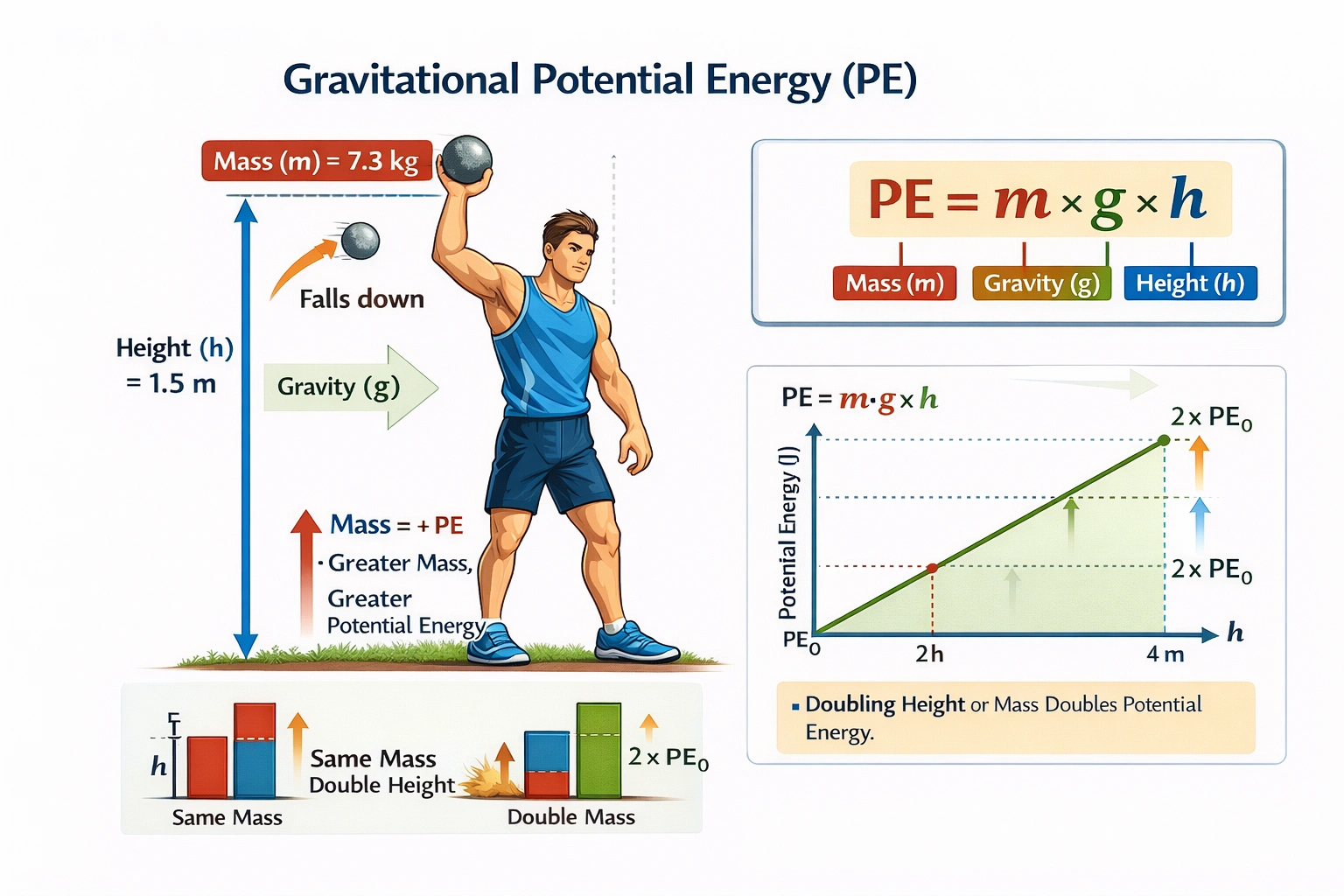
A track and field athlete holds a shot put of mass 7.3 kg at chin level 1.5 m above the ground. How much potential energy does the shot have? (Use g = 9.8 m/s?)
A.
55 J
B. 110 J
C. 180 J
D. 230 J
Rationale
The shot put has approximately 110 joules of gravitational potential energy.
Gravitational potential energy (PE) near Earth's surface is given by PE = m g h, where m is mass, g is the acceleration due to gravity, and h is the height above a chosen reference point (here, the ground).
A) 55 J
This is about half the correct value. It could result from using h = 0.75 m (half the given height) or from forgetting to multiply by g and then misplacing the decimal (e.g., 7.3 × 1.5 = 10.95, then incorrectly scaled).
B) 110 J
Calculation: PE = m g h = 7.3 kg × 9.8 m/s² × 1.5 m = 107.31 J, which rounds to approximately 110 J.
C) 180 J
This value is too high. It might come from using g = 10 m/s² (7.3 × 10 × 1.5 = 109.5) and then rounding up, or from an error like PE = m g² h.
D) 230 J
This is more than double the correct value. It likely stems from a significant arithmetic error, such as multiplying mass by height and then by g twice, or incorrectly squaring a number.
Conclusion
Gravitational potential energy is calculated directly as PE = m g h. With m = 7.3 kg, g = 9.8 m/s², and h = 1.5 m, the potential energy is about 107 J, closest to 110 J among the options.
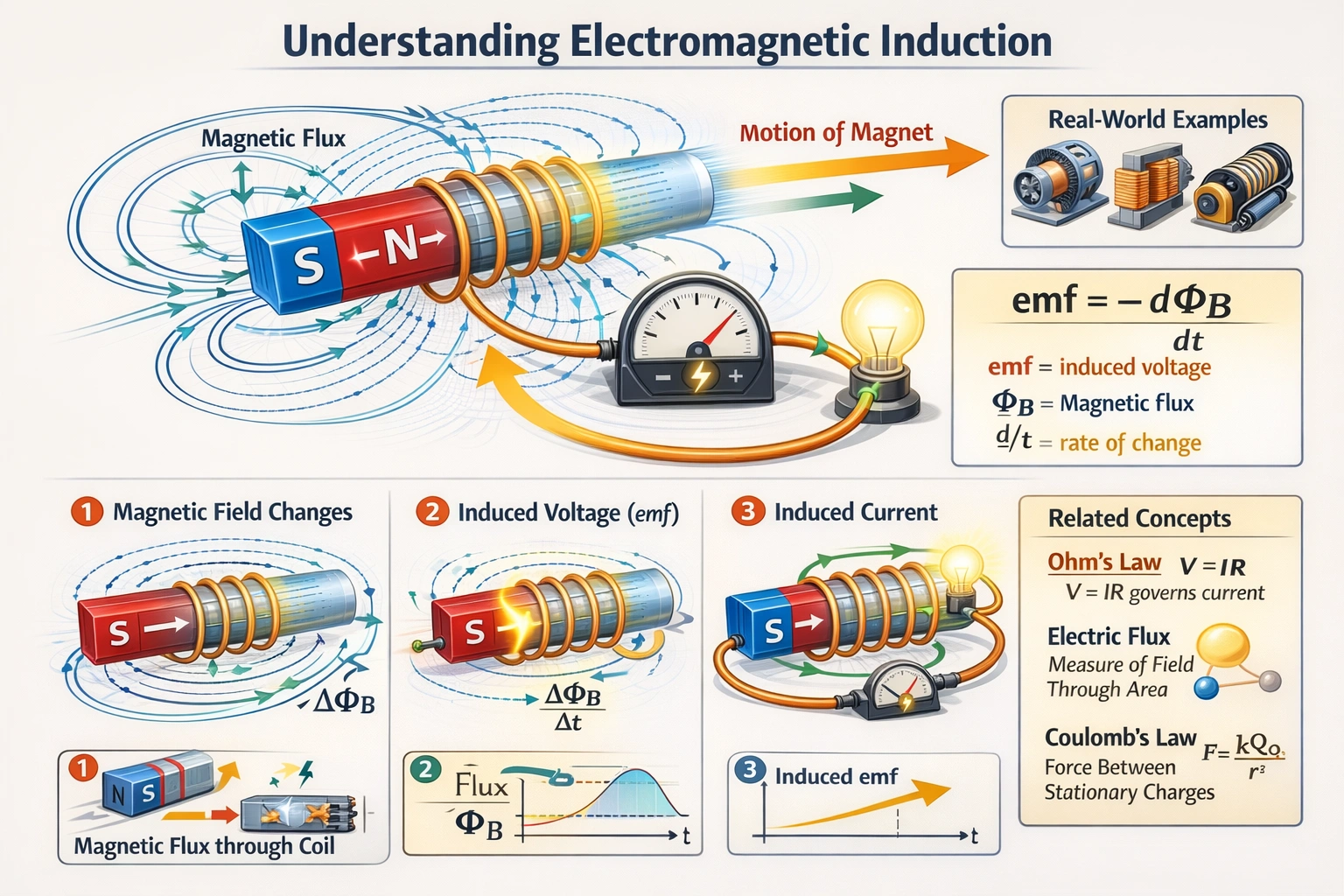
If an engineer converts magnetic fields into an electric potential difference, what is he employing?
A.
Ohm's law
B. Electric flux
C. Coulomb's law
D. Electromagnetic induction
Rationale
The engineer is employing electromagnetic induction.
Electromagnetic induction is the process of generating an electromotive force (emf) or voltage across an electrical conductor in a changing magnetic field. Discovered by Faraday, this principle is the basis for generators, transformers, and many electrical devices.
A) Ohm's law
Ohm's law (V = I R) describes the relationship between voltage, current, and resistance in a conductive material. It does not explain the generation of voltage from a magnetic field.
B) Electric flux
Electric flux is a measure of the electric field passing through a given area (related to Gauss's law). It pertains to electric fields, not the conversion of magnetic fields to voltage.
C) Coulomb's law
Coulomb's law gives the force between two stationary electric charges. It is a law of electrostatics and does not involve magnetic fields or induction.
D) Electromagnetic induction
This is the correct principle. Faraday's law of induction states that a changing magnetic flux through a loop induces an emf. This induced voltage can drive a current if the circuit is closed. Converting magnetic fields into electric potential difference is the hallmark of electromagnetic induction.
Conclusion
The conversion of magnetic energy into electrical energy via a changing magnetic field is described by electromagnetic induction. This principle underpins the operation of generators and transformers.
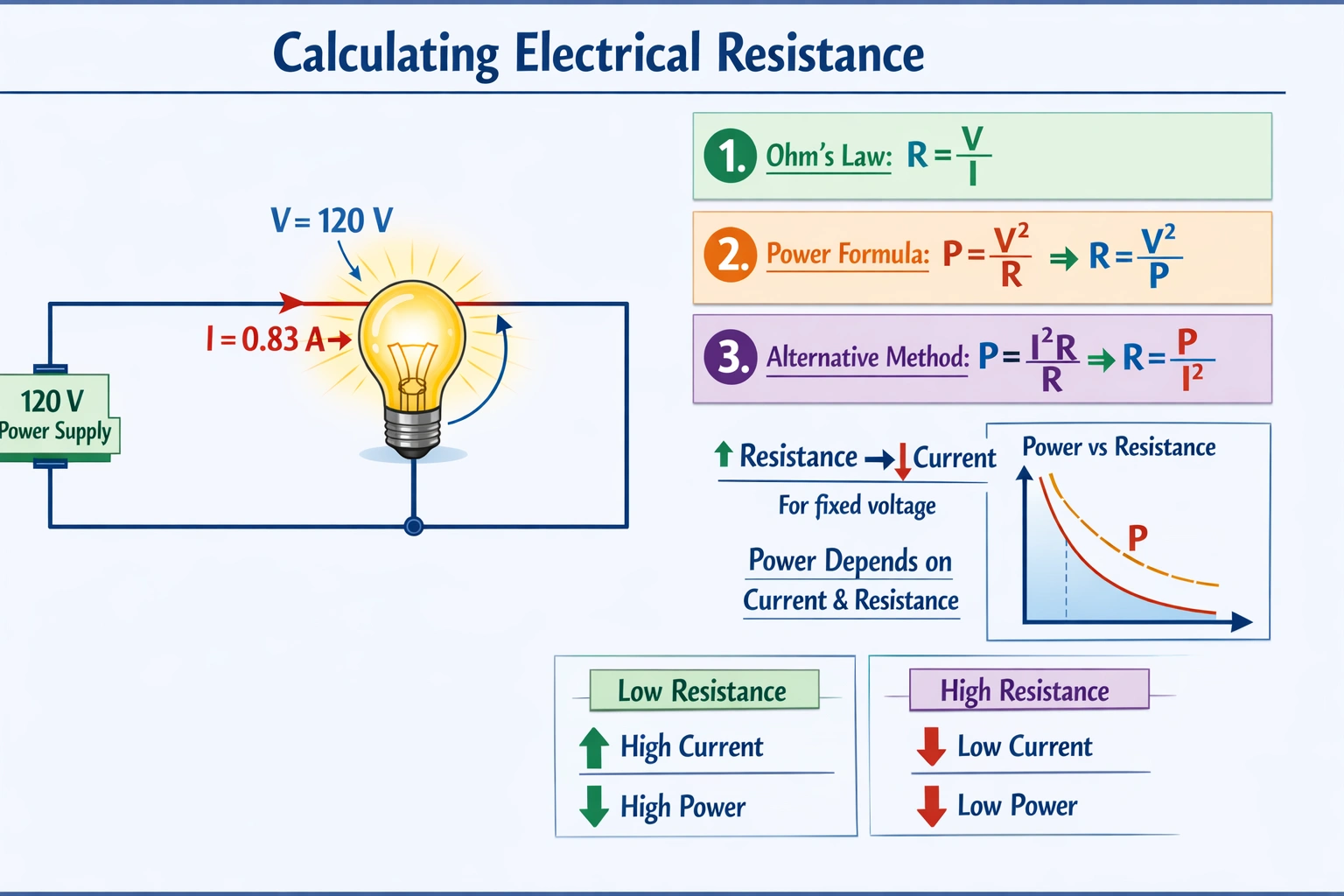
A 100-watt light bulb runs off a 120-volt source. If 0.83 amps flow through the bulb, what is its resistance?
A.
100 ohms
B. 120 ohms
C. 140 ohms
D. 270 ohms
Rationale
The bulb's resistance is approximately 140 ohms.
Ohm's law states V = I R, where V is voltage, I is current, and R is resistance. Thus, R = V / I. Alternatively, power formulas (P = V I = I² R = V² / R) can be used. The given power (100 W) and voltage (120 V) are consistent with the current (0.83 A) via these relationships.
A) 100 ohms
Using R = V / I: 120 V / 0.83 A ? 144.6 ?, not 100 ?. With R = 100 ?, current would be I = V / R = 120 / 100 = 1.2 A, and power would be P = V I = 120 × 1.2 = 144 W, not 100 W.
B) 120 ohms
This would give I = 120 V / 120 ? = 1.0 A, and P = 120 V × 1.0 A = 120 W, neither matching the given values.
C) 140 ohms
Using Ohm's law: R = V / I = 120 V / 0.83 A ? 144.6 ?, which rounds to about 140 ?. Using power: R = V² / P = (120)² / 100 = 14400 / 100 = 144 ?. Or R = P / I² = 100 / (0.83)² ? 100 / 0.6889 ? 145.1 ?. All methods yield approximately 144-145 ?, closest to 140 ? among the choices.
D) 270 ohms
This would give I = 120 V / 270 ? ? 0.444 A, and P = 120 × 0.444 ? 53.3 W, inconsistent with the given 100 W and 0.83 A.
Conclusion
The resistance can be found directly from Ohm's law: R = V / I. With V = 120 V and I = 0.83 A, R ? 144.6 ?, which is closest to 140 ?. The power rating provides a consistency check.
HESI A2 Exams
Biology Quizzes
3 Practice Tests
Biology Quizzes
3 Practice Tests
Chemistry Quizzes
3 Practice Tests
Chemistry Quizzes
3 Practice Tests
Anatomy Quizzes
3 Practice Tests
Anatomy Quizzes
3 Practice Tests
Reading Quizzes
4 Practice Tests
Reading Quizzes
4 Practice Tests
Grammar Quizzes
3 Practice Tests
Grammar Quizzes
3 Practice Tests
Vocabulary Quizzes
3 Practice Tests
Vocabulary Quizzes
3 Practice Tests
HESI Quizzes
3 Practice Tests
HESI Quizzes
3 Practice Tests