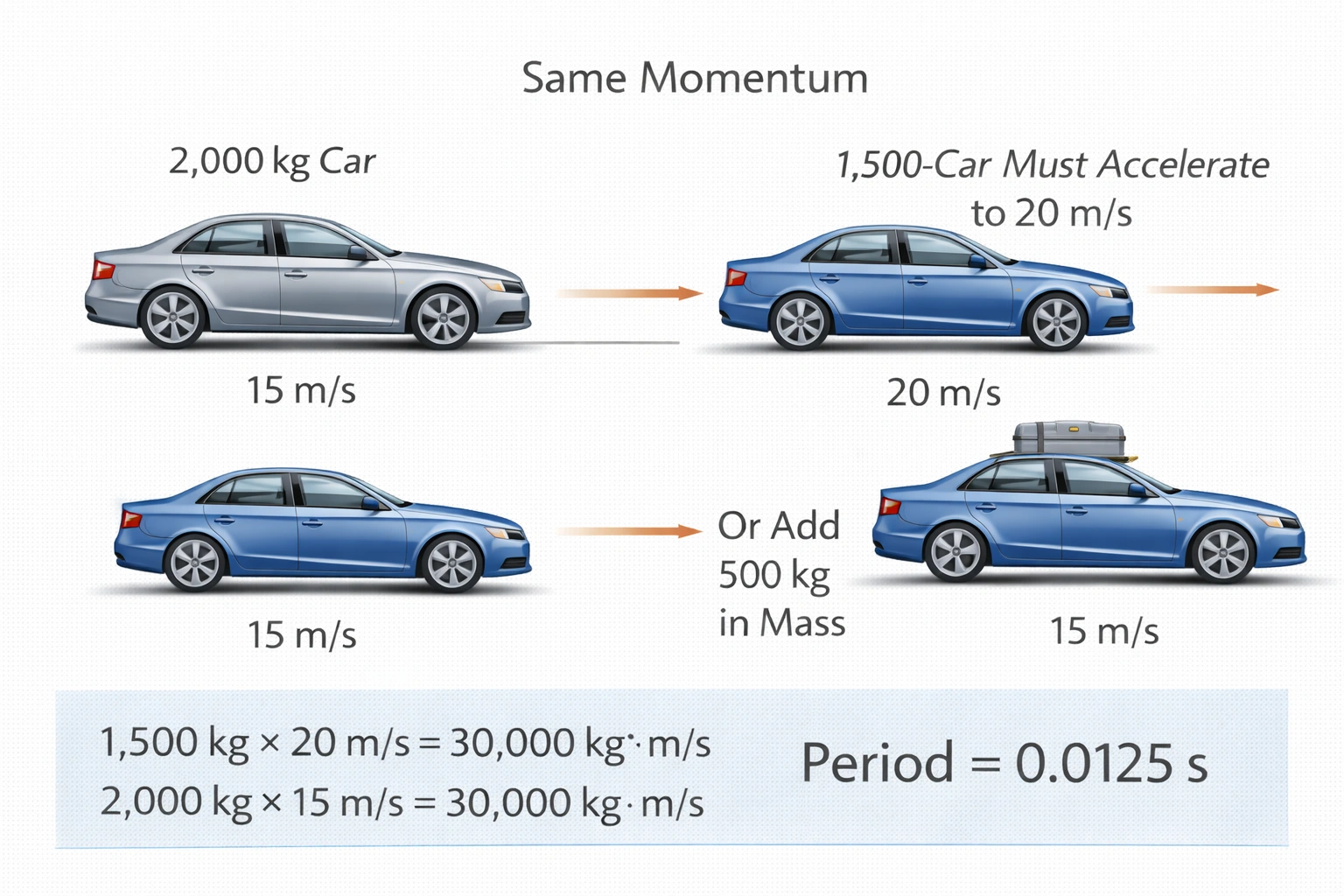
A 2,000-kg car travels at 15 m/s. For a 1,500-kg car traveling at 15 m/s to generate the same momentum, which would need to happen?
-
A
It would need to accelerate to 20 m/s.
-
B
It would need to add 500 kg in mass.
-
C
Both A and B
-
D
Either A or B
For a 1,500-kg car to possess the same momentum as a 2,000-kg car moving at 15 m/s, it must increase its speed to 20 m/s.
Momentum, the product of mass and velocity, requires the lighter car to compensate for its reduced mass with higher speed to achieve equivalence.
A) It would need to accelerate to 20 m/s
This satisfies the momentum equation: 2,000 kg × 15 m/s = 30,000 kg·m/s, and 1,500 kg × 20 m/s = 30,000 kg·m/s. Adjusting velocity alone achieves identical momentum without altering the system’s mass.
B) It would need to add 500 kg in mass
While adding mass would also equalize momentum, the scenario describes the same 1,500-kg car, implying modification of motion rather than composition. Mass addition is unnecessary when speed adjustment suffices.
C) Both A and B
This is redundant. Either change independently achieves the goal; requiring both contradicts the principle of equivalent solutions in physics.
D) Either A or B
Although both are mathematically valid, the context of the question, comparing two cars in motion, favors velocity as the variable parameter. Mass is typically fixed for a given vehicle, making speed the appropriate adjustment.
Conclusion
Momentum equality is achieved by increasing the lighter car’s speed to 20 m/s. The correct answer is A) It would need to accelerate to 20 m/s.

Topic Flashcards
Click to FlipWhat is the formula for linear momentum (p)?
p = mass (m) × velocity (v)
Calculate the momentum of the 2,000 kg car traveling at 15 m/s.
p = 2,000 kg × 15 m/s = 30,000 kg·m/s
If a car's mass is reduced, what must happen to its velocity to keep momentum the same?
Its velocity must increase, because momentum is directly proportional to both mass and velocity.
For the 1,500 kg car to have 30,000 kg·m/s of momentum, solve for the required velocity.
30,000 kg·m/s = 1,500 kg × v. Therefore, v = 30,000 / 1,500 = 20 m/s.
In a practical sense, why is changing the car's speed a more likely solution than changing its mass?
A car's mass is generally fixed during travel, while its speed is the variable that a driver can directly control.