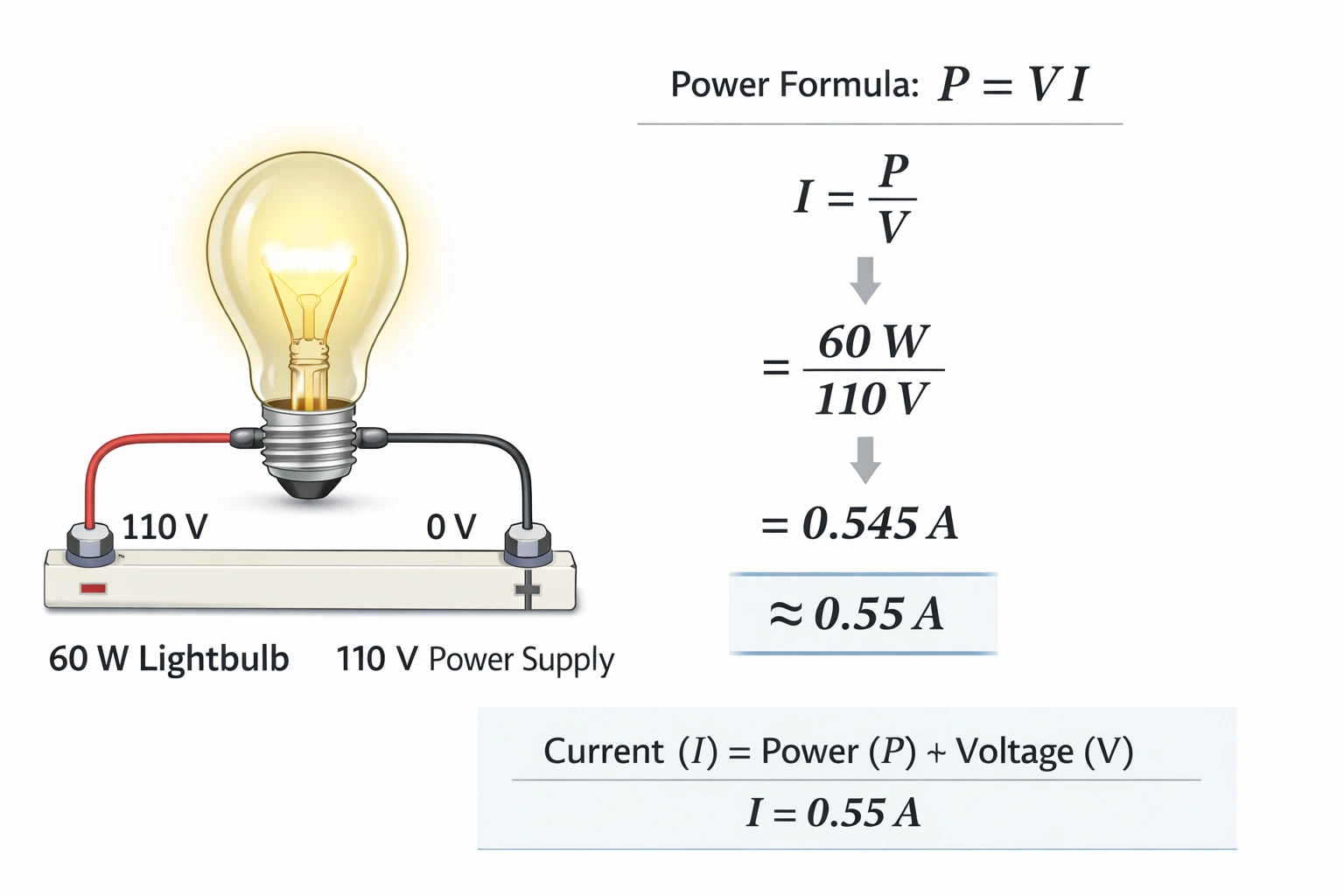
A 60-watt lightbulb is powered by a 110-volt power source. What is the current being drawn?
-
A
0.55 amperes
-
B
1.83 amperes
-
C
50 amperes
-
D
6,600 amperes
The current drawn by the lightbulb is 0.55 amperes.
Using the electrical power formula P=VIP=VI, the current is found by dividing power by voltage, yielding approximately 0.55 A for a 60-watt bulb on a 110-volt circuit.
A) 0.55 amperes
This is correct. I=P/V=60 W/110 V≈0.545 A, which rounds to 0.55 A, a typical current for household incandescent lighting.
B) 1.83 amperes
This results from inverting the formula (V/PV/P), which gives resistance in ohms, not current. It misapplies the power relationship and is incorrect.
C) 50 amperes
This is unrealistically high, comparable to a large kitchen appliance, and likely stems from arithmetic error or unit confusion. It does not reflect realistic household circuit behavior.
D) 6,600 amperes
This multiplies power and voltage (60 × 110), yielding watt-volts, not amperes. This value is physically absurd and indicates a fundamental misunderstanding of electrical units.
Conclusion
Current is power divided by voltage, and only 0.55 A matches the calculation. The correct answer is A) 0.55 amperes.

Topic Flashcards
Click to FlipUsing the formula P = I × V, you calculated a current of ~0.55 A. Now, use Ohm's Law (V = I × R) to find the approximate resistance of the lightbulb's filament when it is operating.
R = V / I = 110 V / 0.55 A ≈ 200 Ω. This connects power formulas to Ohm's Law and gives a tangible property (resistance) of the bulb.
If you plugged this 60-watt, 110-volt bulb into a 220-volt outlet by mistake, what would initially happen to the current drawn? (Assume the resistance stays roughly the same).
The current would be I = V / R = 220 V / 200 Ω = 1.1 A. This is double the intended current, which would cause the bulb to burn out almost instantly. This teaches the critical concept that devices are designed for specific voltages.
A "60-watt" rating tells you the bulb's power consumption at its designed voltage. How much electrical energy (in Joules) does this bulb use if it is left on for 5 hours?
Energy = Power × Time. Convert time: 5 hours × 3600 s/hour = 18,000 s. Calculate: 60 W × 18,000 s = 1,080,000 J or 1.08 MJ. This links the common unit of "watts" to the fundamental unit of energy (joules) and practical usage.
A modern 9-watt LED bulb produces the same light as this old 60-watt incandescent. If both are powered by 110 volts, how does the current drawn by the LED compare?
I_LED = P / V = 9 W / 110 V ≈ 0.082 A. The LED draws only about 15% of the current (0.082 A vs. 0.55 A) to produce the same light, illustrating the dramatic efficiency improvement of newer technology.
In the formula P = I × V, if you increase the voltage while keeping the power constant (like in efficient devices), what must happen to the current?
The current must decrease. Since P is held constant, I = P / V. This is an inverse relationship. This explains why high-voltage power lines are used for transmission: for the same power, higher voltage means lower current, which reduces energy loss in the wires.