An electromagnet is holding a 1,500-kg car at a height of 25 m above the ground. The magnet then experiences a power outage, and the car falls to the ground. Which of the following is false?
-
A
The car had a potential energy of 367.5 kJ.
-
B
367.5 kJ of potential energy is converted to kinetic energy.
-
C
The car retains potential energy of 367.5 kJ when it hits the ground.
-
D
The car’s potential energy converts to kinetic energy and then to sound energy.
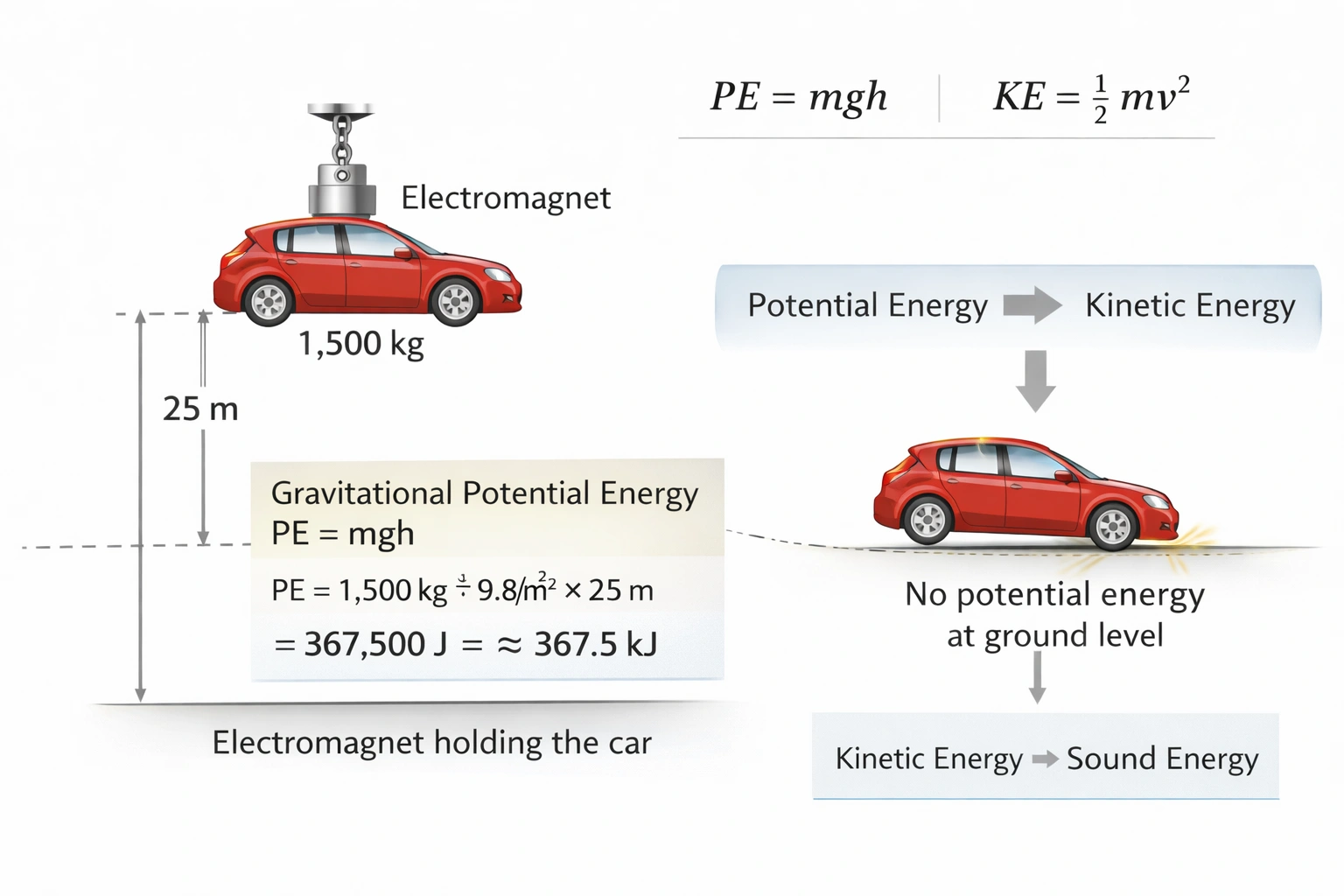
The false statement is C) The car retains potential energy of 367.5 kJ when it hits the ground.
Gravitational potential energy depends on height above a reference point, and at ground level (height = 0), potential energy is zero, meaning none is retained upon impact.
A) The car had a potential energy of 367.5 kJ
This is true. Using PE=mgh=1,500 kg×9.8 m/s2×25 m=367,500 J=367.5 kJPE=mgh=1,500 kg×9.8 m/s2×25 m=367,500 J=367.5 kJ, the initial potential energy is correctly stated.
B) 367.5 kJ of potential energy is converted to kinetic energy
This is true under ideal conditions (ignoring air resistance). As the car falls, gravitational potential energy transforms into kinetic energy, conserving total mechanical energy.
C) The car retains potential energy of 367.5 kJ when it hits the ground
This is false. At ground level, height is zero, so PE=mg(0)=0PE=mg(0)=0. All potential energy has been converted; none remains. This statement contradicts the definition of gravitational potential energy.
D) The car’s potential energy converts to kinetic energy and then to sound energy
This is true. Upon impact, kinetic energy dissipates as sound, heat, and deformation, consistent with energy transformation principles.
Conclusion
Potential energy is zero at ground level, so the claim that it is “retained” is false. The correct answer is C) The car retains potential energy of 367.5 kJ when it hits the ground.

Topic Flashcards
Click to FlipCalculate the gravitational potential energy (GPE) of the 1,500-kg car held at 25 m. Using the principle of conservation of energy (ignoring air resistance), determine the car's velocity the moment before it hits the ground.
GPE = mgh = (1500 kg)(9.8 m/s²)(25 m) = 367,500 J or 367.5 kJ. Before impact, all GPE is converted to Kinetic Energy (KE): KE = ½mv² = 367,500 J. Solving for v: v = √(2KE/m) = √(2*367500/1500) = √(490) ≈ 22.1 m/s.
In a real-world scenario, air resistance is present. How does this affect the energy conversion described in the problem? Specifically, what happens to the final kinetic energy and velocity compared to the ideal calculation?
Air resistance does work against the car, converting some of the car's mechanical energy (GPE) into thermal energy (heat) and sound in the air. Therefore, the final kinetic energy upon impact is less than 367.5 kJ, and the final velocity is less than the calculated 22.1 m/s. Total energy is still conserved, but it is no longer confined to just GPE and KE.
The false statement is that the car retains GPE at ground level. If we define the ground as our zero reference point (h=0), what is the car's GPE at that moment? If, instead, we defined a reference point 10 meters below the ground, what would the car's GPE be upon impact?
With ground as h=0: GPE = mg(0) = 0 J. With a point 10m below as h=0: At impact, the car's height is h = +10m relative to that new zero. GPE = (1500)(9.8)(10) = 147 kJ. This teaches that GPE values are relative and depend on the chosen reference level, but changes in GPE are absolute.
Statement D says energy converts to kinetic and then to sound. Detail the primary energy transformations from the moment of the power outage until the car is at rest on the ground.
GPE → Kinetic Energy → Internal Energy (Thermal/Heat) and Sound Energy. As the car falls, GPE converts to KE. Upon impact, KE is transferred: 1) to the car and ground as deformation (converted to heat), 2) to vibrational energy in the air and materials (sound), and 3) possibly to other forms like light (sparks).
If the car's mass were doubled to 3,000 kg but still dropped from 25 m, how would the following change: a) Initial GPE, b) Final velocity just before impact (ignoring air resistance), c) The falsity of statement C?
a) Initial GPE doubles to 735 kJ (GPE is directly proportional to mass). b) Final velocity remains unchanged at ~22.1 m/s. In the equation v = √(2gh), mass cancels out. c) Statement C ("retains potential energy...") remains false. Regardless of mass, GPE at zero height is always zero relative to that point.