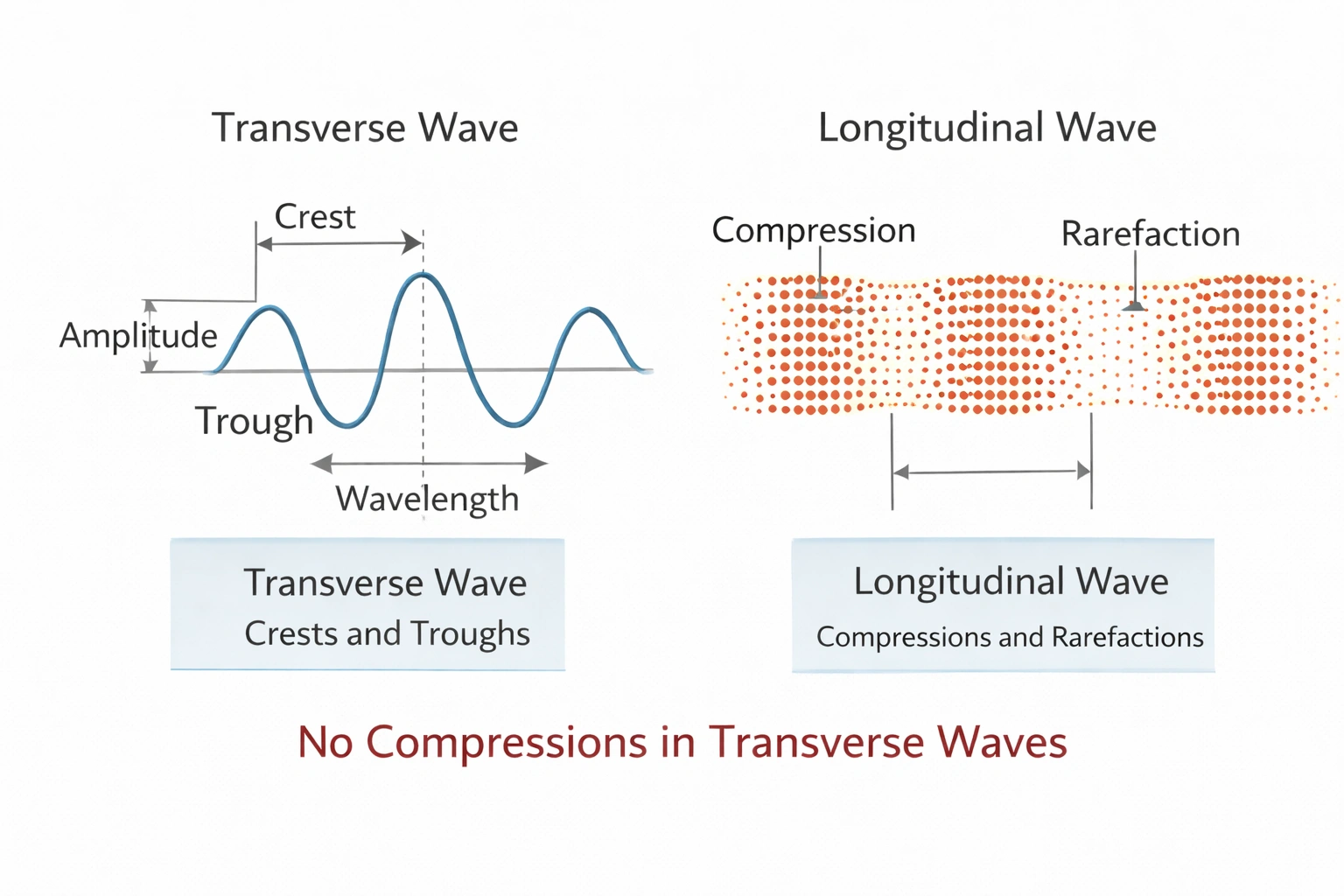
A transverse wave does not have ___________.
-
A
a compression
-
B
an amplitude
-
C
a frequency
-
D
a wavelength
A transverse wave does not have a compression.
In transverse waves, particle displacement is perpendicular to the direction of wave propagation, so there are no regions of high particle density (compressions) or low density (rarefactions), features exclusive to longitudinal waves.
A) a compression
This is correct. Compressions occur only in longitudinal waves (e.g., sound), where particles oscillate parallel to wave motion. Transverse waves (e.g., light, rope waves) exhibit crests and troughs, not compressions.
B) an amplitude
Transverse waves do have amplitude, the maximum displacement from equilibrium. This is a fundamental property of all waves.
C) a frequency
All periodic waves, including transverse waves, have frequency, the number of oscillations per second.
D) a wavelength
Transverse waves have wavelength, the distance between consecutive crests or troughs. This is a standard wave characteristic.
Conclusion
Compressions are absent in transverse waves. The correct answer is A) a compression.

Topic Flashcards
Click to FlipWhat is the defining characteristic of particle motion in a transverse wave?
Particle displacement is perpendicular to the direction of wave propagation.
What feature, found in longitudinal waves, is absent in transverse waves?
Compressions and rarefactions (regions of high and low particle density).
Name two wave properties that ALL periodic waves (transverse and longitudinal) possess.
Amplitude, frequency, and wavelength.
What type of wave is a sound wave in air, and does it have compressions?
Longitudinal wave, and yes, it has compressions.
In a transverse wave on a rope, what does the amplitude measure?
The maximum displacement of the rope from its equilibrium (rest) position.