A cell is in a solution in which the concentration of solutes is higher inside the cell than outside the cell. What would you expect to happen to the cell?
-
A
It will swell and possibly burst.
-
B
It will shrivel and shrink.
-
C
It will maintain its current size.
-
D
It will grow a supportive cell wall.
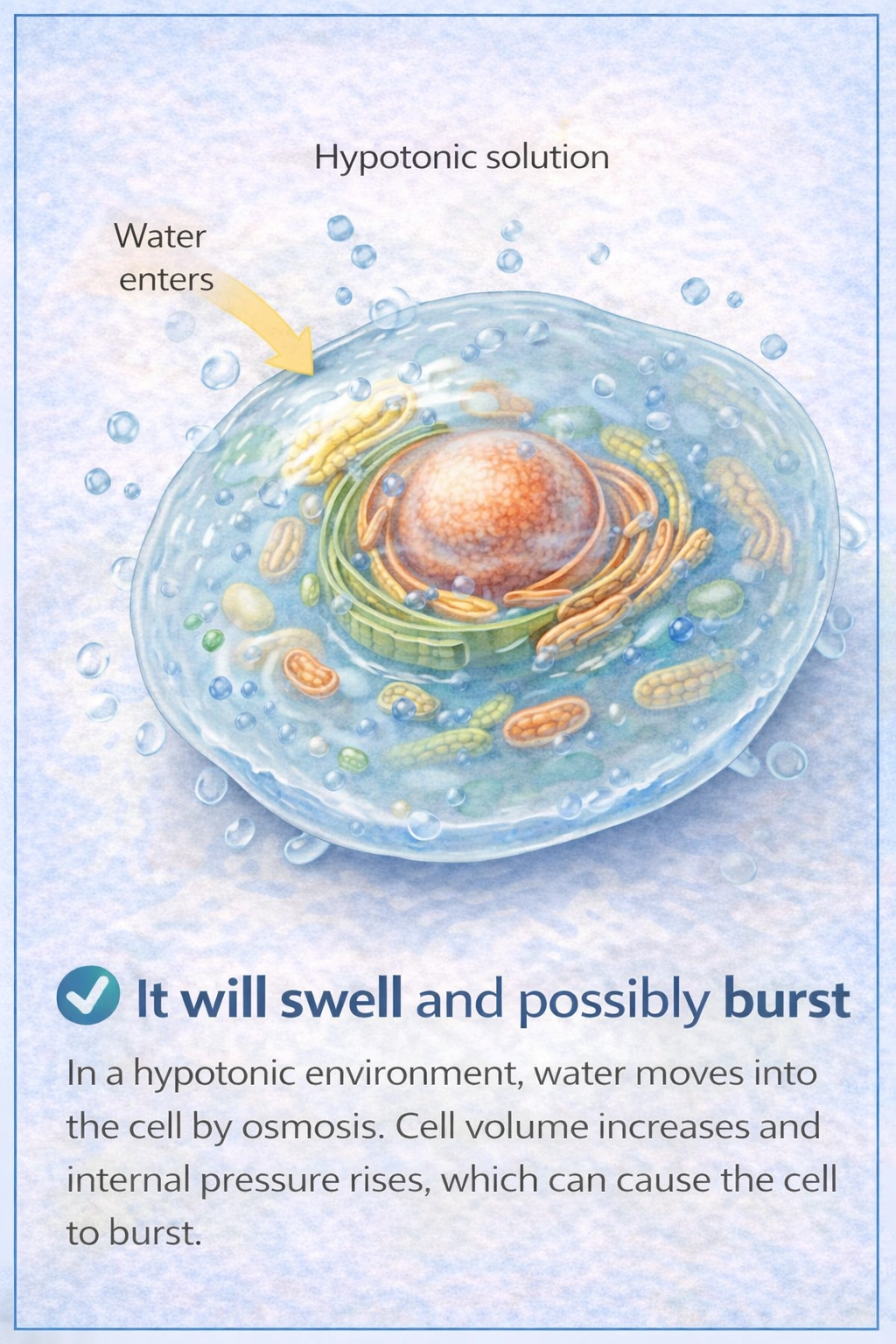
The cell will swell and may possibly burst.
When the solute concentration is higher inside the cell than outside, the surrounding solution is hypotonic relative to the cell. Water moves by osmosis from areas of lower solute concentration (higher water concentration) to areas of higher solute concentration (lower water concentration). As a result, water enters the cell, increasing its internal volume and pressure, which can cause the cell to swell and potentially rupture.
A) It will swell and possibly burst
In this situation, the extracellular fluid has fewer solutes than the intracellular fluid. Osmosis drives water into the cell to equalize solute concentrations across the membrane.
As water enters:
- The cell volume increases
- The plasma membrane stretches
- Internal pressure rises
Animal cells lack a rigid cell wall, so excessive swelling can lead to lysis (bursting). This process is called osmotic lysis or cytolysis.
Because this outcome directly follows from the given solute conditions, this option is correct.
B) It will shrivel and shrink
Shrinking occurs in a hypertonic environment, where solute concentration is higher outside the cell than inside.
In that case, water would leave the cell, causing it to lose volume and become crenated (shrunken). Since the problem states that solute concentration is higher inside the cell, not outside, this option is incorrect.
C) It will maintain its current size
A cell maintains its size in an isotonic solution, where solute concentrations inside and outside the cell are equal.
Under isotonic conditions, water moves in and out at equal rates, resulting in no net change in volume. This does not apply to the situation described, so this option is incorrect.
D) It will grow a supportive cell wall
Animal cells cannot form cell walls at any stage of their life cycle.
Cell walls are found in plants, fungi, and some microorganisms, and their formation is genetically programmed, not triggered by osmotic conditions. Even in plant cells, osmotic pressure does not cause new cell wall formation as an immediate response.
Therefore, this option is incorrect.
Conclusion:
Because the solute concentration is higher inside the cell than outside, water moves into the cell by osmosis. This influx causes the cell to swell and, in animal cells, may result in bursting due to the absence of a rigid cell wall.
Thus, the correct outcome is that the cell will swell and possibly burst.

Topic Flashcards
Click to FlipIn which type of solution is the solute concentration lower outside the cell than inside?
A hypotonic solution.
What is the direction of net water movement when a cell is placed in a hypotonic solution?
Water moves into the cell.
What happens to an animal cell (without a cell wall) in a hypotonic solution?
It swells and may burst (lyse) due to osmotic pressure.
Do animal cells possess or produce rigid cell walls for support?
No. Cell walls are found in plants, fungi, and some microbes; animal cells only have a flexible plasma membrane.