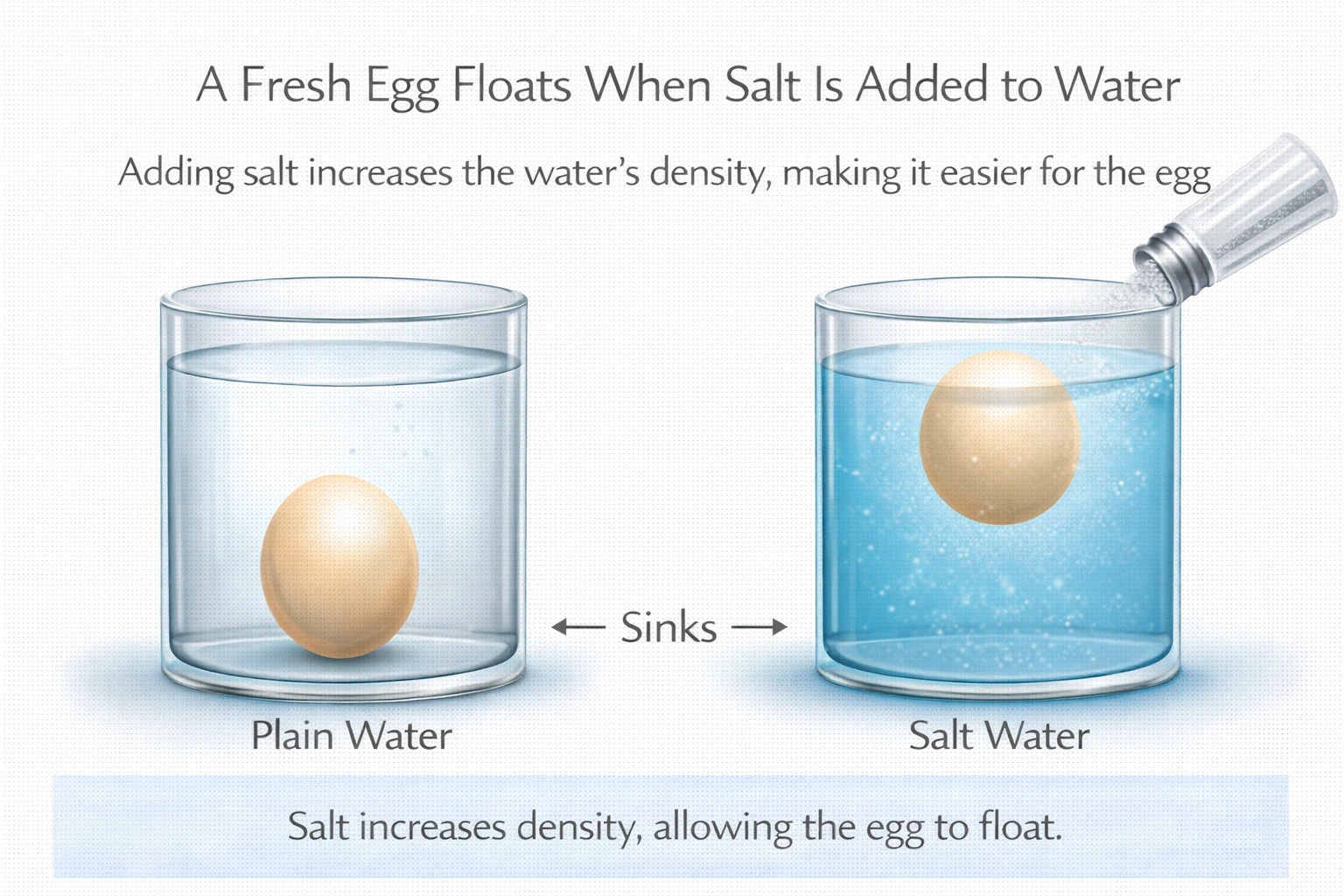
A fresh egg will float in water .
-
A
when the water is cold
-
B
it will not float in any circumstance
-
C
always
-
D
when salt is added to the water
A fresh egg will float in water when salt is added because the added salt increases the water's density, making it easier for the egg to float.
- A) When the water is cold:
- The temperature of the water does not have a direct effect on whether an egg floats or sinks. The floating or sinking of an egg is based on the density of the egg relative to the water. Cold water may make the egg's contents denser, but it is not the primary factor for floating.
- B) It will not float in any circumstance:
- A fresh egg typically sinks in plain water because its density is greater than that of water. However, as eggs age, air enters the shell and causes the egg to become less dense, potentially making it float. This option is inaccurate as eggs can float when salt is added to water.
- C) Always:
- Fresh eggs generally sink in water unless they have become very old. If the egg floats, it is likely due to aging and the accumulation of air inside the shell, not a characteristic of fresh eggs. Therefore, this option is incorrect.
- D) When salt is added to the water:
- Adding salt to water increases the density of the water. This makes it easier for an egg to float because the egg will displace more water than it would in plain water. As a result, saltwater increases buoyancy and can cause even a fresh egg to float. This is the correct answer.
Conclusion: A fresh egg will float in water when salt is added to the water, making D) When salt is added to the water the correct answer.

Topic Flashcards
Click to FlipWhat physical property of a liquid determines whether an object will float or sink in it?
Density.
Adding salt to water increases its density. What principle explains why this helps an egg float?
Archimedes' principle / Buoyancy.
In plain water, a fresh egg sinks. Why does an old egg often float instead?
An air cell inside the egg expands over time, decreasing the egg's overall density.
What is a common, simple home test to check an egg's freshness using water?
Place it in a bowl of plain water; if it sinks and lies flat, it's fresh.
What is the term for the upward force exerted by a fluid that opposes the weight of an immersed object?
Buoyant force.