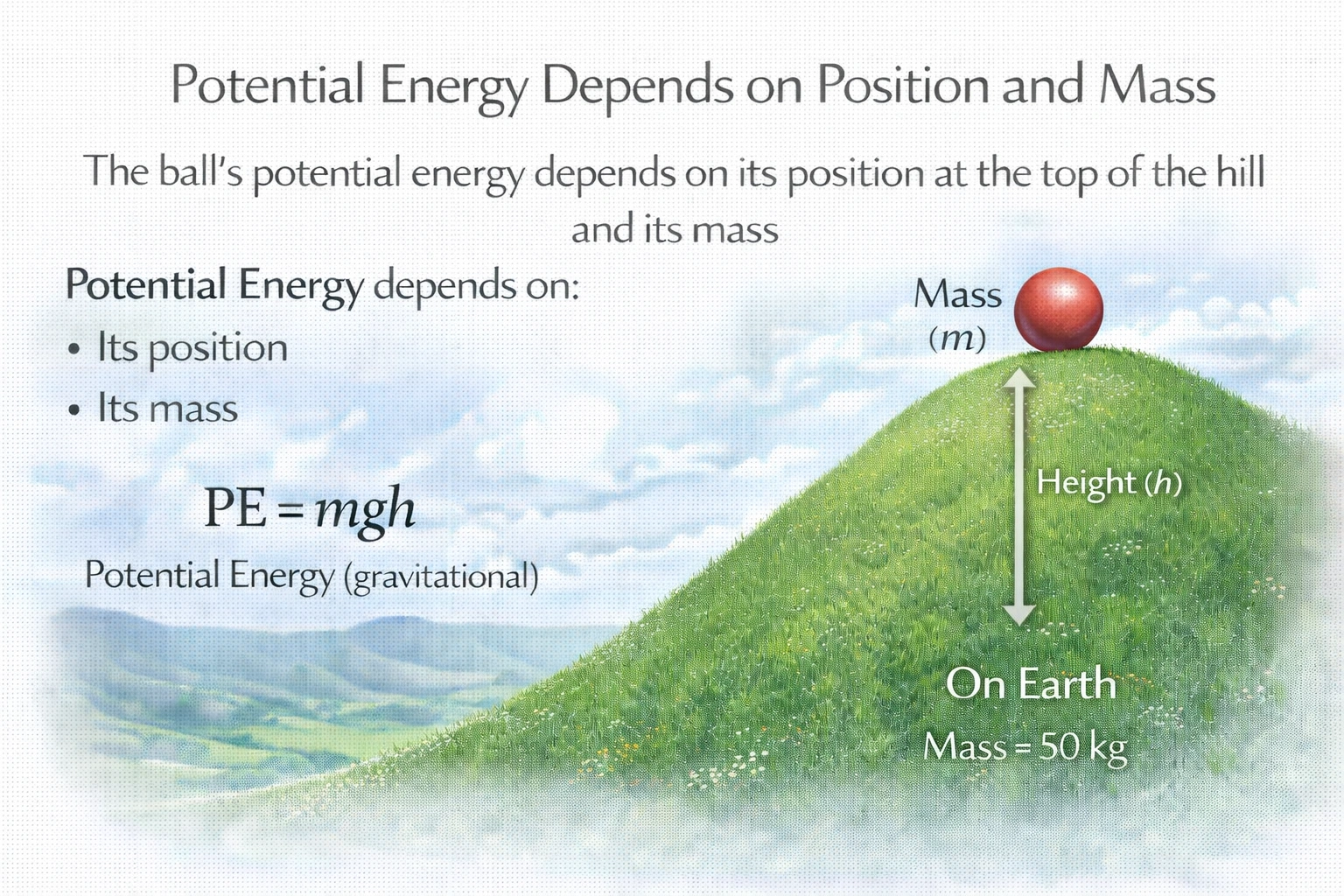
A ball is at the top of a hill. Which factor, or factors, is responsible for its potential energy?
-
A
its position and its mass
-
B
its acceleration and its position
-
C
its mass
-
D
Its circular shape
The ball's potential energy is determined by its position at the top of the hill and its mass.
Both factors contribute to the energy stored in the ball due to gravity.
- A) Its position and its mass:
- Potential energy is the energy stored in an object due to its position in a force field (like gravity). For an object at the top of a hill, the height of the ball (its position) and its mass both contribute to its gravitational potential energy. The higher the position of the object and the greater its mass, the more potential energy it will have. The formula for gravitational potential energy is:
where m is mass, g is the acceleration due to gravity, and h is height. This makes A) Its position and its mass the correct answer.
- B) Its acceleration and its position:
- Acceleration is related to kinetic energy and not potential energy. Potential energy is determined by an object’s position in a gravitational field, but acceleration is not a factor in calculating potential energy. Therefore, this option is incorrect.
- C) Its mass:
- While mass is an important factor in calculating potential energy, the object’s position is equally important. The ball’s position at the top of the hill gives it the potential energy, but the mass also plays a role. Therefore, mass alone is not sufficient to describe potential energy.
- D) Its circular shape:
- The shape of the ball does not affect its gravitational potential energy. Potential energy is primarily determined by the position and mass of the object, not by whether the object is spherical or not. Therefore, this option is not correct.
Conclusion: The position and mass of the ball determine its potential energy, making A) Its position and its mass the correct answer.

Topic Flashcards
Click to FlipWhat two properties of an object does its gravitational potential energy directly depend on?
Its mass (m) and its height/position above a reference point (h).
A 2 kg book and a 4 kg book are sitting on the same shelf. Which has more gravitational potential energy, and why?
The 4 kg book has more GPE. At the same height (h), GPE is directly proportional to mass (m). Since the 4 kg book has twice the mass, it has twice the GPE, assuming 'g' is the same.
The same 5 kg box is placed on a 1-meter tall table and then a 3-meter tall shelf. In which position does it have greater potential energy, and what is the factor of increase?
On the 3-meter shelf. Its GPE is three times greater. With the same mass, GPE is directly proportional to height (h). Tripling the height (from 1m to 3m) triples the GPE.
If an object's mass is doubled and its height is also doubled, by what factor does its gravitational potential energy change?
It increases by a factor of 4. GPE = m*g*h. If you double mass (2m) and double height (2h), the new GPE = (2m)*g*(2h) = 4(mg*h). So it becomes four times the original.
Why is "acceleration" not a direct factor in the potential energy stored in the ball on the hill?
Acceleration due to gravity (g) is the environmental constant that enables potential energy, but it is not a property of the ball. The factors responsible for the ball's energy are its own mass and its position in that gravitational field.