How fast does sound travel through a vacuum?
-
A
25 m/s
-
B
25 m/s
-
C
222 m/s
-
D
0 m/s
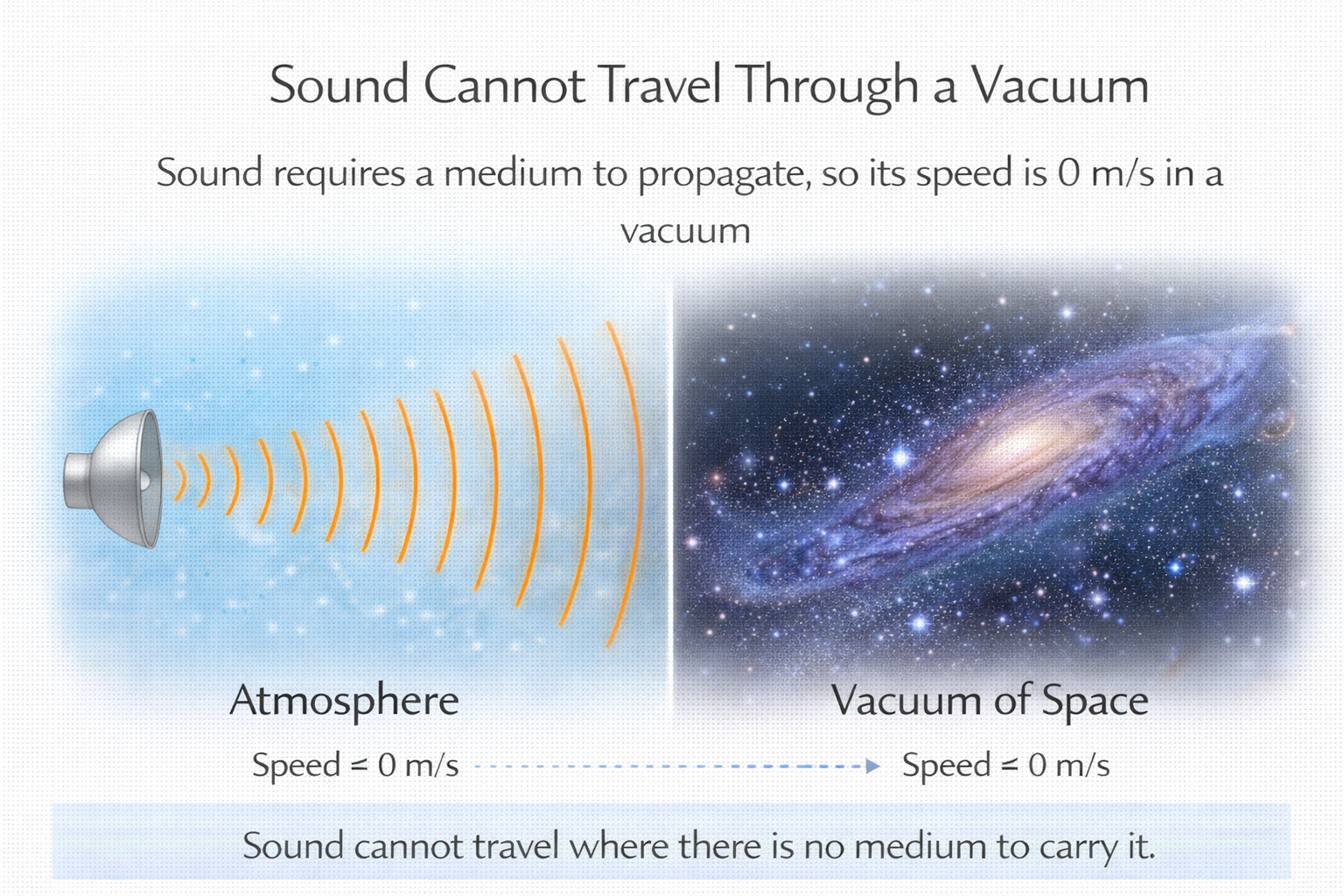
Sound cannot travel through a vacuum, so its speed is 0 m/s in such an environment
- A) 25 m/s:
- Sound is a mechanical wave that requires a medium (solid, liquid, or gas) to propagate. In a vacuum, there are no molecules or particles to transmit the vibrations that sound waves rely on. Therefore, sound cannot travel through a vacuum at any speed, including 25 m/s. This answer is incorrect.
- B) 331.4 m/s:
- This is the approximate speed of sound in air at 0°C. Sound travels at different speeds depending on the medium through which it propagates. However, this value is for air and does not apply to a vacuum, where sound cannot travel at all.
- C) 222 m/s:
- This is an incorrect answer. It could represent the speed of sound in another medium, but sound cannot travel through a vacuum. Sound requires molecules to vibrate and transmit energy, and there are no molecules in a vacuum.
- D) 0 m/s:
- Sound requires a medium to propagate, and in a vacuum (which has no particles), there is no way for sound waves to travel. The speed of sound in a vacuum is therefore 0 m/s, because sound cannot travel at all in such an environment.
Conclusion: In a vacuum, sound cannot propagate, and its speed is 0 m/s, making D) 0 m/s the correct answer.

Topic Flashcards
Click to FlipSound is classified as this type of wave, which requires a physical medium to travel.
A mechanical wave.
What is the primary reason sound cannot travel through the vacuum of space?
There are no particles/molecules to vibrate and transmit the sound energy.
Unlike sound, light can travel through a vacuum. What type of wave is light?
An electromagnetic wave.
In which state of matter (solid, liquid, or gas) does sound generally travel the fastest?
Solid
What is the approximate speed of sound in dry air at room temperature (20°C or 68°F)?
About 343 meters per second (m/s).