Extract:
A researcher is looking at a procedure that says he needs 0.0505 g of sodium. What unit of measurement does this describe?
-
A
Length
-
B
Time
-
C
Volume
-
D
Mass
The unit 'g' describes a measurement of mass.
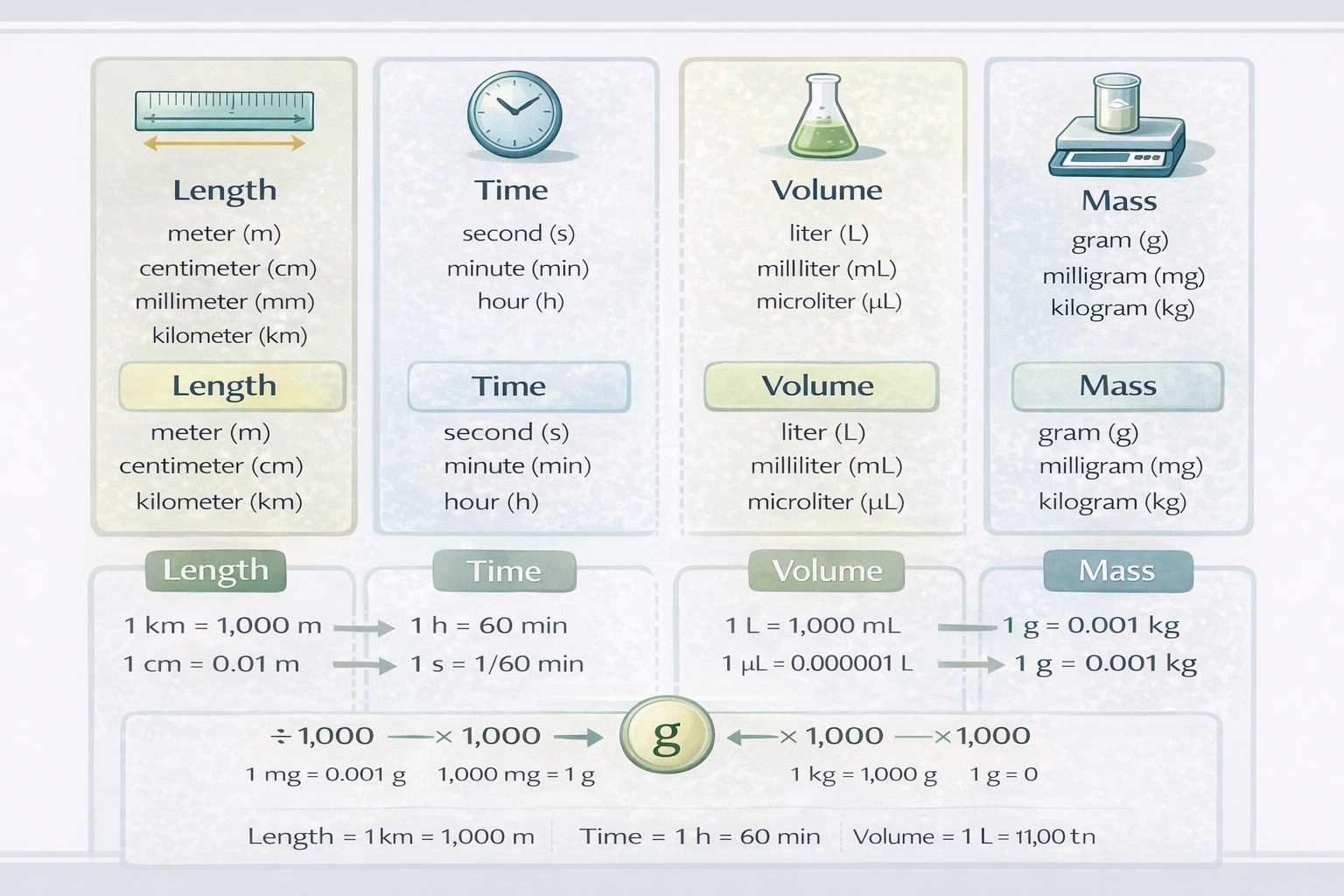
In the International System of Units (SI) and common laboratory practice, the symbol 'g' stands for the gram, which is the base unit for mass. Measurements of chemical reagents, like sodium, are almost always given in units of mass (e.g., grams, milligrams) or moles, as these quantities are crucial for calculating stoichiometry, preparing solutions of specific concentration, and ensuring reproducible reactions.
A) Length
The standard base unit for length is the meter (m). Common derived units include centimeter (cm), millimeter (mm), and kilometer (km). The abbreviation 'g' is never used as a symbol for any unit of length.
B) Time
The base unit for time is the second (s). Other accepted units include minutes (min) and hours (h or hr). The symbol 'g' does not correspond to any unit of time measurement.
C) Volume
Volume is typically measured in liters (L) or its derivatives, such as milliliters (mL) or microliters (µL). While the mass of a substance can be used to calculate its volume if the density is known (Volume = Mass / Density), the unit 'g' itself explicitly denotes grams, a unit of mass, not volume.
D) Mass
The gram (g) is a unit of mass. 0.0505 g is equivalent to 50.5 milligrams. In a laboratory procedure, this specifies the precise amount of sodium to be weighed out on a balance. This is the standard and unambiguous interpretation of the notation.
Conclusion:
Recognizing standard unit symbols is fundamental in scientific contexts. The symbol 'g' is universally recognized as the abbreviation for gram, a unit of mass. Therefore, the procedure specifies a mass of 0.0505 grams of sodium.

Topic Flashcards
Click to FlipWhat does the unit abbreviation "g" stand for in a measurement like 0.0505 g?
Grams, which is a unit of mass.
What is the most appropriate lab instrument to use to obtain 0.0505 g of sodium?
A balance (or scale), which is used to measure mass.
Convert 0.0505 grams into milligrams.
50.5 mg (since 1 g = 1000 mg).
Which quantity type (mass, volume, length, or time) is always represented by the unit grams (g)?
Mass.
If a procedure instead asked for 5.0 mL of a liquid, would it be measuring the same property as 0.0505 g?
No. "mL" measures volume, while "g" measures mass.