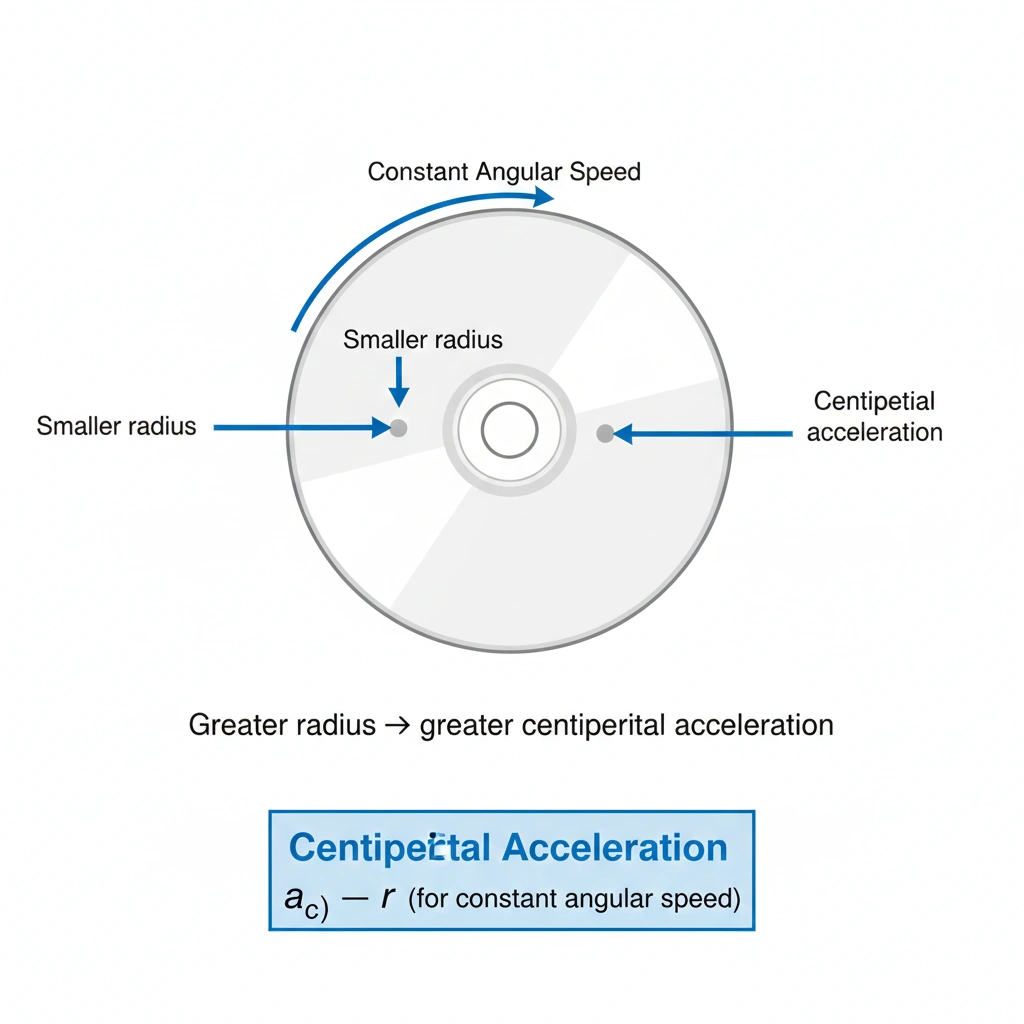
CD dust specks: which has greater centripetal acceleration?
-
A
Edge speck
-
B
Mid radius speck
-
C
Zero
-
D
Same
The dust speck on the edge of the CD has the greater centripetal acceleration.
When a CD spins at a constant angular velocity, every point on the disc completes each rotation in the same amount of time. However, points farther from the center move in a larger circle. Centripetal acceleration depends directly on the distance from the axis of rotation, so location matters.
A) Edge speck
Centripetal acceleration is given by the relationship:
centripetal acceleration equals angular velocity squared multiplied by radius
where angular velocity is the same for all points on the CD and radius is the distance from the center. At the edge of the CD, the radius is largest, so the centripetal acceleration is greatest.
B) Mid-radius speck
This speck has a smaller radius than the edge speck. With the same angular velocity but a smaller radius, its centripetal acceleration is smaller.
C) Zero
Any object moving in a circular path has a nonzero centripetal acceleration because its direction of motion is continuously changing. A dust speck on a rotating CD is therefore never at zero centripetal acceleration.
D) Same
Centripetal acceleration would only be the same if the specks were at the same radius. Since one speck is closer to the center and the other is at the edge, their accelerations are different.
Conclusion
At constant angular velocity, centripetal acceleration increases with radius. The dust speck on the edge of the CD, being farthest from the center, experiences the greatest centripetal acceleration.
Topic Flashcards
Click to FlipWhat is the direction of the centripetal acceleration for an object, like a dust speck, moving in a uniform circular path?
The centripetal acceleration is always directed toward the center of the circular path.
What is the primary formula for centripetal acceleration (a_c) when you know an object's constant angular speed (ω) and its radius (r) from the axis?
a_c = ω²r. This shows that for a constant ω, acceleration is directly proportional to the radius.
On a rotating platform like a merry-go-round, where do you feel a stronger "pull" outward: near the center or near the edge? Use centripetal acceleration to explain.
You feel a stronger effect near the edge. The centripetal force required to keep you moving in a circle (and your inertia reacting to it) is greater there because the centripetal acceleration a_c = ω²r is greater at the larger radius (r).
In a washing machine's spin cycle, why is water forced out of the clothes and through the drum's holes?
The drum spins, providing a centripetal force on the clothes. The water particles, needing a greater centripetal force to follow the same circular path, cannot get enough force from the fabric and therefore move to a path of larger radius (the drum wall) where less centripetal acceleration is needed, and eventually exit through the holes.
A dust speck at a radius of 0.04 m on a CD has a centripetal acceleration of 2 m/s². What is the acceleration of a speck at 0.02 m radius if the CD's angular speed is constant?
1 m/s². Using a_c = ω²r and constant ω, acceleration is directly proportional to r. Halving the radius (0.04 m → 0.02 m) halves the acceleration (2 m/s² → 1 m/s²).