Momentum of 5.5 kg ball at 4.5 m/s?
-
A
10 kg⋅m/s
-
B
16.2 km/h
-
C
24.75 kg⋅m/s
-
D
Not enough info
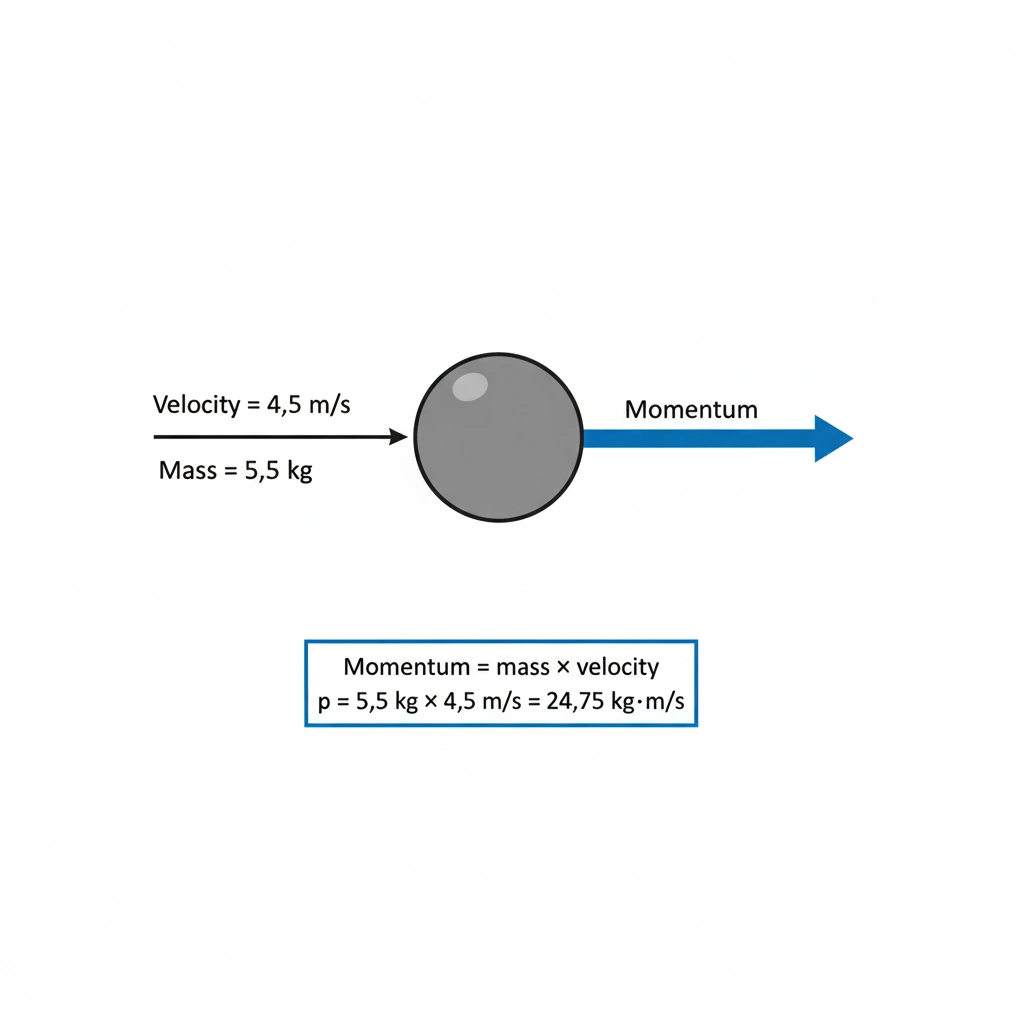
The momentum of the ball is 24.75 kg·m/s.
Momentum is a measure of how much motion an object has and depends on both its mass and its velocity. It is calculated using the relationship:
momentum equals mass multiplied by velocity
where momentum is the quantity of motion, mass is the amount of matter in the object, and velocity is the speed of the object in a given direction.
For this problem, the mass of the ball is 5.5 kg and its velocity is 4.5 m per second.
A) 10 kg·m/s
This value is far too small and likely results from rounding incorrectly or using only part of the information. Multiplying 5.5 kg by 4.5 m per second gives a much larger result than 10.
B) 16.2 km/h
This option has incorrect units. Momentum is measured in kilogram–meters per second, not in kilometers per hour. This value represents a speed, not momentum.
C) 24.75 kg·m/s
Using the momentum relationship gives:
momentum equals 5.5 kilograms multiplied by 4.5 meters per second
momentum equals 24.75 kilogram–meters per second
This calculation correctly applies both the mass and velocity with the proper units, making this option accurate.
D) Not enough info
Both required quantities, mass and velocity, are clearly given in the problem. Therefore, there is sufficient information to calculate momentum.
Conclusion
Momentum is found by multiplying mass by velocity. With a mass of 5.5 kg and a velocity of 4.5 m per second, the momentum of the ball is 24.75 kg·m/s.
Topic Flashcards
Click to FlipWhat is the defining equation for linear momentum (p), and what are its standard units?
p = m * v, where *m* is mass and *v* is velocity. The standard unit is the kilogram-meter per second (kg·m/s).
A 5.5 kg ball rolls at 4.5 m/s. Calculate its momentum. What would the momentum be if its velocity were doubled?
Initial momentum: 24.75 kg·m/s (5.5 kg * 4.5 m/s). If velocity doubles to 9.0 m/s, the new momentum would be 49.5 kg·m/s (5.5 kg * 9.0 m/s). Momentum is directly proportional to velocity when mass is constant.
How does the momentum of a heavy truck moving slowly compare to a light bullet moving very fast? Explain using the formula p=mv.
The truck can have a large momentum due to its very large mass (m), even at a low speed. The bullet can have a large momentum due to its very high velocity (v), despite a small mass. Both mass and velocity contribute to the quantity of motion.
Why is momentum described as a vector quantity, and what does this imply for calculations?
Because velocity (v) is a vector (has magnitude and direction). Therefore, momentum (p=mv) also has direction. This means momenta in opposite directions can cancel each other out, and direction must be accounted for in problems.
What fundamental law of physics states that the total momentum of a closed, isolated system remains constant?
The Law of Conservation of Momentum. This principle is crucial for analyzing collisions and explosions