Speed of light slowest in _______.
-
A
Air
-
B
Glass
-
C
Water
-
D
Never changes
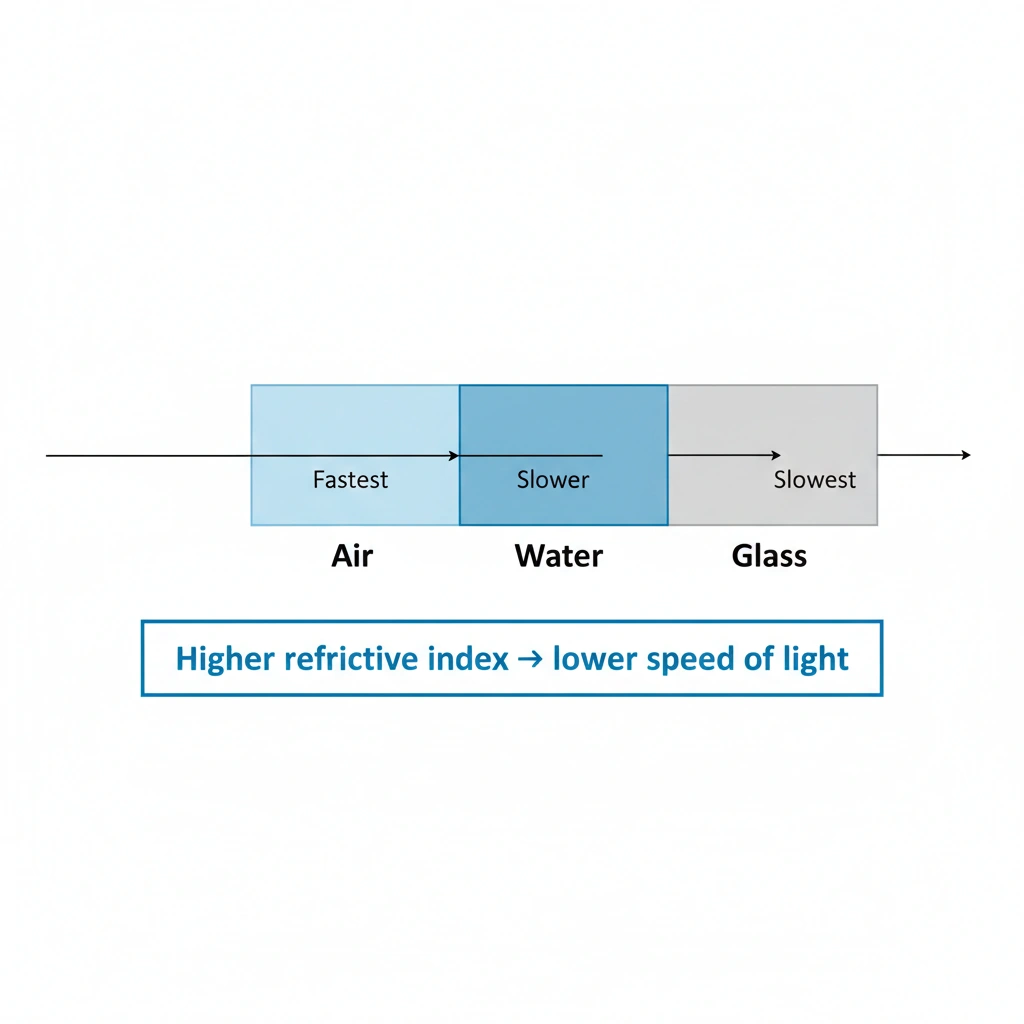
The speed of light is slowest in glass.
Light travels at different speeds depending on the medium it passes through. The speed of light in a medium is determined by the medium’s refractive index. A higher refractive index means light travels more slowly through that material.
A) Air
Air has a refractive index very close to 1.00, so light travels through air at nearly the same speed as it does in a vacuum. This makes air one of the fastest of the listed media for light.
B) Glass
Glass has a relatively high refractive index (about 1.5), meaning light travels significantly more slowly through it compared with air or water. This reduction in speed is why light bends noticeably when entering or leaving glass.
C) Water
Water has a refractive index of about 1.33, which slows light down compared with air but not as much as glass does.
D) Never changes
The speed of light in a vacuum is constant, but its speed changes when it passes through different materials. Therefore, this statement is incorrect.
Conclusion
Among the given options, glass has the highest refractive index and therefore slows light the most.
Topic Flashcards
Click to FlipWhat is the refractive index (n) of a material, and how is it mathematically defined in terms of the speed of light?
The refractive index is a measure of how much a material slows down light. It is defined as n = c / v, where c is the speed of light in a vacuum and v is the speed of light in the material.
Rank the following materials from lowest to highest refractive index: Water (n≈1.33), Air (n≈1.00), Glass (n≈1.5). Based on this, in which does light travel fastest and slowest?
Air (1.00) < Water (1.33) < Glass (1.5). Light travels fastest in air and slowest in glass. A higher n means a lower speed v.
Why does light bend (refract) more sharply when entering glass from air compared to entering water from air?
Light bends more in glass because the change in speed is greater. Glass has a higher refractive index than water, meaning the light slows down more dramatically, causing a larger change in direction.
What is the speed of light in a vacuum (c)? Approximately what is its speed in a typical glass with n=1.5?
In a vacuum, c ≈ 3.00 x 10⁸ m/s. In glass, v = c / n = (3.00 x 10⁸) / 1.5 ≈ 2.00 x 10⁸ m/s.
The "optical density" of a material is related to its refractive index. Does a higher optical density mean light travels faster or slower through it?
Slower. A material with higher optical density has a higher refractive index, which corresponds to a lower speed of light within it.