100% 4 Rated
Attempts 127

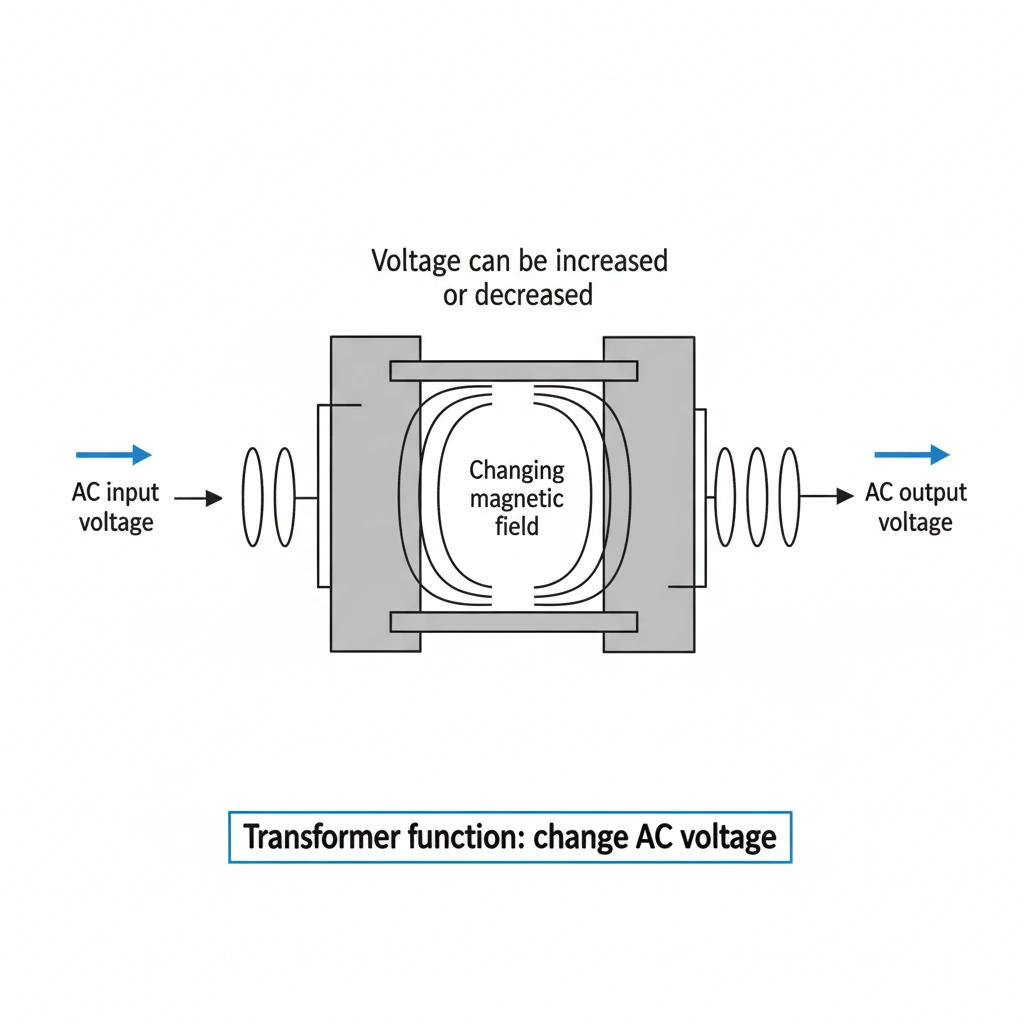
Function of transformer?

  1. A
    Reduce current flow
  2. B
    Inhibit conduction
  3. C
    Charge by proximity
  4. D
    Increase/reduce AC voltage

Topic Flashcards

Click to Flip
Question

What fundamental law of physics, discovered by Michael Faraday, is the operating principle behind every transformer?

Answer

Electromagnetic Induction. A changing magnetic field in one coil induces a voltage in a nearby coil.

Question

Why is it crucial that a transformer only works with Alternating Current (AC) and not Direct Current (DC)?

Answer

A transformer requires a changing magnetic field to induce voltage in the secondary coil. AC current naturally creates this changing field, while steady DC does not.

Question

What is the name of the ratio that determines whether a transformer is a "step-up" or "step-down" transformer, and what is the formula for it?

Answer

The turns ratio (N_s / N_p). The voltage transformation follows: V_s / V_p = N_s / N_p, where V is voltage and N is the number of coil turns.

Question

If a transformer steps up the voltage, what must happen to the current (assuming ideal, 100% efficiency) to satisfy the law of conservation of energy?

Answer

The current is stepped down proportionally. For an ideal transformer, Power_in = Power_out, so V_p * I_p = V_s * I_s. If V increases, I must decrease.

Question

Beyond changing voltage levels, what is another critical function transformers provide in electrical safety for many devices?

Answer

Galvanic Isolation. Since the primary and secondary coils are not electrically connected (only magnetically coupled), they can separate two circuits, protecting users from electric shock.

Mini Quiz

1 / 3
Can a transformer change the frequency of the alternating current (AC) passing through it?
Available Test Sets
Available FREE Test Sets