During which phase of the cell cycle is DNA copied?
-
A
Mitotic
-
B
First Gap
-
C
Synthesis
-
D
Second Gap
DNA is copied during the Synthesis (S) phase of the cell cycle.
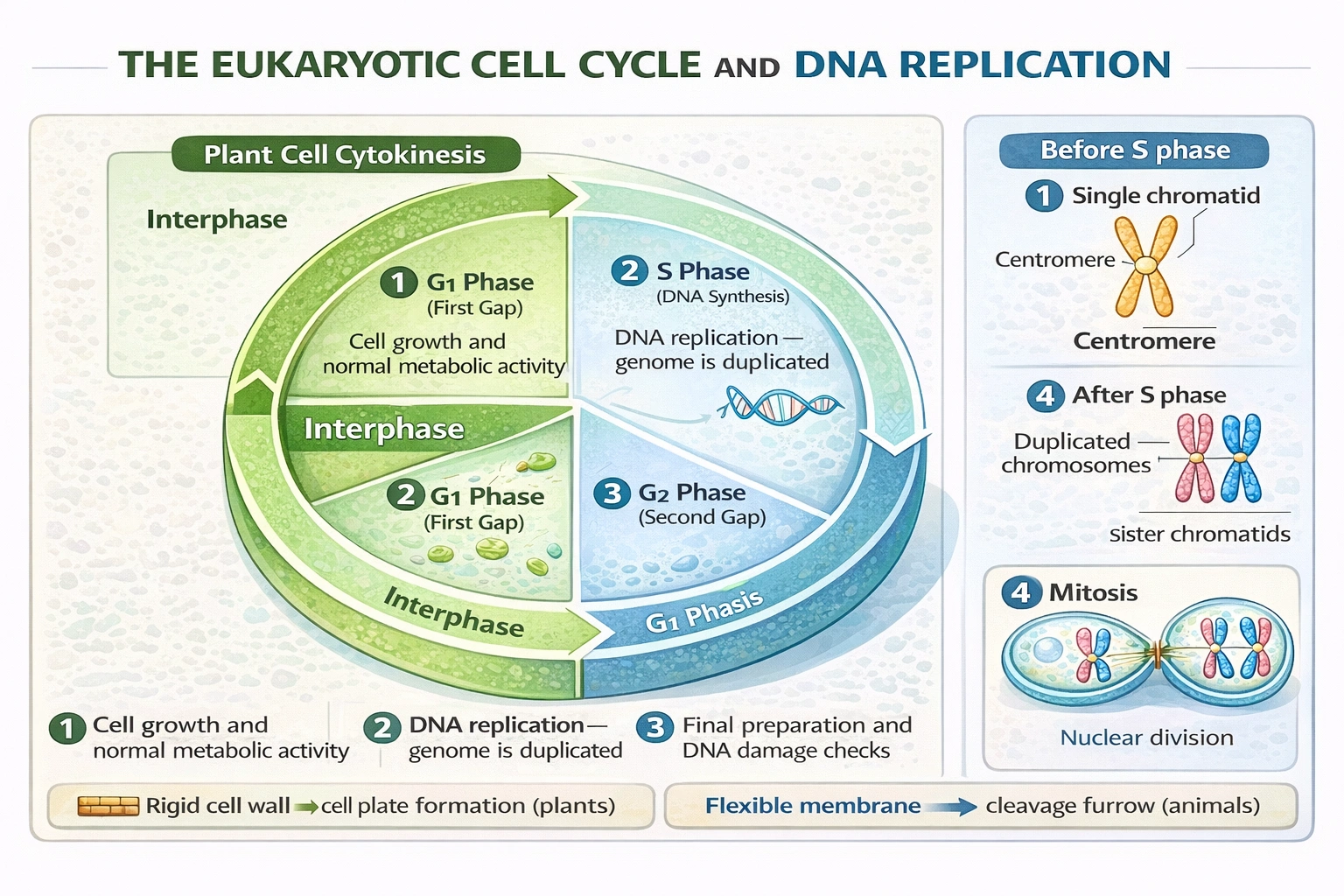
The eukaryotic cell cycle is an ordered sequence of events that leads to cell growth and division. It is divided into two major phases: interphase and the mitotic (M) phase. Interphase, the period of growth and preparation, is itself subdivided into three stages: G1 (First Gap), S (Synthesis), and G2 (Second Gap). The critical process of DNA replication, where the entire genome is duplicated, is confined to the S phase. This ensures that each daughter cell will receive a complete and identical set of genetic information. The process is highly regulated and error-checked to maintain genomic fidelity. Prior to S phase (in G1), the cell grows and prepares the necessary machinery and nucleotides. After S phase (in G2), the cell continues to grow and prepares for mitosis, ensuring the replicated DNA is undamaged before segregation.
A) Mitotic
The mitotic (M) phase includes mitosis (nuclear division) and cytokinesis (cytoplasmic division). During mitosis, the already duplicated chromosomes condense, align, separate, and decondense into two new nuclei. DNA is not copied during M phase; rather, the replicated chromosomes from S phase are meticulously distributed to the daughter cells.
B) First Gap (G1)
G1 phase is a period of active growth and metabolic activity. The cell increases in size, synthesizes proteins and organelles, and carries out its specialized functions. It is a preparatory phase for DNA replication, producing the enzymes and nucleotides required for synthesis. However, the actual replication of the DNA genome does not occur during G1. A critical checkpoint at the end of G1 (the restriction point) determines if the cell is ready to commit to the S phase.
C) Synthesis (S)
The S phase is dedicated to DNA synthesis. Enzymes like DNA helicase unwind the double helix, and DNA polymerase synthesizes new complementary strands for each original template strand. By the end of S phase, each chromosome has been duplicated and consists of two identical sister chromatids joined at the centromere. The cell's DNA content doubles from 2n to 4n (where n is the number of unique chromosomes).
D) Second Gap (G2)
G2 phase occurs after DNA replication is complete. It is a second gap period for final preparation for mitosis. The cell continues to grow, synthesizes proteins (particularly those needed for mitosis like tubulin for the spindle), and conducts a final check to ensure DNA replication was accurate and complete. No further DNA replication occurs during G2; its purpose is to verify the products of S phase and prepare for their equitable distribution.
Conclusion
The cell cycle is a carefully orchestrated process where key events are temporally separated to ensure accuracy and fidelity. DNA replication is arguably the most critical of these events, as it must happen exactly once per cycle. Confining this monumental task to a distinct S phase allows for concentrated regulatory control and error correction. Growth and preparation happen in the gap phases (G1 and G2), while division happens in M phase. Therefore, the Synthesis phase is the specific, non-overlapping period during which the cell's entire genome is duplicated.
Topic Flashcards
Click to FlipDuring which phase of the cell cycle is DNA copied?
Synthesis (S) phase.
What major event defines the S phase?
DNA replication.
What is formed after DNA replication in S phase?
Sister chromatids.
Which phases prepare the cell for DNA replication and division?
G1 prepares for replication; G2 prepares for mitosis.
Why is DNA replication restricted to one phase of the cell cycle?
To ensure accurate duplication and prevent errors.