When would a cell most likely contain the most nucleotides?
-
A
S
-
B
G₁
-
C
M
-
D
G₂
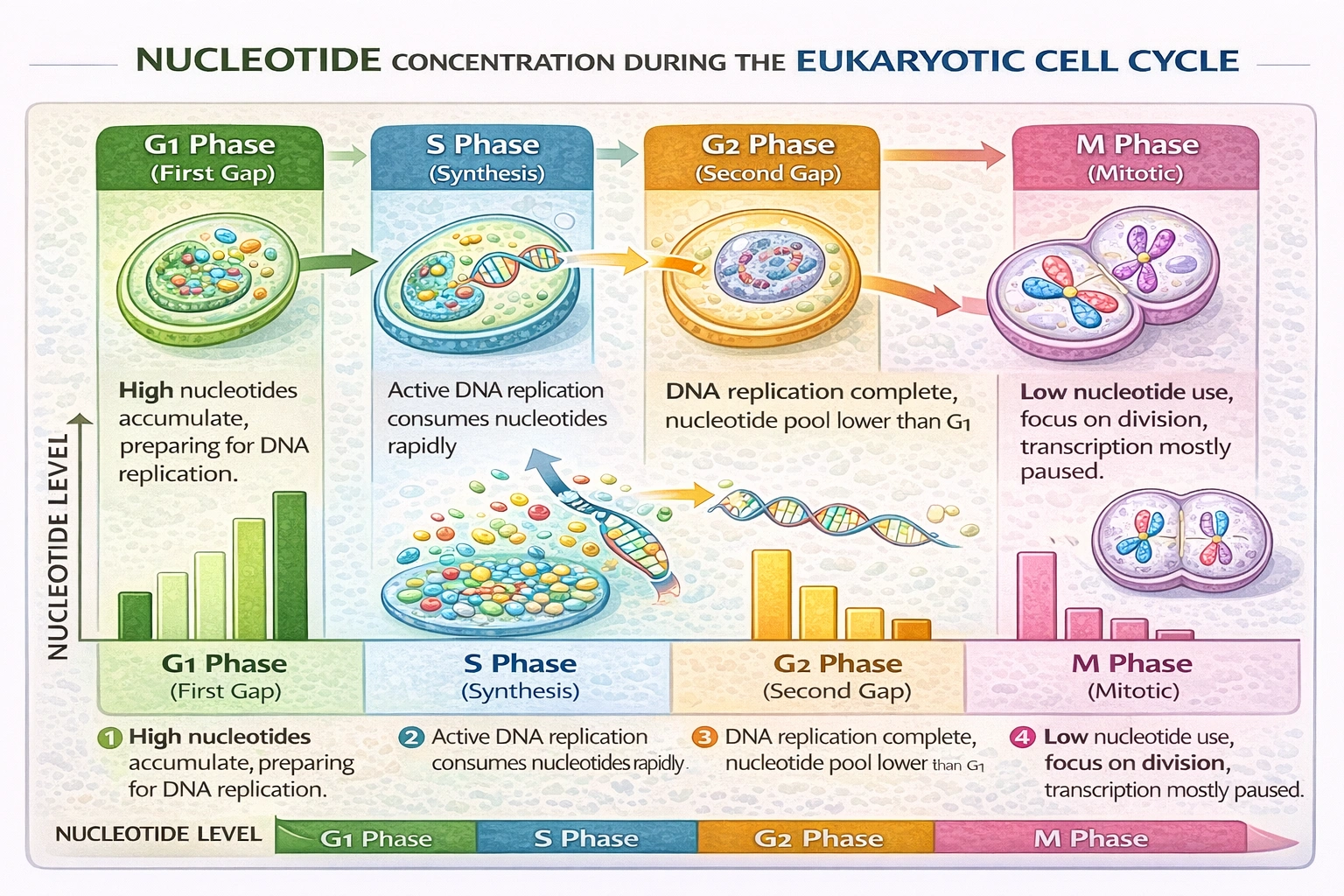
A cell most likely contains the highest concentration of free nucleotides during the G₁ phase.
Nucleotides are the monomeric building blocks for nucleic acids (DNA and RNA) and also serve as energy carriers (e.g., ATP, GTP) and signaling molecules (e.g., cAMP). Their intracellular concentration is not static but fluctuates in anticipation of and in response to the demands of the cell cycle. The most nucleotide-intensive event is DNA replication during the S phase, where an entire genome's worth of nucleotides must be incorporated into new DNA strands. To ensure this process is efficient and rapid, the cell stockpiles deoxyribonucleotides (dNTPs) and ribonucleotides in the preceding G₁ phase. During late G₁, in preparation for S phase, the cell upregulates the enzymes of nucleotide biosynthesis and actively accumulates a high pool of these precursors. This stockpile is then rapidly consumed during S phase as DNA polymerase incorporates them into new strands.
A) S (Synthesis phase)
During S phase, the cell is actively replicating its DNA. Free nucleotides are being incorporated into the growing DNA strands at a very high rate. While biosynthetic pathways are active to replenish the pool, the rate of consumption (polymerization) typically outstrips the rate of synthesis. Therefore, the concentration of free nucleotides is often at its lowest during active S phase, not its highest.
B) G₁ (First Gap phase)
G₁ is a period of growth and preparation for DNA replication. The cell is not yet synthesizing DNA, but it is producing all necessary components, including a large reserve of nucleotides. Enzymes like ribonucleotide reductase are activated to convert ribonucleotides to deoxyribonucleotides. The free nucleotide pool peaks in late G₁, just before the G₁/S checkpoint, ensuring a ready supply for the impending burst of DNA synthesis.
C) M (Mitotic phase)
During mitosis, the cell's focus is on the physical separation of chromosomes and division of the cytoplasm. DNA replication is long complete. Transcription is largely shut down, and most RNA synthesis ceases, reducing the demand for ribonucleotides. The cell is not building new nucleic acid polymers at a high rate, so the free nucleotide pool is relatively low, having been depleted during S phase and not rebuilt to pre-S levels.
D) G₂ (Second Gap phase)
G₂ occurs after S phase and before M phase. The cell continues to grow and prepares for mitosis. While some nucleotide synthesis occurs to support RNA transcription needed for protein synthesis in preparation for division, the massive stockpile from G₁ has been largely consumed during S phase. The cell does not rebuild the free nucleotide pool to its G₁ peak because the next DNA replication event is a full cell cycle away (after the next mitosis and subsequent G₁). The priority in G₂ is on repairing any replication errors and synthesizing mitotic proteins, not on nucleotide stockpiling.
Conclusion
The cell cycle is characterized by careful preparation for each major event. Just as a builder gathers materials before starting construction, the cell accumulates nucleotides before initiating DNA replication. The G₁ phase serves as this preparatory period, where metabolic pathways are tuned to produce and store a surplus of nucleic acid precursors. This anticipatory accumulation ensures that when the S phase begins, the replication machinery has an abundant, readily available supply of dNTPs, allowing for fast and accurate genome duplication. Consequently, the concentration of free nucleotides is highest just before this demand surge, during the G₁ phase.
Topic Flashcards
Click to FlipDuring which phase of the cell cycle would a cell contain the most free nucleotides?
G₁ phase.
Why are nucleotides abundant during G₁?
The cell is preparing for DNA replication in S phase.
What are nucleotides primarily used for during S phase? .
DNA synthesis
What happens to free nucleotide levels during S phase?
They decrease as nucleotides are incorporated into DNA.
Which enzyme helps prepare deoxyribonucleotides before S phase?
Ribonucleotide reductase.