In DNA replication, a DNA strand is separated, and a
-
A
complementary strand attaches.
-
B
complementary strand is assembled.
-
C
complementary strand replicates itself.
-
D
complementary strand forms a double helix.
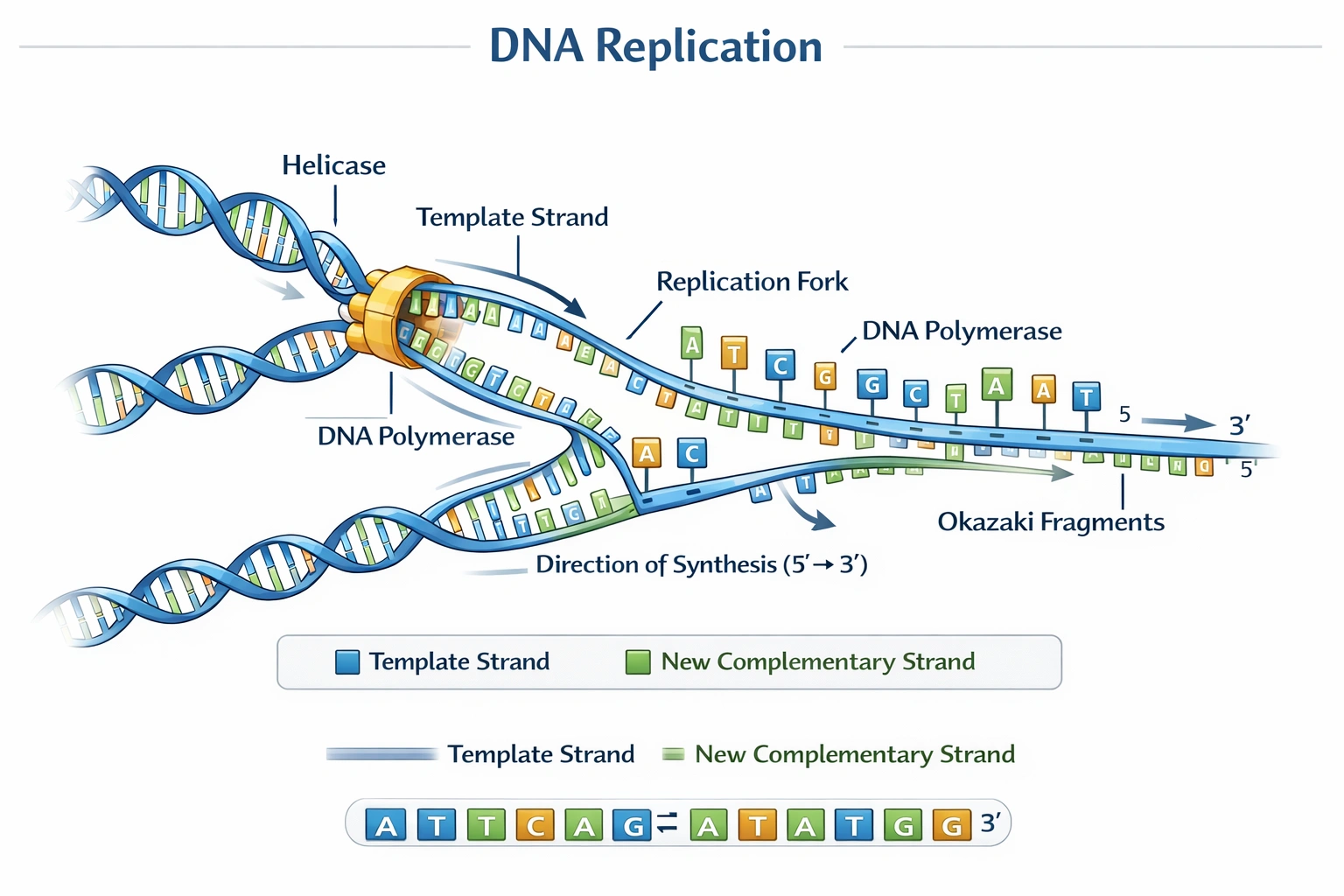
In DNA replication, a DNA strand is separated, and a complementary strand is assembled.
DNA replication is a semi-conservative process where each of the two original strands serves as a template for the synthesis of a new complementary strand. The process begins with enzymes like helicase unwinding the double helix and breaking the hydrogen bonds between base pairs, separating the two parental strands. This creates a replication fork. The enzyme primase then synthesizes a short RNA primer on each template strand. DNA polymerase III (in prokaryotes) or DNA polymerase δ/ε (in eukaryotes) then begins adding DNA nucleotides to the 3' end of the primer, following the base-pairing rules (A with T, G with C). This synthesis proceeds continuously on the leading strand and in fragments (Okazaki fragments) on the lagging strand. The key point is that the new strand is constructed de novo from individual nucleotide triphosphates; it is not a pre-existing molecule that simply attaches.
A) complementary strand attaches.
This implies that a fully formed, pre-existing strand somehow finds and binds to the exposed template. This is incorrect. DNA strands are not pre-assembled elsewhere and then attached. They are synthesized in situ at the replication fork by the action of DNA polymerase, which catalyzes the formation of phosphodiester bonds between incoming nucleotides.
B) complementary strand is assembled.
This accurately describes the process. "Assembled" conveys the active, stepwise construction of a new polymer from monomeric units (deoxyribonucleotides). DNA polymerase selects the correct nucleotide based on the template, catalyzes the bond formation, and proofreads its work. Other enzymes (ligase) then join the fragments together. Assembly is an active, enzyme-driven biosynthesis.
C) complementary strand replicates itself.
DNA strands do not possess the ability to self-replicate. They are inert templates. The replication is carried out by a complex cellular machinery involving over a dozen enzymes and proteins. The phrase "replicates itself" suggests autocatalysis, which does not occur in DNA replication; the information in the strand directs the assembly of its complement, but the strand itself does not perform the chemical work.
D) complementary strand forms a double helix.
While the final outcome is the formation of two double helices, this option describes the end state rather than the immediate action following strand separation. The double helix re-forms as a natural consequence of the new complementary strand being synthesized and forming hydrogen bonds with the template strand. However, the direct action after separation is the synthesis or assembly of that new strand, not the passive formation of the helix, which is a spontaneous result of base pairing.
Conclusion
DNA replication is a dynamic process of biosynthesis. The separation of strands by helicase provides the single-stranded templates. The fundamental action that follows is the enzymatic assembly of new polynucleotide chains complementary to these templates. This assembly involves the sequential addition of nucleotides, proofreading, and fragment joining. The language of "assembly" best captures this active, constructive, and regulated biochemical process, distinguishing it from passive attachment or self-replication.
Topic Flashcards
Click to FlipWhat happens after DNA strands separate during replication?
A complementary strand is assembled.
What does “semi-conservative replication” mean?
Each new DNA molecule contains one original strand and one newly synthesized strand.
Which enzyme assembles the new DNA strand?
DNA polymerase.
How does DNA polymerase choose the correct nucleotide?
By complementary base pairing (A–T, G–C).
Why is DNA replication described as an assembly process?
Because nucleotides are added one by one to build a new strand.