If an organism has a total of 12 chromosomes, 12 is _____ the number of chromosomes.
-
A
diploid
-
B
equivalent
-
C
haploid
-
D
neutral
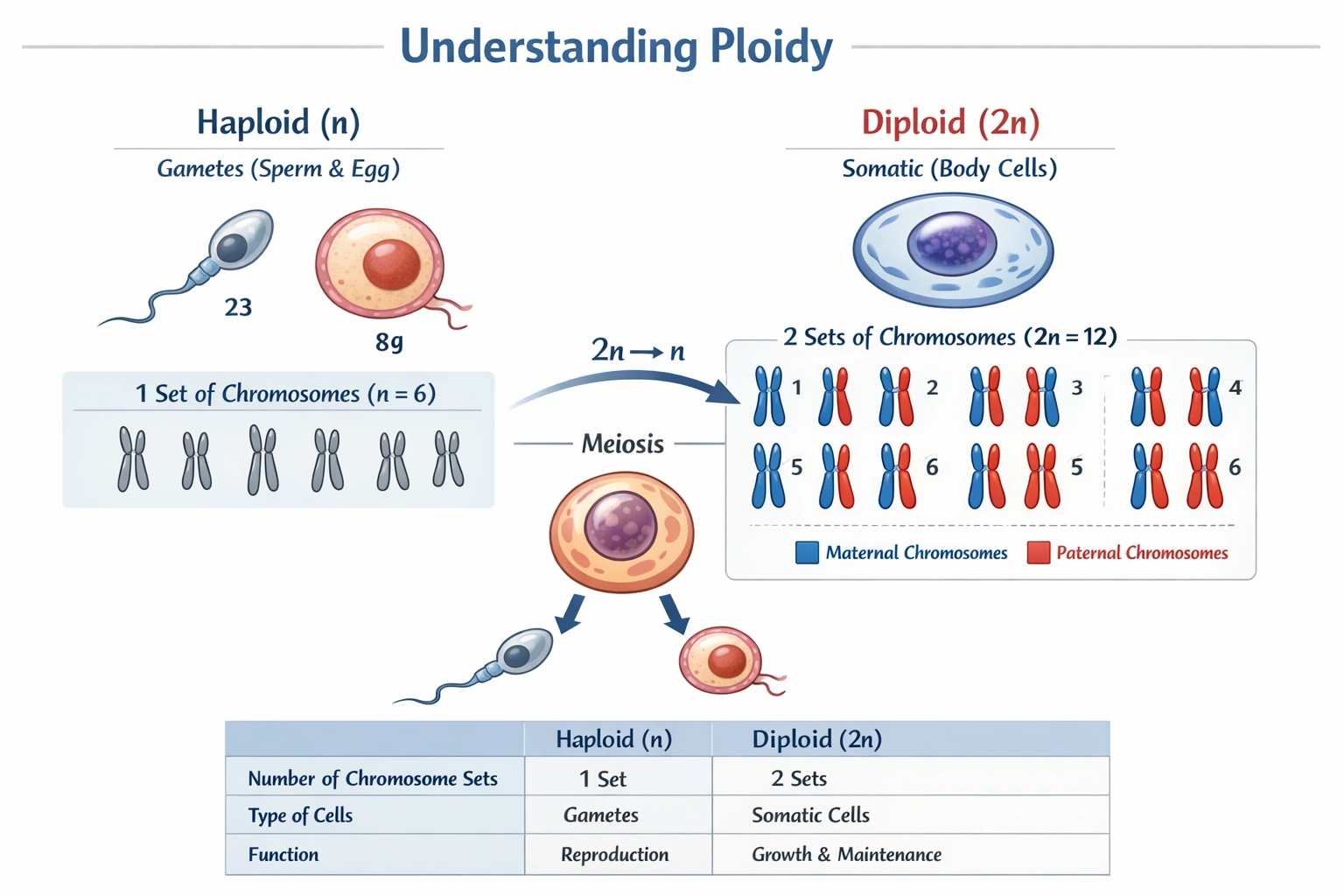
If an organism has a total of 12 chromosomes, 12 is the diploid number.
Ploidy refers to the number of sets of chromosomes in a cell. A diploid cell (represented as 2n) contains two complete sets of chromosomes, one set inherited from each parent. The total number of chromosomes in a typical somatic (body) cell is the diploid number. Gametes (sperm and egg) are haploid (n), containing only one set, which is half the diploid number. When a question states an organism has a "total of 12 chromosomes," it is conventionally referring to the chromosome number in its somatic cells. Therefore, 12 represents the diploid count (2n=12). This implies that the haploid number (n) would be 6, found in its gametes.
A) diploid
This is the correct term. In a diploid organism, like most animals and many plants, every somatic cell has two copies of each type of chromosome (homologous pairs). If the total count is 12, it means there are 12 distinct chromosomes in the cell, which correspond to 6 homologous pairs. Thus, 12 is the diploid number.
B) equivalent
"Equivalent" is a vague, non-scientific term in this context. It does not convey any specific information about ploidy, set number, or genetic constitution. Genetics uses precise terms like haploid, diploid, or polyploid to describe chromosome numbers. "Equivalent" could imply equality to something else, but it is not a standard biological descriptor for ploidy.
C) haploid
The haploid number (n) is half the diploid number. If the diploid number (2n) is 12, then the haploid number (n) is 6. Stating that 12 is the haploid number would imply that the diploid number is 24, which contradicts the given information. In the context of a typical biology question, a stated chromosome number for an organism almost always refers to the diploid number unless explicitly specified otherwise (e.g., "in a gamete").
D) neutral
"Neutral" has no defined meaning in chromosome biology or genetics. It is not used to describe ploidy, chromosome sets, or any related concept. It is an irrelevant and incorrect choice in this context.
Conclusion
Understanding ploidy is fundamental to genetics, meiosis, and reproduction. The convention in biology is to describe an organism by the chromosome number in its somatic cells, which is the diploid number. Therefore, when presented with a statement like "an organism has a total of 12 chromosomes," the logical interpretation is that 12 represents the diploid (2n) count. This establishes that its gametes will have 6 chromosomes (the haploid number), and it provides a basis for predicting chromosome behavior during cell division.