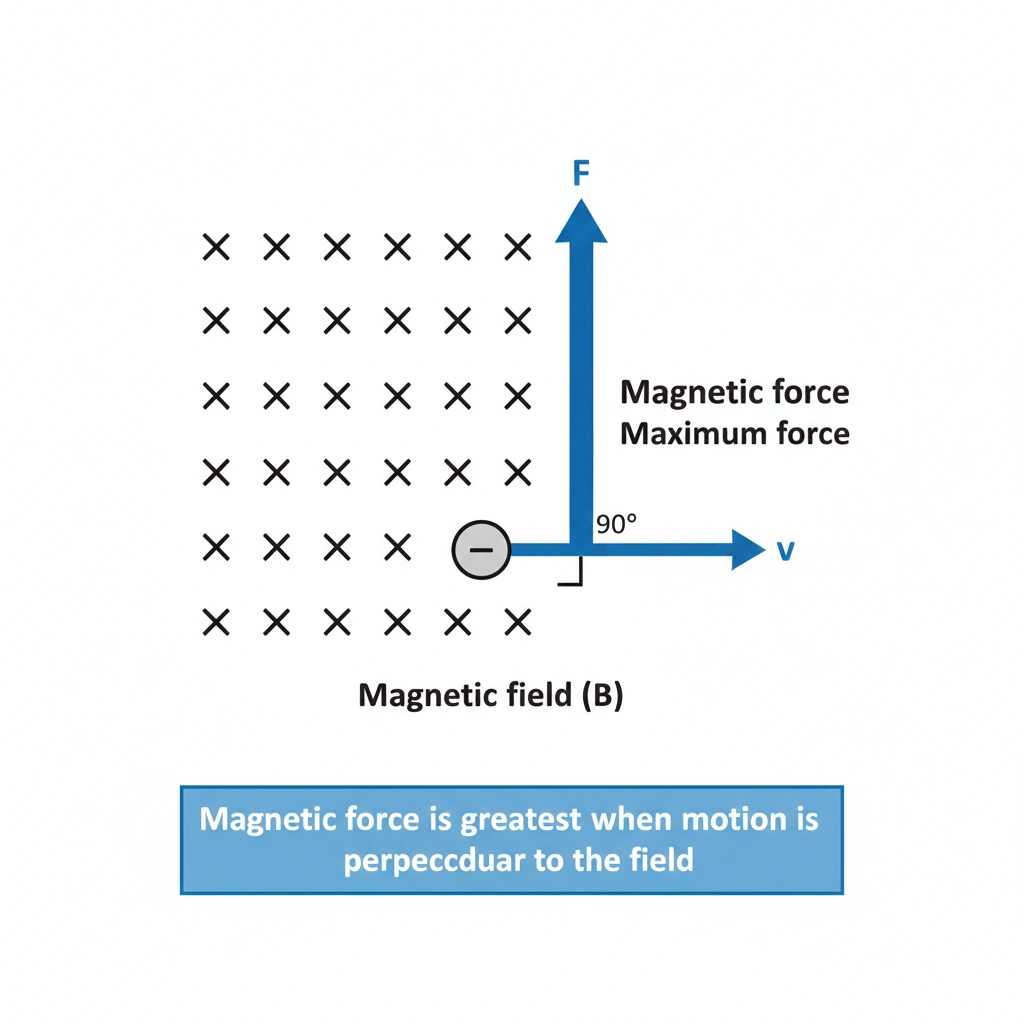
Force on electron in magnetic field greatest when _______.
-
A
Opposite field
-
B
Same direction
-
C
Perpendicular
-
D
Always constant
The magnetic force acting on a moving charged particle is described by the Lorentz force relationship, which states that the magnetic force equals charge multiplied by speed multiplied by magnetic field strength multiplied by the sine of the angle between the velocity and the magnetic field.
In words, the magnetic force depends on the charge of the particle, how fast it is moving, the strength of the magnetic field, and how much of the particle’s velocity is perpendicular to the magnetic field. The sine of the angle determines this perpendicular component.
A) Opposite field
When the electron moves opposite to the direction of the magnetic field, the angle between the velocity and the field is 180 degrees. The sine of 180 degrees is zero, so no magnetic force acts on the electron in this case.
B) Same direction
If the electron moves in the same direction as the magnetic field, the angle is 0 degrees. Because the sine of 0 degrees is zero, the magnetic force is again zero, and there is no deflection.
C) Perpendicular
When the electron’s velocity is perpendicular to the magnetic field, the angle is 90 degrees. At this angle, the sine of 90 degrees is one, which produces the maximum possible magnetic force. This is why charged particles moving perpendicular to a magnetic field experience the strongest deflection and often move in circular paths.
D) Always constant
The magnetic force is not constant. It changes with the speed of the particle, the strength of the magnetic field, and the angle between the particle’s motion and the field direction.
Conclusion
Because the magnetic force depends on the sine of the angle between velocity and the magnetic field and reaches its maximum value at 90 degrees, the force on an electron in a magnetic field is greatest when the electron moves perpendicular to the magnetic field.
Topic Flashcards
Click to FlipWhat is the complete formula for the magnitude of the magnetic force (F) on a charged particle moving in a magnetic field?
F = |q| * v * B * sinθ, where |q| is the magnitude of the charge, v is its speed, B is the magnetic field strength, and θ is the angle between the velocity vector and the magnetic field vector.
According to the formula F = |q|vB sinθ, at what angle (θ) between the velocity and the magnetic field is the force on a moving charge maximized, and what is the value of sinθ at that angle?
The force is maximized when θ = 90° (perpendicular). At this angle, sin(90°) = 1, so the force equation simplifies to its maximum value: F_max = |q|vB.
What rule is used to determine the direction of the magnetic force on a moving charge, and how does it apply to a negatively charged electron?
The right-hand rule is used for positive charges. For a negative charge like an electron, the force direction is opposite to the direction given by the right-hand rule.
If an electron moves in the exact same direction as a magnetic field (θ = 0°), what is the magnetic force acting on it? Why?
The force is zero. Because sin(0°) = 0, the magnetic force formula F = |q|vB sinθ yields F = 0.
What is the magnetic force on an electron that is completely stationary (v = 0 m/s) within a magnetic field?
The force is zero. The magnetic force depends on the charge's motion (F ∝ v). A stationary charge experiences no magnetic force, only electric force if an electric field is present.