100% 4 Rated
Attempts 127

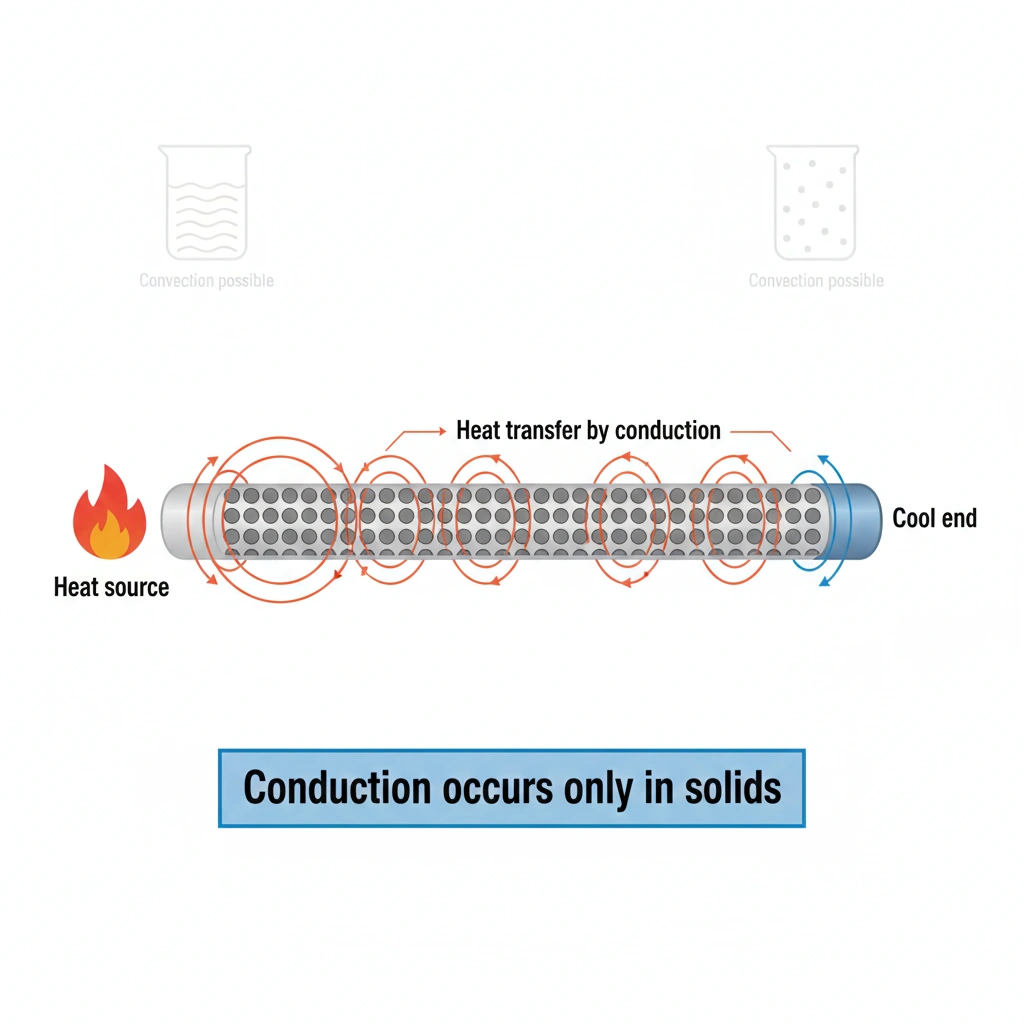
Heat uses only conduction through _______.

  1. A
    Gases
  2. B
    Liquids
  3. C
    Solids
  4. D
    Solids and liquids

Topic Flashcards

Click to Flip
Question

What is the defining characteristic of conduction as a method of heat transfer, and what are the primary particles involved in solids?

Answer

Conduction is the transfer of heat through direct particle collisions and interactions without bulk movement of the material. In solids, this occurs via vibrating atoms/molecules and, in metals, mobile electrons.

Question

Why is convection not possible in a solid block of material?

Answer

Convection requires the bulk movement of a fluid (liquid or gas) to carry heat. The particles in a solid are locked in a fixed position in a lattice and cannot flow, so convection cannot occur.

Question

How do the three modes of heat transfer (conduction, convection, radiation) differ in terms of their requirement for a medium?

Answer

Conduction & Convection require a material medium. Radiation does not; it can travel through a vacuum (e.g., heat from the Sun).

Question

A metal spoon and a wooden spoon are placed in a hot soup. The metal handle becomes hot quickly, while the wood stays cool longer. Both are solids, so why the difference?

Answer

The difference is due to thermal conductivity. Metals are good conductors because of their free electrons, which transfer kinetic energy rapidly. Wood is a poor conductor (good insulator)

Question

Describe a simple real-world example where heat transfer in a solid relies only on conduction.

Answer

Heating one end of a metal rod over a flame. The other end eventually gets hot because heat travels through the rod via conduction (vibrating atoms and free electrons), with no material flowing.

Mini Quiz

1 / 3
Can heat transfer by conduction occur in a perfect vacuum?
Available Test Sets
Available FREE Test Sets