What is the name of the opposite and equal contact force between a surface and an object standing on it?
-
A
gravity force
-
B
friction force
-
C
centripetal force
-
D
normal force
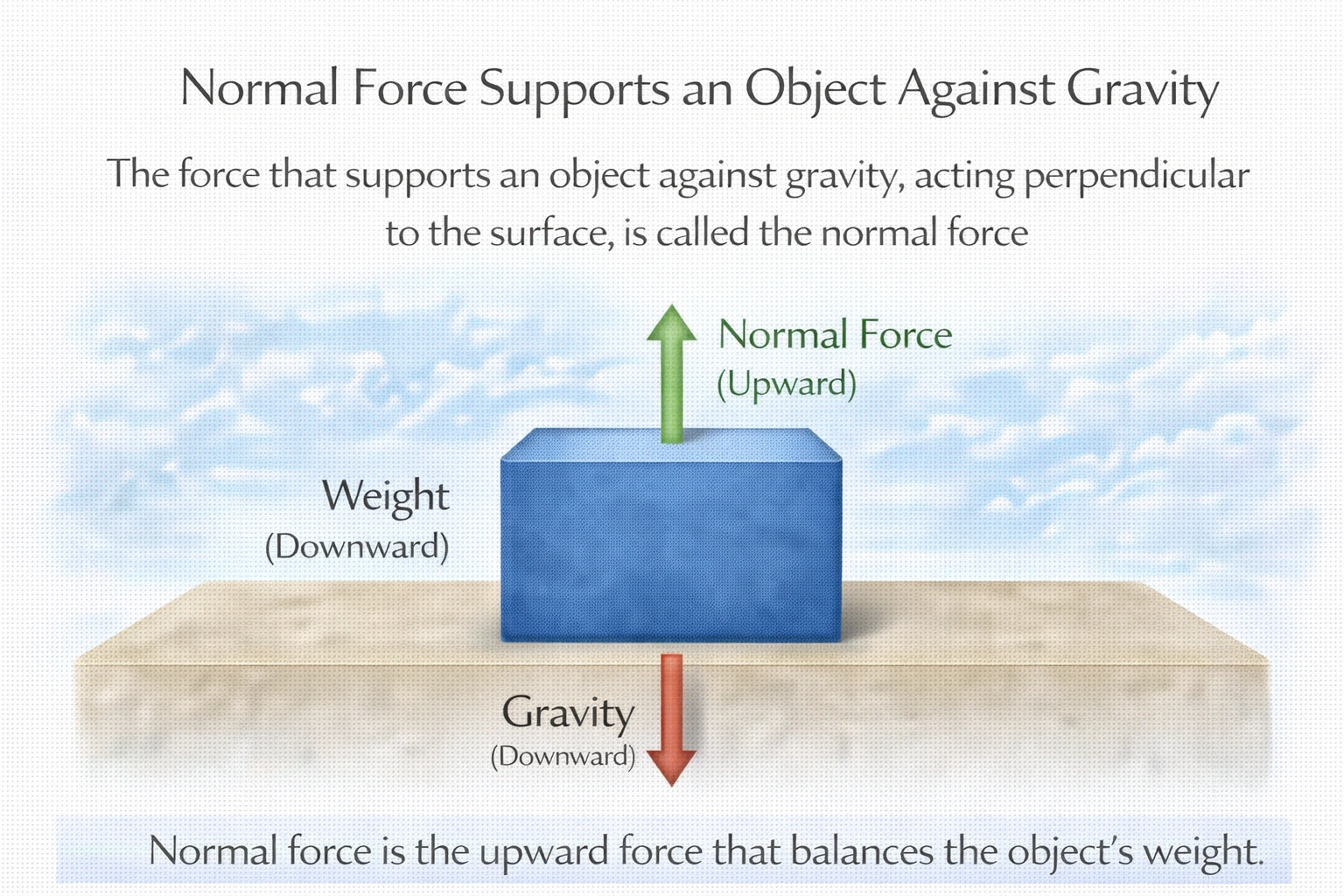
The force that supports an object against gravity, acting perpendicular to the surface, is called the normal force.
- A) Gravity force:
- Gravity is a non-contact force that attracts objects toward the center of the Earth or any other massive body. It is always directed downward, pulling objects toward the ground. While gravity acts on the object, it is not the equal and opposite force in response to the object's weight on a surface. The force that supports the object against gravity is the normal force.
- B) Friction force:
- Friction is the resistance that occurs when two surfaces slide against each other. It acts parallel to the surface, opposing the relative motion of objects. While friction is related to the motion of the object, it is not the force that balances the object's weight when standing on a surface. The friction force does not act directly opposite to the object's weight.
- C) Centripetal force:
- Centripetal force is the force that keeps an object moving in a circular path. It acts toward the center of the circle and is not related to the balance of forces when an object is at rest on a flat surface. This force is only relevant in circular motion, not when standing on a surface.
- D) Normal force:
- Normal force is the force exerted by a surface to support the weight of an object resting on it. It acts perpendicular (normal) to the surface and balances the object's weight. The normal force is the equal and opposite contact force that supports the object against gravity. For an object standing still on a flat surface, the normal force exactly cancels out the gravitational force acting on the object.
Conclusion: The normal force is the opposite and equal contact force between a surface and an object standing on it, making D) Normal force the correct answer.

Topic Flashcards
Click to FlipAccording to Newton's Third Law, if a book exerts a downward force on a table, what is the table's equal and opposite force on the book called?
The normal force.
What two characteristics define the direction of the normal force exerted by a surface?
It is perpendicular to the surface and away from the surface.
On a flat, horizontal surface, an object at rest has a normal force that is equal in magnitude to which other force? Why?
Its weight (the force of gravity). They are equal because the net vertical force on the stationary object is zero (Newton's First Law).
How does the normal force on an object change if you push down on it while it rests on a horizontal table?
The normal force increases. It must now balance both the object's weight and your additional downward push.
On an inclined plane (ramp), is the normal force acting on an object equal to the object's full weight? Why or why not?
No. On an incline, the normal force is only a component of the weight; it is equal to mg cos(θ), which is less than the full weight mg for any angle greater than 0°.