Huntington’s disease is carried on the dominant allele. In a situation where twoheterozygous parents have the disease, what percentage of their offspring arepredicted to be disease-free?
-
A
0%
-
B
25%
-
C
50%
-
D
100%
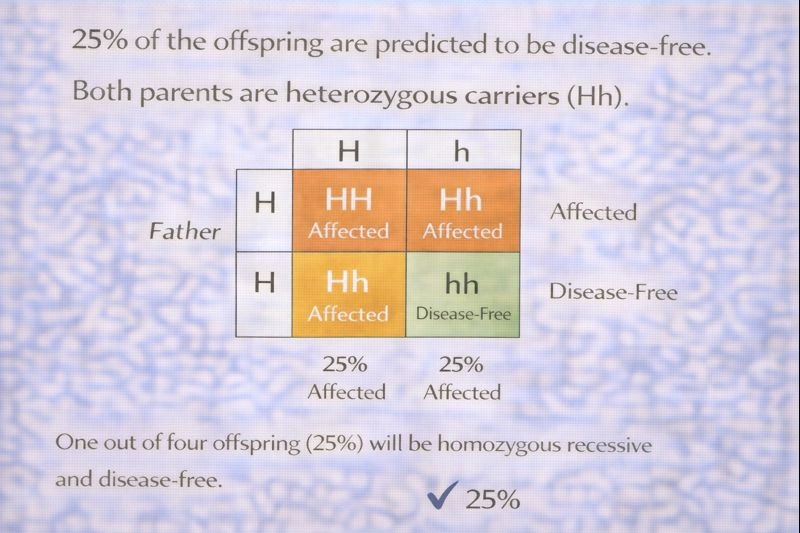
25% of the offspring are predicted to be disease-free.
Huntington’s disease is caused by a dominant allele. This means that a person only needs one copy of the disease allele to show the condition. Individuals with genotypes HH or Hh will have Huntington’s disease, while only individuals with genotype hh (homozygous recessive) will be disease-free.
In this question, both parents are heterozygous (Hh), meaning each parent has one dominant disease allele and one normal recessive allele.
When these parents reproduce, their possible genetic combinations can be shown using a Punnett square:
- H × H → HH (affected)
- H × h → Hh (affected)
- h × H → Hh (affected)
- h × h → hh (disease-free)
This gives the following proportions:
- 25% HH → affected
- 50% Hh → affected
- 25% hh → disease-free
Only the hh offspring do not have the disease.
A) 0%
Two heterozygous parents can produce homozygous recessive offspring (hh), which are disease-free. Therefore, the percentage cannot be zero.
B) 25%
One out of four possible offspring genotypes (hh) does not carry the dominant disease allele. That corresponds to 25% of the offspring being disease-free.
C) 50%
Fifty percent represents the heterozygous offspring (Hh), but these individuals still have the disease because the allele is dominant.
D) 100%
Not all offspring will inherit the dominant allele. There is always a chance of producing hh offspring from two heterozygous parents.
Conclusion
When two heterozygous parents with a dominant disorder have children, only the homozygous recessive offspring will be disease-free. This occurs in 25% of cases. Therefore, the correct answer is B) 25%.

Topic Flashcards
Click to FlipIf both parents are heterozygous (Hh) for a dominant disorder like Huntington's, what is the probability that a child of theirs will be homozygous recessive (hh) and disease-free?
25%. This is determined by a Punnett square: Hh x Hh yields HH, Hh, Hh, and hh. Only the hh genotype is disease-free.
What is the key genetic reason that two parents who both have a dominant disorder can still have a child who does not have it?
Both parents can be heterozygous (Hh). Each can pass on their recessive, healthy allele (h), giving the child a homozygous recessive (hh) genotype.
True or False: In a cross between two individuals heterozygous for Huntington's, 75% of the offspring will have the disease, and 50% will be heterozygous carriers.
True. 75% will have the disease (HH + Hh genotypes). Within that affected group, 2 out of 3 (or ~67%) are heterozygous, but 50% of the total offspring are heterozygous (Hh).
How does the inheritance pattern of a dominant disorder differ from a recessive one in terms of "carriers"?
For dominant disorders, there are no asymptomatic "carriers." Individuals with one copy of the allele (heterozygous) have the disease. The term "carrier" is used for recessive traits.
In genetic counseling, why is the 25% disease-free prediction for two heterozygous parents considered a statistical probability and not a guarantee for a small family?
Each pregnancy is an independent event with a 25% chance of hh. In a small sample (like 4 children), the actual outcomes may not match the predicted ratio exactly due to random chance.