In genetics, Punnett squares are used to predict crosses between traits. What is the name of the factor that is used to signify each trait passed down from the parents of the offspring?
-
A
Allele
-
B
Chromatid
-
C
Chromosome
-
D
Enzyme
The factor used to signify each trait passed down from parents in a Punnett square is called an allele.
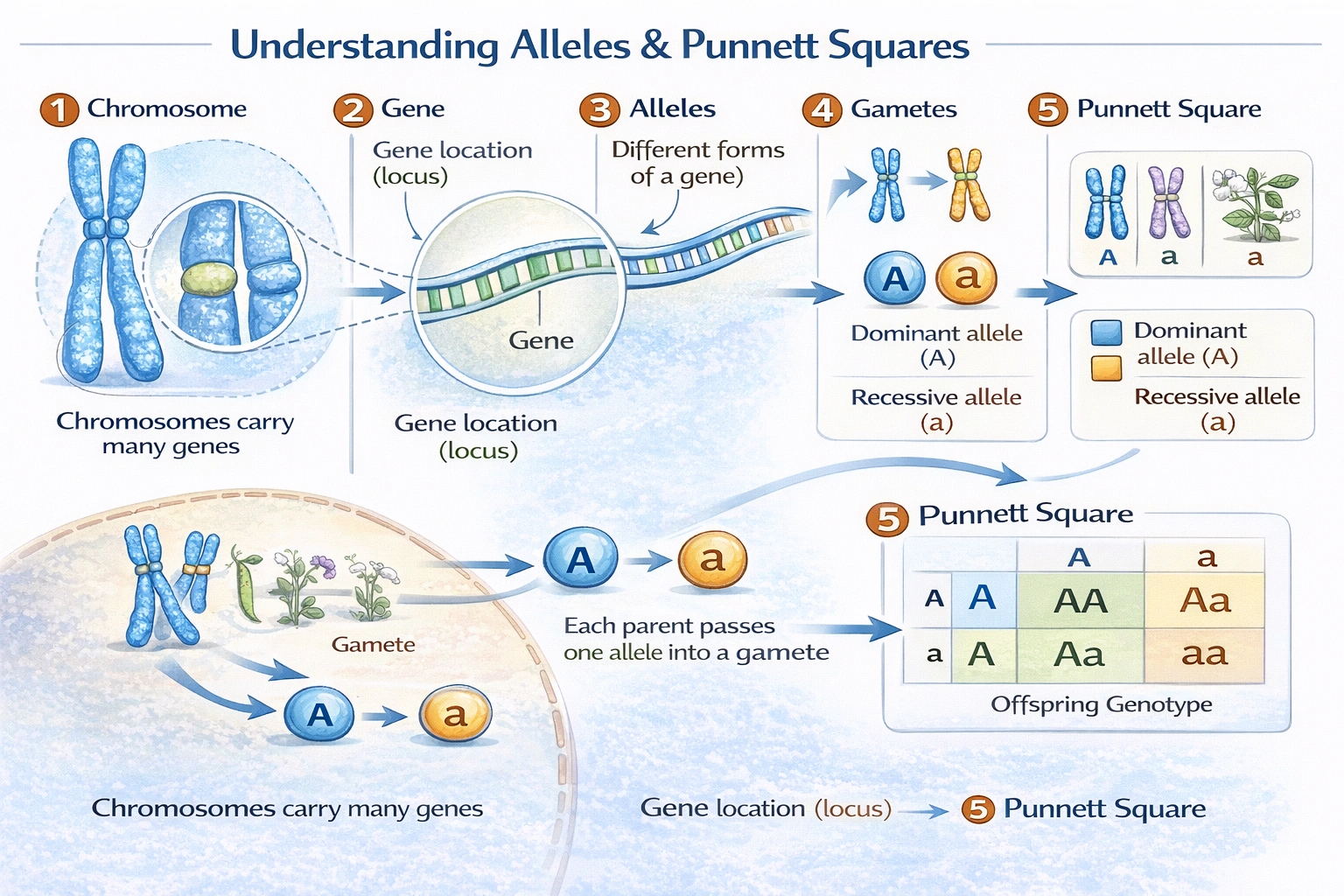
A Punnett square is a graphical tool used to predict the genotypic and phenotypic outcomes of a genetic cross. It operates on Mendelian principles, visualizing how gametes from each parent combine during fertilization. The squares of the grid represent possible zygotes. The letters placed along the top and side of the square represent the genetic contribution of each parent. These letters symbolize different versions of a gene, known as alleles. An allele is one of two or more alternative forms of a gene that arise by mutation and are found at the same locus (position) on homologous chromosomes. For example, for the gene controlling pea plant height, there is an allele for tall (T) and an allele for short (t). In a Punnett square, these alleles represent the single hereditary factor for that trait contained in each gamete.
A) Allele
An allele is the correct term for the variant form of a gene. In a monohybrid cross, a single letter (e.g., A or a) represents the allele. In a Punnett square, the combination of alleles from the sperm and egg determines the genotype (e.g., AA, Aa, aa) and, consequently, the phenotype of the offspring. Alleles are the units of inheritance that segregate and assort according to Mendel's laws.
B) Chromatid
A chromatid is one of the two identical copies of a duplicated chromosome, joined at the centromere. Chromatids are separated during mitosis or meiosis II. They are physical structures made of DNA and proteins, not the abstract hereditary factors for traits. While chromatids carry alleles, they themselves are not the factors used in the symbolic representation of a cross. Punnett squares deal with the transmission of alleles, not the transmission of whole chromatids.
C) Chromosome
A chromosome is a long, continuous molecule of DNA containing many genes along its length. While chromosomes carry alleles from parents to offspring, they are not the specific factors signifying a single trait in a Punnett square. A Punnett square typically focuses on one or two traits at a time, representing the alleles for those specific genes, not the entire chromosome with its thousands of genes.
D) Enzyme
Enzymes are proteins that catalyze biochemical reactions. While genes (through their alleles) code for the amino acid sequences of enzymes, the enzymes themselves are not inherited directly. The inherited factor is the DNA sequence (the allele) that contains the instructions for building the enzyme. Enzymes are the products of gene expression, not the heritable units passed from parent to offspring.
Conclusion
Punnett squares simplify the process of genetic prediction by focusing on the behavior of alleles during gamete formation and fertilization. Alleles are the symbolic representations of the genetic information for a trait that is contributed by each parent. Understanding that these letters stand for alleles, alternative forms of a gene, is crucial to interpreting the square's predictions about genotype frequencies and phenotypic ratios. The other options refer to larger structures (chromatids, chromosomes) or products (enzymes) that are involved in genetics but are not the fundamental units plotted on the Punnett square grid.
Topic Flashcards
Click to FlipWhat is the factor used in a Punnett square to represent a trait passed from parents?
An allele.
What is an allele?
An alternative form of a gene found at the same locus on a chromosome.
What do the letters in a Punnett square represent?
Alleles contributed by each parent.
How many alleles for a gene does an offspring inherit?
Two—one from each parent.
What does a Punnett square predict?
Possible genotypes and phenotypes of offspring.